
Whole Foods vs Fortified Foods: When Does Adding Nutrients to Packaging Actually Help?

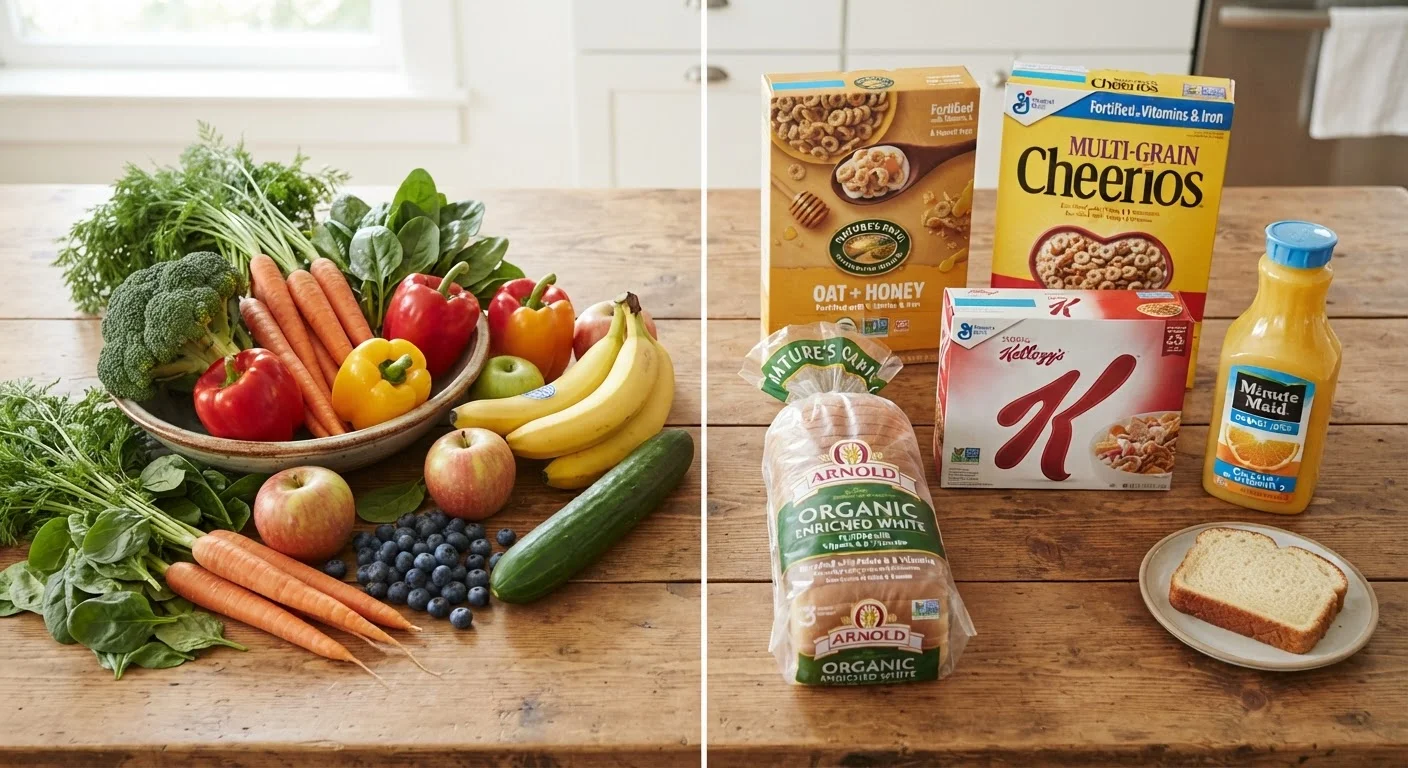
Key Takeaways
- Fortification has successfully reduced deficiency diseases like rickets and pellagra at a population level.
- Whole foods deliver nutrients alongside fiber, phytochemicals, and synergistic compounds that fortified foods typically lack.
- Fortified foods are most valuable when whole-food access is limited or specific populations have documented deficiencies.
- Bioavailability — how well your body absorbs a nutrient — can differ between synthetic and naturally occurring forms.
- Neither approach is universally superior; context, diet quality, and individual needs all matter.
Our Verdict
Whole foods remain the nutritional gold standard because they deliver nutrients in complex, synergistic packages that science hasn't fully replicated. Fortified foods, however, are a legitimate and evidence-backed tool for addressing specific deficiencies — particularly at the population level or for those with restricted diets. The most practical approach for most adults is to anchor the diet in whole foods while recognizing that fortification fills meaningful gaps where it's warranted.
| Best for | Recommended |
|---|---|
| Adults with varied, balanced diets seeking optimal nutrition | Whole Foods |
| People with restricted diets, including vegans or those with limited food access | Fortified Foods |
| Pregnant individuals or those with documented clinical deficiencies | Fortified Foods (alongside professional guidance) |
| Anyone building sustainable long-term eating habits | Whole Foods as the foundation |
What Fortification Actually Means
Food fortification is the deliberate addition of vitamins or minerals to a food product — either to restore nutrients lost during processing (called enrichment) or to add nutrients that weren't present in meaningful amounts to begin with. Iodized salt, folic acid in bread, vitamin D in milk, and iron in breakfast cereals are among the most familiar examples in the United States.
Fortification as a public health strategy has a strong track record. Mandatory folic acid enrichment of grain products, introduced in the U.S. in 1998, is associated with a significant decline in neural tube defects. Iodization of salt helped eliminate iodine-deficiency disorders that were once common in landlocked regions. These are not trivial achievements — they represent genuine population-level health gains. Understanding which nutrients are added and why is key to using fortified foods wisely. See our guide to reading nutrition labels for help decoding what's actually in your packaged foods.
Where Whole Foods Have the Advantage
Whole foods — vegetables, fruits, legumes, whole grains, nuts, seeds, and minimally processed animal products — deliver nutrients in their natural matrix. That matrix matters. Fiber, antioxidants, polyphenols, and phytochemicals travel alongside vitamins and minerals in whole foods, and research consistently suggests these compounds interact in ways that support health beyond what isolated nutrients can replicate.
Take vitamin C in an orange versus ascorbic acid added to a juice drink. Both supply the vitamin, but the orange also provides hesperidin, naringenin, and fiber — compounds with their own biological activity. Similarly, the iron in lentils comes packaged with folate, magnesium, and plant compounds that influence how the body responds to the meal overall.
| Whole Foods | Fortified Foods | |
|---|---|---|
| Nutrient complexity | Rich matrix of vitamins, minerals, fiber, phytochemicals | Targeted added nutrients, often without synergistic compounds |
| Bioavailability | Generally well-absorbed in food matrix context | Varies by nutrient form and food vehicle used |
| Deficiency prevention (population level) | Effective for varied diets, less reliable for restricted ones | Proven track record for specific deficiency reduction |
| Accessibility and cost | Fresh produce can be expensive or unavailable | Widely distributed, often low-cost staple products |
| Risk of overconsumption | Very low — nutrients self-regulate in whole-food form | Possible if multiple fortified products consumed together |
| Evidence base | Strong long-term dietary pattern research | Strong for specific deficiencies; weaker for broader health claims |
Bioavailability is another consideration. Some synthetic nutrient forms used in fortification are absorbed comparably to their natural counterparts; others are not. For fat-soluble vitamins in particular, the food vehicle matters — fat-soluble nutrients require dietary fat for absorption. Our article on fat-soluble vs water-soluble vitamins covers why this distinction is practically important.
Check the Whole Ingredient Picture
When evaluating a fortified food, look beyond the vitamin and mineral panel to the full ingredient list. A product with added nutrients but high added sugar, refined starch, or minimal fiber may not deliver the health value its label implies. A useful habit is to ask whether the fortified food is improving an otherwise nutrient-poor item or genuinely complementing a balanced diet.
When Fortified Foods Fill a Real Gap
Fortification is most defensible when whole-food sources of a nutrient are genuinely difficult to obtain in adequate amounts. Vitamin B12 is a clear example: it's found almost exclusively in animal products, making fortified foods or supplements a practical necessity for those eating plant-based diets. The differences between plant-based, vegan, and whole-food diets are worth understanding here, since nutrient gap risks vary across these approaches.
Vitamin D presents a similar case. Few foods are naturally rich in it, and many adults in northern latitudes have limited sun exposure during winter months. Fortified dairy and plant-based milks provide a meaningful contribution toward adequacy. Food insecurity is also a legitimate consideration — for populations with constrained access to fresh produce and varied diets, fortified staple foods can meaningfully reduce deficiency risk. Blanket skepticism toward fortification ignores these realities.
Where fortification becomes less useful — or potentially problematic — is when it's used primarily as marketing. A breakfast cereal delivering 25 vitamins but minimal fiber and high added sugar is not nutritionally equivalent to a bowl of oats topped with fruit, regardless of what the label claims. For a deeper look at how nutrient density differs from calorie content, see building a nutrient-dense plate.
~23%
Reduction in neural tube defect rates
U.S. folic acid fortification of grain products is associated with an estimated 23% decline in neural tube defect-affected pregnancies since 1998, according to CDC data.
40%+
U.S. adults with insufficient vitamin D
Studies using nationally representative NHANES data suggest a substantial portion of American adults have vitamin D levels below optimal thresholds, supporting the case for fortification.
A Practical Framework for Everyday Decisions
Rather than treating this as an either/or choice, a practical approach uses whole foods as the dietary foundation and evaluates fortified products on their individual merits. Ask whether the fortified food replaces something more nutritious or genuinely adds value given your diet and circumstances. A fortified plant milk used in place of dairy may be a sound swap; a vitamin-enriched candy bar is a different matter entirely.
Certain groups benefit most clearly from intentional inclusion of fortified foods: people following restrictive diets, older adults with reduced absorption capacity, pregnant individuals (folate and iron needs are elevated), and those with documented clinical deficiencies. In these situations, fortification or supplementation under professional guidance is appropriate — not a compromise. For most other adults eating a reasonably varied diet, focusing energy on increasing whole-food variety will generally yield more durable nutritional benefit than seeking out fortified alternatives. The contrast between whole and ultra-processed food choices is explored further in our article on whole foods vs ultra-processed foods.
This article is for general informational and educational purposes only and does not constitute medical or nutritional advice. Consult a qualified healthcare professional or registered dietitian before making significant dietary changes, especially if you have a health condition or are in a special population such as pregnancy or older adulthood.