

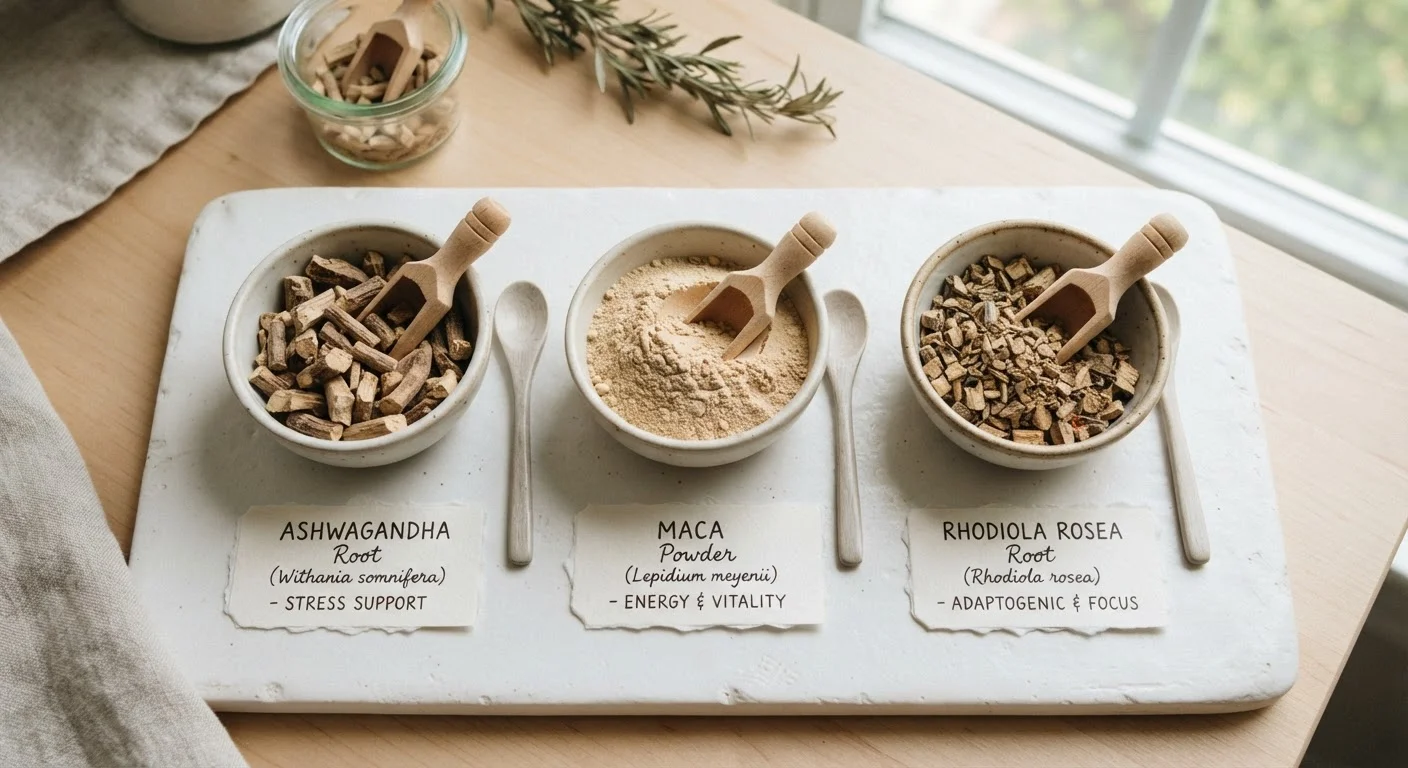
Key Takeaways
- All three adaptogens have some supporting research, but evidence quality varies significantly across herbs and outcomes.
- Ashwagandha shows the strongest data for stress-related cortisol reduction, which may indirectly support hormonal balance.
- Maca is most studied for perimenopausal symptoms and libido, though its hormonal mechanism is still debated.
- Rhodiola's primary evidence base is fatigue and mental resilience — its direct hormonal effects are less established.
- None of these herbs should replace medical care; always consult a healthcare provider before use, especially if pregnant or managing a health condition.
Our Verdict
Each adaptogen brings a distinct evidence profile to the table. Ashwagandha appears most relevant for stress-driven hormonal disruption, maca for menopausal transitions and low libido, and rhodiola for fatigue and mood. No single herb suits every woman, and the research supporting all three remains preliminary — making professional guidance essential before starting any adaptogen regimen.
| Best for | Recommended |
|---|---|
| Women experiencing stress-related hormonal disruption or elevated cortisol | Ashwagandha |
| Women navigating perimenopause or concerned about libido | Maca |
| Women dealing with fatigue, low energy, or stress-related mental fog | Rhodiola |
What Are Adaptogens and Why Do They Matter for Hormonal Health?
Adaptogens are a class of plant-based compounds — roots, herbs, and fungi — traditionally used to help the body cope with physical and emotional stress. The idea is that they work on the body's stress-response systems, most notably the hypothalamic-pituitary-adrenal (HPA) axis, which also plays a central role in regulating reproductive hormones like estrogen, progesterone, and cortisol.
Because chronic stress can genuinely disrupt hormonal cycles — contributing to irregular periods, low libido, disrupted sleep, and perimenopausal symptom intensity — there is real biological plausibility behind using stress-modulating herbs to support hormonal health. That said, plausibility is not the same as proof. The research base for adaptogens is growing but remains mostly composed of small trials, short durations, and animal studies. For a broader view of how lifestyle factors interact with hormones, our guide to nutrition and hormonal balance offers useful context.
Ashwagandha: Stress Hormone Support With Emerging Evidence
Ashwagandha (Withania somnifera) is probably the most clinically studied adaptogen for stress. Several randomized controlled trials — including a frequently cited 2019 study published in Medicine — have found that standardized ashwagandha extract can meaningfully reduce self-reported stress scores and serum cortisol levels compared to placebo over 8–12 weeks.
Because cortisol and reproductive hormones compete for the same biochemical precursors, sustained high cortisol can suppress progesterone and disturb the menstrual cycle. By modulating the HPA axis, ashwagandha may help create conditions where reproductive hormone balance is less disrupted — though this pathway is still being explored in humans rather than confirmed.
There is also early human research suggesting ashwagandha may support thyroid hormone levels in subclinical hypothyroidism, though this warrants caution: anyone with a thyroid condition should speak with a physician before use. For a side-by-side look at ashwagandha's stress profile versus rhodiola's, see our detailed comparison.
Start With One Herb at a Time
If you decide to try an adaptogen, consider introducing one at a time and giving it 8–12 weeks before evaluating its effect. Stacking multiple adaptogens simultaneously makes it difficult to assess what's helping — or causing side effects. Tracking your stress, sleep, and cycle changes in a journal can give you more meaningful data to share with your provider.
Maca: The Hormone-Balancing Reputation Under the Microscope
Maca (Lepidium meyenii), a Peruvian root vegetable, has a long traditional history of use for fertility and vitality. Modern research has focused primarily on menopausal symptoms and sexual function. Several small trials suggest maca may reduce hot flashes, night sweats, and mood disturbances in perimenopausal and postmenopausal women — though sample sizes are typically small and study design varies widely.
Importantly, maca does not appear to act as a phytoestrogen or directly raise estrogen levels. Researchers hypothesize it may work through the hypothalamus and pituitary rather than by mimicking hormones — a meaningful distinction for women with hormone-sensitive conditions. This also means it may be lower risk than true phytoestrogens for those with estrogen-receptor-positive breast cancer history, but this is an area where a conversation with a specialist is non-negotiable.
Evidence for maca's effect on libido is modest but arguably among the more consistent in the adaptogen literature, with some studies reporting improvements in sexual dysfunction. Still, well-powered long-term trials are lacking. Explore the herbal remedies hub for additional context on plant-based approaches.
| Ashwagandha | Maca | Rhodiola | |
|---|---|---|---|
| Primary evidence base | Stress & cortisol reduction | Menopausal symptoms & libido | Fatigue & mental resilience |
| Hormonal mechanism | HPA axis modulation | Hypothalamic-pituitary signaling | Indirect via stress reduction |
| Evidence quality | Moderate (multiple RCTs) | Low–moderate (small trials) | Moderate (replicated trials) |
| Best studied population | Adults under chronic stress | Perimenopausal women | Adults with burnout/fatigue |
| Known safety concerns | Avoid in pregnancy; thyroid caution | Low risk; avoid with hormone-sensitive cancer | Mild stimulant; avoid in pregnancy |
| Traditional use origin | Ayurvedic medicine (India) | Andean folk medicine (Peru) | Siberian & Scandinavian traditions |
Rhodiola: Energy and Resilience, Indirect Hormonal Relevance
Rhodiola rosea has the most consistent evidence for fatigue reduction and mental performance under stress — areas where it outperforms the other two adaptogens in terms of trial quality and replication. A 2015 review in the journal Phytomedicine summarized data showing rhodiola can reduce burnout-related fatigue and stress symptoms over four to eight weeks.
Its connection to hormonal health is more indirect than ashwagandha's. Chronic fatigue and burnout — states where rhodiola appears most effective — are frequently intertwined with HPA axis dysregulation, adrenal fatigue concepts (though "adrenal fatigue" is not a recognized medical diagnosis), and disrupted cortisol rhythms. By improving the body's stress resilience, rhodiola may help preserve hormonal rhythms that burnout tends to disturb.
Rhodiola is generally well tolerated, though it may cause mild stimulating effects in some people. It is not recommended during pregnancy. For more on what the research actually says about adaptogens and stress broadly, our evidence review on adaptogens and stress is worth reading alongside this piece.
This article is for informational purposes only and does not constitute medical advice. Always consult a qualified healthcare professional before starting any supplement, particularly if you are pregnant, breastfeeding, managing a health condition, or taking medication.