

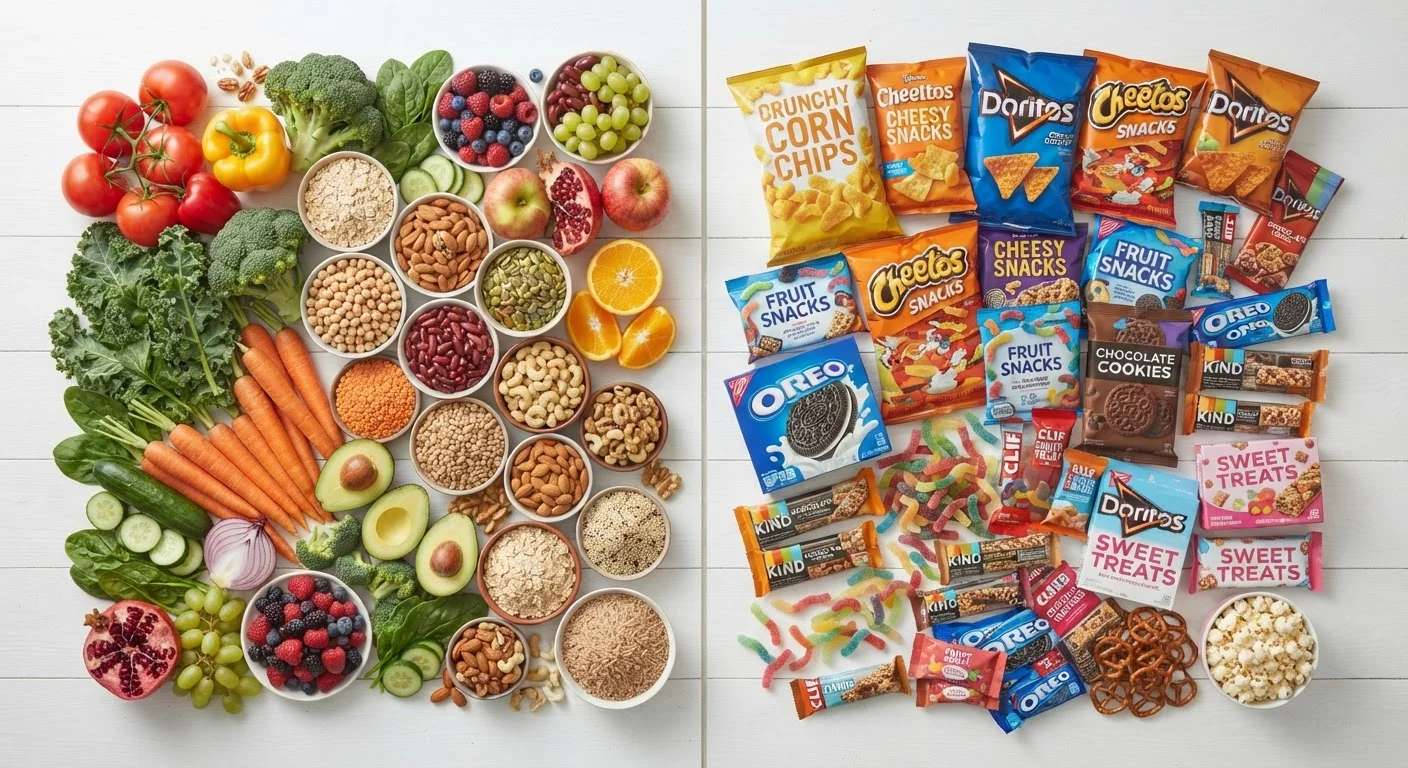
Key Takeaways
- Whole foods retain their natural nutrient matrix; ultra-processed foods often strip or replace it artificially.
- The NOVA classification system groups foods by degree of industrial processing, not just ingredient lists.
- Higher ultra-processed food intake is consistently linked to lower diet quality in large observational studies.
- Reducing ultra-processed food doesn't require a perfect diet — incremental swaps make a measurable difference.
- Reading ingredient lists, not just nutrition panels, is the most reliable way to identify processing level.
Option A
Whole Foods
Foods as close to their natural state as possible.
Best for: Anyone seeking nutrient density, satiety, and long-term dietary sustainability without extreme restrictions.
Option B
Ultra-Processed Foods
Industrially manufactured products engineered for palatability and shelf life.
Best for: Convenience-driven situations, though frequent reliance is associated with poorer dietary quality overall.
If you want to maximize nutrient density per calorie
Whole Foods
Whole foods deliver vitamins, minerals, fiber, and phytonutrients in their naturally occurring forms, with fewer additives competing for metabolic priority.
If you're short on time and need practical middle-ground options
Whole Foods
Minimally processed whole foods — canned beans, frozen vegetables, plain oats — offer near-equivalent nutrition to fresh with significantly less prep time.
If you're navigating a tight food budget
Whole Foods
Staples like dried legumes, whole grains, and seasonal produce are frequently more economical per serving than name-brand ultra-processed snacks.
If occasional convenience foods are part of your realistic routine
Whole Foods
Anchor most meals in whole foods and treat ultra-processed items as exceptions rather than defaults — this pattern reflects what the evidence actually supports.
What Separates a Whole Food from an Ultra-Processed One?
The phrase "processed food" gets thrown around loosely, which creates genuine confusion. A can of chickpeas is technically processed. So is a bag of cheese-flavored corn puffs. But these two items are not remotely equivalent nutritionally or physiologically.
The most useful framework comes from the NOVA classification system, developed by researchers at the University of São Paulo. NOVA groups foods into four categories based on the extent and purpose of industrial processing — not simply whether they've been touched by machinery:
- Group 1 – Unprocessed or minimally processed foods: Fresh or frozen vegetables, plain meats, eggs, legumes, whole grains, plain nuts, and milk. These are whole foods in the truest sense.
- Group 2 – Processed culinary ingredients: Oils, flours, salt, sugar, and butter — used in cooking, not eaten alone.
- Group 3 – Processed foods: Items like canned fish in brine, fermented cheeses, or simple bread made from flour, water, yeast, and salt. Recognizable ingredients, modest transformation.
- Group 4 – Ultra-processed foods (UPFs): Industrially manufactured products containing substances rarely used in home kitchens — emulsifiers, flavor enhancers, hydrogenated oils, artificial colorings, stabilizers, and high-fructose corn syrup. Think packaged snack cakes, reconstituted meat products, flavored instant noodles, and most fast-food items.
The critical distinction isn't processing itself — it's the degree and purpose of that processing. Ultra-processed foods are engineered primarily for palatability, extended shelf life, and profit margin, often at the expense of nutritional integrity. For a deeper look at how to spot the difference at the shelf, our guide to reading food labels covers ingredient lists in plain language.
What the Research Actually Shows
Large observational studies consistently associate high ultra-processed food consumption with lower intake of fiber, vitamins, and minerals — and higher intake of added sugars, sodium, and saturated fat. A landmark study published in BMJ (Monteiro et al., 2019) found that a 10% increase in UPF consumption was associated with a 12% higher risk of cardiovascular disease events, though researchers note these are associations, not confirmed causal links.
57%
Share of US calories from ultra-processed foods
A dietary analysis published in BMJ Open estimated that ultra-processed foods account for roughly 57% of daily caloric intake for US adults.
~28g
Average daily fiber shortfall in US adults
Most US adults consume well below the recommended fiber intake, a gap closely tied to displacement of whole foods by low-fiber processed options.
10%
UPF increase linked to cardiovascular risk rise
Observational research published in the BMJ associated each 10% increment in ultra-processed food consumption with a 12% higher rate of cardiovascular events.
Whole foods, by contrast, tend to deliver nutrients within their natural food matrix — the complex physical and chemical structure of food that influences how quickly nutrients are absorbed and how satiety hormones respond. An apple and apple-flavored candy may have similar sugar content on paper, but the fiber, water content, and cellular structure of the whole fruit slow digestion and moderate blood sugar response differently.
It's worth noting that nutrition research has real limitations. Most UPF studies are observational and rely on self-reported dietary recall, meaning confounding factors are difficult to fully eliminate. Still, the consistency of findings across populations lends weight to the general pattern. This isn't an area of active scientific controversy — the direction of evidence is fairly clear even if precise mechanisms are still being studied.
Not All Processing Is Equal
The term 'processed' legally covers everything from pasteurized milk to mass-produced snack cakes. When evaluating a food's processing level, focus on the ingredient list rather than front-of-pack claims. Foods labeled 'natural' or 'made with whole grains' can still fall into the ultra-processed category depending on their full ingredient composition. Degree and purpose of processing — not the word itself — is what matters nutritionally.
Head-to-Head Comparison
The table below contrasts whole foods and ultra-processed foods across the criteria that matter most for everyday decision-making.
| Criterion | Whole Foods | Ultra-Processed Foods |
|---|---|---|
| Nutrient density | High; vitamins, minerals, fiber intact | Variable; often displaced by additives |
| Ingredient transparency | Few, recognizable ingredients | Long lists; industrial additives common |
| Fiber content | Naturally present | Frequently removed or minimal |
| Added sugars and sodium | Absent or minimal | Often high |
| Satiety per calorie | Generally higher due to food matrix | Generally lower; engineered for overconsumption |
| Shelf life | Short to moderate | Extended via preservatives |
| Preparation required | Moderate; some cooking needed | Minimal; ready-to-eat by design |
| Cost per serving | Often lower for staples (grains, legumes) | Variable; branded items often cost more |
One category that often surprises people: fortified ultra-processed products. A breakfast cereal may list impressive vitamin quantities on its panel, but that doesn't make it equivalent to whole foods. Our article on whole foods vs. fortified foods examines this trade-off honestly.
Practical Steps Without Overhauling Everything
Shifting dietary patterns doesn't require perfection or elimination of every packaged item. The goal is reducing reliance on ultra-processed foods as dietary staples — not treating them as moral failures when they appear occasionally.
Some evidence-grounded starting points:
- Anchor meals around Group 1 foods. Build at least two of three daily meals around vegetables, whole grains, legumes, eggs, or plain proteins before adding anything from a package.
- Read ingredient lists, not just nutrition facts panels. A short ingredient list of recognizable items is a reliable proxy for lower processing. The nutrition label walkthrough explains what to prioritize at a glance.
- Leverage minimally processed conveniences. Frozen vegetables, canned beans (rinsed to reduce sodium), plain Greek yogurt, and rolled oats are all technically processed but nutritionally close to their whole counterparts — and genuinely time-efficient.
- Understand what you're comparing. If you're also exploring plant-based or vegan eating patterns, note that these labels don't automatically mean whole-food. See why plant-based and whole-food diets aren't the same for clarity.
This article is for general informational and educational purposes only and does not constitute medical or dietary advice. Consult a qualified healthcare professional or registered dietitian for personalized guidance.