
Fat-Soluble vs Water-Soluble Vitamins: Why the Difference Matters for Your Diet

Key Takeaways
- Fat-soluble vitamins (A, D, E, K) are stored in body fat and the liver, raising toxicity risk if over-supplemented.
- Water-soluble vitamins (B-complex and C) are excreted in urine, requiring more consistent daily intake from food.
- Absorption of fat-soluble vitamins depends on dietary fat being present in the same meal.
- Most people can safely meet water-soluble vitamin needs through a varied, whole-food diet.
- Supplementing fat-soluble vitamins carries more risk than water-soluble ones; always consult a healthcare provider.
Option A
Fat-Soluble Vitamins
Stored in the body, powerful — and worth monitoring.
Best for: People focused on understanding long-term storage, supplementation risks, and absorption from fatty foods.
Option B
Water-Soluble Vitamins
Freely circulating, regularly replenished, less risky to over-consume.
Best for: Anyone wanting to understand daily nutrient needs, excretion patterns, and consistent dietary intake strategies.
If you want to understand supplement safety and toxicity risk
Fat-Soluble Vitamins
Understanding how A, D, E, and K accumulate in tissue helps explain why over-supplementation poses genuine health risks not seen with most water-soluble nutrients.
If you're planning consistent daily eating habits to meet micronutrient needs
Water-Soluble Vitamins
Because B vitamins and vitamin C aren't stored in significant quantities, regular dietary intake through varied whole foods is the most reliable strategy.
If you follow a low-fat or plant-based diet
Fat-Soluble Vitamins
Dietary fat is required for absorbing vitamins A, D, E, and K — making it important to include healthy fat sources alongside vegetables and fortified foods.
If you're managing a chronic condition or taking medications
Fat-Soluble Vitamins
Fat-soluble vitamin levels (especially D and K) can interact with certain medications and conditions; professional monitoring is particularly important here.
What Vitamin Solubility Actually Means
Every vitamin your body needs is classified by how it dissolves — either in fat or in water. This isn't an abstract chemistry detail. Solubility dictates how a vitamin is absorbed through your digestive tract, where it goes afterward, how long it stays in your body, and whether excess amounts can cause harm.
Fat-soluble vitamins — A, D, E, and K — require dietary fat to be absorbed in the small intestine. From there, they travel through the lymphatic system and are stored in fatty tissue and the liver. Water-soluble vitamins — the eight B vitamins and vitamin C — dissolve directly in water, pass into the bloodstream quickly, and what the body doesn't immediately use is largely filtered out by the kidneys and excreted in urine.
This fundamental difference has real consequences for how you eat, how you supplement, and how much margin for error you have with each group.
| Criterion | Fat-Soluble Vitamins | Water-Soluble Vitamins |
|---|---|---|
| Which vitamins | A, D, E, K | B vitamins (x8), vitamin C |
| Absorption route | Via lymphatic system with dietary fat | Directly into bloodstream |
| Storage in body | Liver and fatty tissues (weeks to months) | Minimal; excess excreted in urine |
| Toxicity risk from supplements | Higher — accumulation possible | Lower for most; exceptions at very high doses |
| Dietary intake frequency needed | Less frequent; reserves buffer short gaps | Regular daily intake recommended |
| Sensitivity to cooking/processing | Moderate; relatively heat-stable | Higher; heat and water can reduce levels |
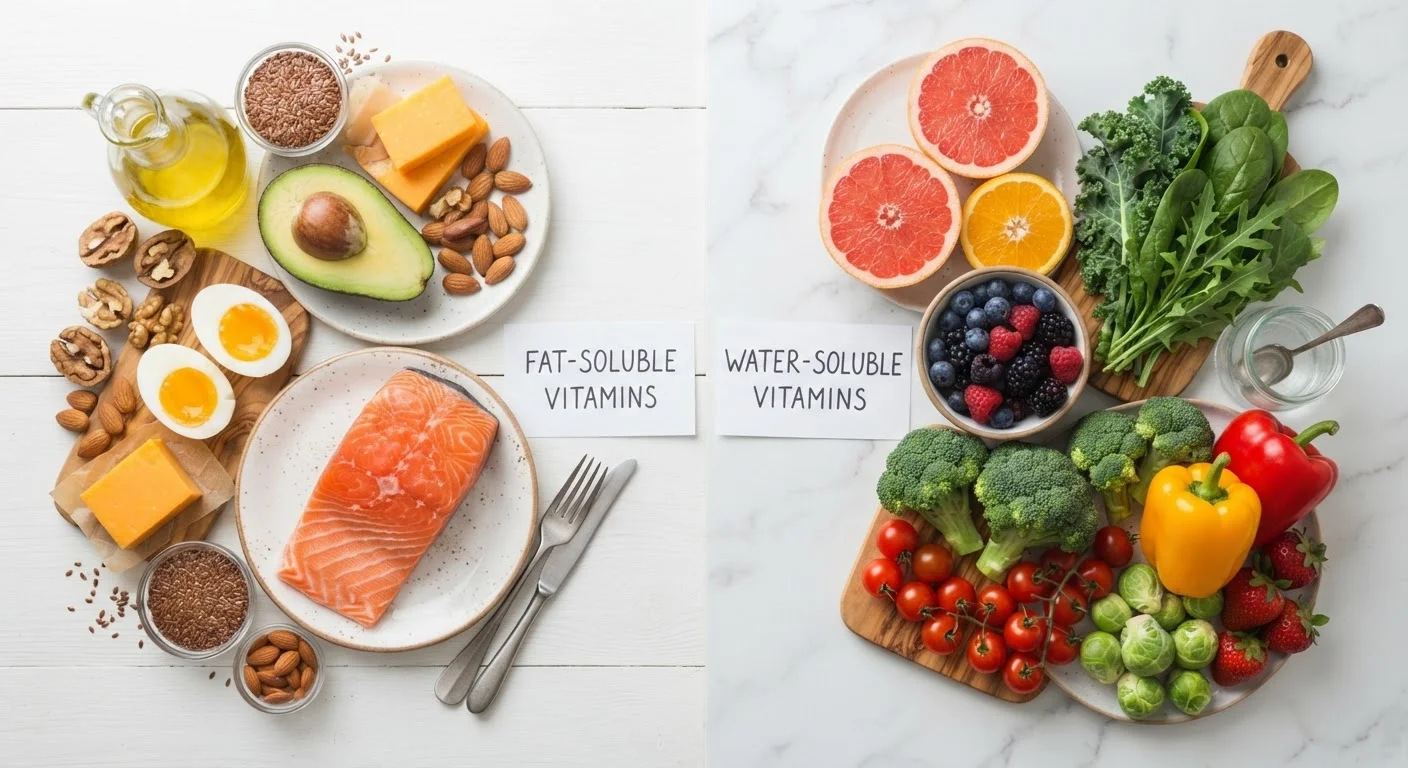
| Key food sources | Fatty fish, liver, eggs, dairy, vegetable oils | Whole grains, legumes, meat, leafy greens, citrus |
Fat-Soluble Vitamins: Stored, Powerful, and Requiring Attention
The storage capacity of fat-soluble vitamins is both a strength and a risk. Because the body can draw on these reserves over days or weeks, deficiency develops more slowly than with water-soluble vitamins. However, that same storage means excess can build up — particularly from high-dose supplementation — potentially reaching levels that cause harm.
Vitamin A toxicity (hypervitaminosis A), for example, is well-documented and associated with doses far above dietary reference intakes, most commonly from preformed vitamin A in supplements rather than from food sources like vegetables. Vitamin D toxicity, while less common, can occur with aggressive supplementation and is being studied more carefully as supplement use has increased. For a detailed look at the evidence behind one of the most frequently supplemented fat-soluble vitamins, see our review of the vitamin D research.
Absorption is another critical variable. Eating fat-soluble vitamins alongside dietary fat meaningfully improves uptake. Consuming a salad with vitamin K-rich greens alongside a fat-free dressing, for instance, may significantly reduce absorption compared to pairing it with olive oil or avocado. This is especially relevant for people on low-fat diets or those using fat-free packaged foods heavily. Our comparison of whole foods versus fortified foods explores how food matrix affects nutrient delivery more broadly.
Water-Soluble Vitamins: Regular Replenishment, Lower Risk
Because water-soluble vitamins aren't stored in meaningful amounts, the body depends on consistent dietary supply. The B vitamins — including thiamin, riboflavin, niacin, B6, folate, B12, biotin, and pantothenic acid — play central roles in energy metabolism, nervous system function, and red blood cell production. Vitamin C supports immune function, collagen synthesis, and acts as an antioxidant.
The upside of rapid excretion is a considerably lower toxicity risk for most water-soluble vitamins. However, this isn't universal. High-dose vitamin B6 supplementation has been associated with peripheral neuropathy (nerve damage) over time, and very high doses of niacin carry liver-related risks. These examples are relevant mainly at supplemental doses that are difficult to reach through food alone.
40%
US adults potentially low in vitamin D
National Health and Nutrition Examination Survey (NHANES) data have estimated that a substantial proportion of U.S. adults have vitamin D levels below recommended thresholds, though definitions of deficiency vary across studies.
~90mg
Daily vitamin C reference intake for adults
The U.S. National Institutes of Health Office of Dietary Supplements lists 90mg/day for adult men and 75mg/day for adult women as the recommended dietary allowance for vitamin C.
B12
Water-soluble vitamin with longest body retention
Despite being water-soluble, vitamin B12 is an exception — it can be stored in the liver for several years, making deficiency slow to develop but also slow to correct once established.
For most adults eating a reasonably varied diet, water-soluble vitamin needs are manageable through food. This is worth keeping in mind when evaluating supplement marketing that emphasizes daily "replenishment." Consistent whole-food intake — not aggressive supplementation — is the evidence-supported approach for the majority of healthy adults. If you're navigating conflicting messages about nutrient adequacy, our piece on reading nutrition evidence without falling for extremes offers a useful framework.
Practical Diet Implications
Understanding solubility translates directly into smarter eating habits. For fat-soluble vitamins, pairing matters: include a source of healthy fat — nuts, seeds, olive oil, avocado, fatty fish — alongside vegetables and foods rich in vitamins A, D, E, and K. This is especially relevant for those following plant-based diets, where fat intake patterns can vary widely. Our article on the differences between plant-based, vegan, and whole-food diets addresses some of these nutrient considerations in context.
For water-soluble vitamins, regularity across meals and days is more important than any single high-dose source. Cooking method also matters: B vitamins and vitamin C are sensitive to heat, light, and water — boiling vegetables can leach significant amounts into cooking water, while steaming or roasting preserves more.
Before adding any vitamin supplement to your routine — fat-soluble in particular — it's worth discussing your specific dietary patterns and health status with a registered dietitian or physician. Individual absorption, existing reserves, and potential interactions with medications can all influence what's appropriate for you.
This article is for general informational and educational purposes only and is not a substitute for professional medical or dietary advice. Consult a qualified healthcare provider before making changes to your supplement regimen or diet, especially if you have an existing health condition.