

Key Takeaways
- Serving size is the anchor for every other number on the label — check it first.
- Percent Daily Values (% DV) of 5% or less are low; 20% or more are high.
- The ingredient list is ordered by weight, making it a reliable indicator of what dominates a product.
- Front-of-package health claims are marketing; the Nutrition Facts panel is the regulated data.
- Added sugars and sodium deserve extra scrutiny because they are easy to undercount across multiple servings.
What you will need
Why the Nutrition Facts Panel Exists — and What It Actually Covers
The Nutrition Facts panel is a federally regulated format in the United States, overseen by the FDA. Its design was most recently updated to reflect current nutritional science — adding the added sugars line and adjusting Daily Values for certain nutrients based on updated research. Understanding what the panel covers (and what it doesn't) is the starting point for using it intelligently.
The panel reports calories, macronutrients (total fat, saturated fat, trans fat, cholesterol, total carbohydrate, dietary fiber, total sugars, added sugars, and protein), and a selection of micronutrients that the FDA considers important for public health — currently vitamin D, calcium, iron, and potassium. It does not report every nutrient a food contains, so a food with a modest panel can still be nutrient-rich in ways not fully captured there. This is one reason the ingredient list matters as a complement to the numbers. For a deeper look at nutrient density as a concept, building a nutrient-dense plate is worth reading alongside this guide.
Nutrition Facts Panel
The federally regulated section of food packaging that lists calories, macronutrients, key micronutrients, and % Daily Values.
Ingredient List
Lists every ingredient in descending order by weight — used to assess food quality beyond the numbers.
USDA FoodData Central (online database)
Free public database for cross-referencing nutrient data when label details are unclear or minimal.
Step-by-Step: How to Read a Label in Under Two Minutes
What you will need
Start with the serving size — not the calories
Every number on the label is tied to the listed serving size. If a bag of crackers shows 150 calories per serving but the serving size is 10 crackers and you eat 20, you've consumed 300 calories — and doubled every other nutrient figure too. Check the serving size before reading anything else, and estimate how much of the package you actually consume in one sitting.
Use % Daily Value as your quick reference
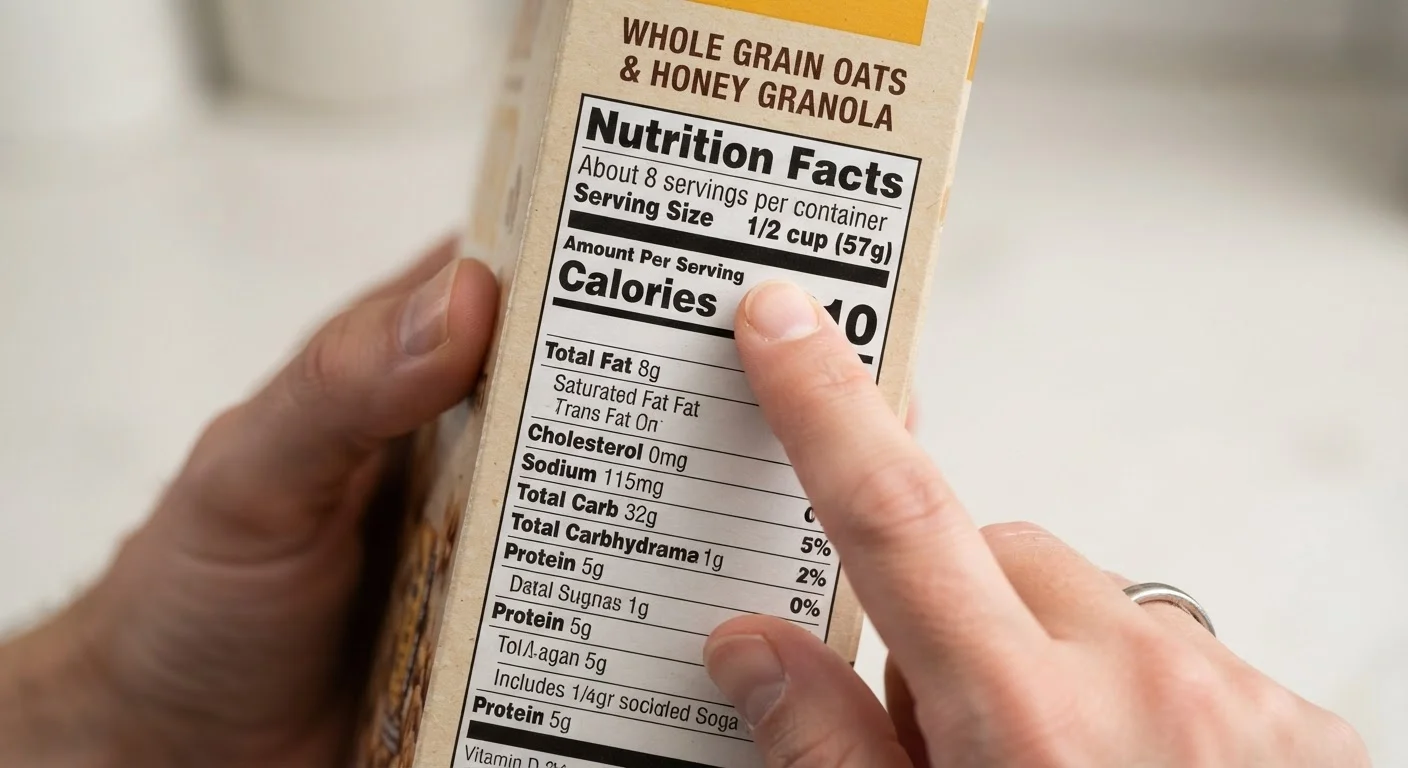
The Percent Daily Value (% DV) column tells you how much a nutrient in one serving contributes to a general daily intake of 2,000 calories. Use the FDA's practical rule of thumb: 5% DV or less is low for a nutrient; 20% DV or more is high. This scale works in both directions — you want higher % DVs for fiber, calcium, iron, and vitamin D, and lower % DVs for saturated fat, sodium, and added sugars.
Distinguish total sugars from added sugars
Total sugars include both naturally occurring sugars (such as lactose in milk or fructose in fruit) and sugars added during processing. The added sugars line — a mandatory sub-entry on updated Nutrition Facts panels — isolates only the sugars manufacturers added. Dietary guidelines from major health authorities suggest keeping added sugars below 10% of total daily calories. A single flavored yogurt can use up a significant portion of that budget, so this line is worth checking on any sweet or flavored product.
Scan sodium and saturated fat with context
Sodium and saturated fat are two nutrients where high % DV is generally something to moderate — though context matters. A single meal component at 30% DV for sodium isn't automatically problematic if the rest of your day is low in sodium. Rather than treating each item in isolation, track these across your full day's eating pattern. This framing aligns with the approach described in sustainable daily nutrition.
Read the ingredient list from top to bottom
Ingredients are listed in descending order by weight. If refined flour or sugar appears first or second, that ingredient makes up the largest share of the product by mass. A shorter ingredient list isn't automatically better, but an ingredient list dominated by whole, recognizable foods is generally a useful positive signal. For more on the distinction between whole and heavily processed options, see whole foods vs. ultra-processed foods.
Evaluate front-of-package claims with skepticism
Terms like "natural," "made with whole grains," or "light" on the front of a package are marketing language, not regulated nutrition descriptors in the same way the Nutrition Facts panel is. "Made with whole grains" can apply even when refined flour is the primary ingredient. Always flip the package and verify any front-panel claim against the actual panel and ingredient list before drawing conclusions.
Common Pitfalls and How to Avoid Them
Even experienced label readers fall into a few predictable traps. The most common: treating a low-calorie count as a proxy for nutritional quality. A product can be low in calories while being high in sodium, low in fiber, and stripped of meaningful nutrients — particularly in highly processed snack foods. Calorie figures alone do not tell you whether food is worth eating.
A second pitfall is ignoring portion accumulation. Many condiments, dressings, and beverages are consumed in amounts that far exceed the stated serving size. Checking the serving size against your realistic portion — particularly for items you add freely, like olive oil or salad dressing — gives a more accurate picture of your actual intake.
Finally, fortified foods can look impressive on a label while delivering nutrients in forms or combinations that differ from whole food sources. fortified vs. whole foods explores this distinction in more detail. For readers who want to connect label reading to broader eating patterns, building a balanced plate without counting calories offers practical proportion principles that complement what you find on any individual label.
Labels Reflect Averages, Not Your Exact Needs
The % Daily Values on nutrition labels are based on a general 2,000-calorie reference diet for healthy adults. Your actual nutritional needs vary based on age, sex, activity level, and health status. People managing chronic conditions, pregnant individuals, and older adults in particular should work with a healthcare provider rather than relying solely on label reference values.
This article is for general informational and educational purposes only and does not constitute medical or dietetic advice. Consult a registered dietitian or qualified healthcare professional for personalized nutrition guidance.