

Key Takeaways
- Plant-based means plant-centered, not necessarily animal-product-free.
- A vegan diet excludes all animal products but places no limits on processing levels.
- Whole-food diets prioritize minimal processing and can include animal products.
- Highly processed vegan foods can be nutritionally inferior to minimally processed omnivore diets.
- No single label guarantees a nutritionally complete or health-supportive diet on its own.
- Consulting a registered dietitian can help you apply any dietary framework to your specific needs.
Plant-Based, Vegan, and Whole-Food Diets
These three dietary labels are frequently used as though they mean the same thing, but each one describes a distinct set of principles. A plant-based diet emphasizes foods derived from plants but may or may not exclude animal products. A vegan diet eliminates all animal-derived ingredients, regardless of how processed those ingredients are. A whole-food diet focuses on minimally processed foods regardless of whether they include meat or dairy. Understanding these distinctions matters because the nutritional profile and health implications of each can differ substantially.
Researchers sometimes use 'plant-based' as a spectrum term ranging from predominantly plant-centered eating to fully animal-product-free — context in any given study matters.
Why the Confusion Exists
Food marketing, social media, and even some health journalism routinely treat "plant-based," "vegan," and "whole-food" as interchangeable labels. They are not. Each term describes a different organizing principle, and confusing them leads to real misunderstandings about what any given diet actually delivers nutritionally.
The overlap between these frameworks is genuine — someone eating a whole-food, plant-based vegan diet occupies all three categories at once. But the overlap is not universal. A person can be vegan without eating whole foods, plant-centered without being vegan, and focused on whole foods while still eating animal products. Getting these distinctions straight helps you evaluate diet headlines more critically, which is why understanding how nutrition studies are designed and reported is a useful companion skill.
What "Plant-Based" Actually Means
"Plant-based" is a spectrum term. At its core, it describes a dietary pattern in which vegetables, fruits, legumes, whole grains, nuts, and seeds form the primary foundation of eating. It does not require the elimination of animal products, though many people who identify as plant-based eat very little of them.
In research literature, plant-based is often used to describe diets that are predominantly derived from plants — a definition broad enough to include Mediterranean-style eating, which includes fish and dairy, alongside stricter vegan approaches. This variability means that when you encounter a headline claiming a plant-based diet reduces a particular health risk, it is worth checking exactly how the researchers defined the term. The full landscape of popular dietary frameworks covers how different patterns define plant emphasis in practice.
~3%
US adults identifying as vegan
Gallup polling has consistently placed the vegan population at roughly 3% of US adults, a figure that has remained relatively stable over the past decade.
57%
US calories from ultra-processed foods
Research published in the journal BMJ Open estimated that ultra-processed foods account for more than half of the average American's daily caloric intake.
10x
B12 deficiency risk increase on unsupplemented vegan diets
Studies have consistently found that vegans who do not supplement or consume fortified foods face substantially elevated risk of vitamin B12 deficiency compared to omnivores.
What Vegan Means — and What It Doesn't
Veganism is defined by exclusion: no animal-derived ingredients, including meat, poultry, seafood, dairy, eggs, and honey. It is the clearest and most categorical of the three labels. What veganism does not specify is the degree of food processing.
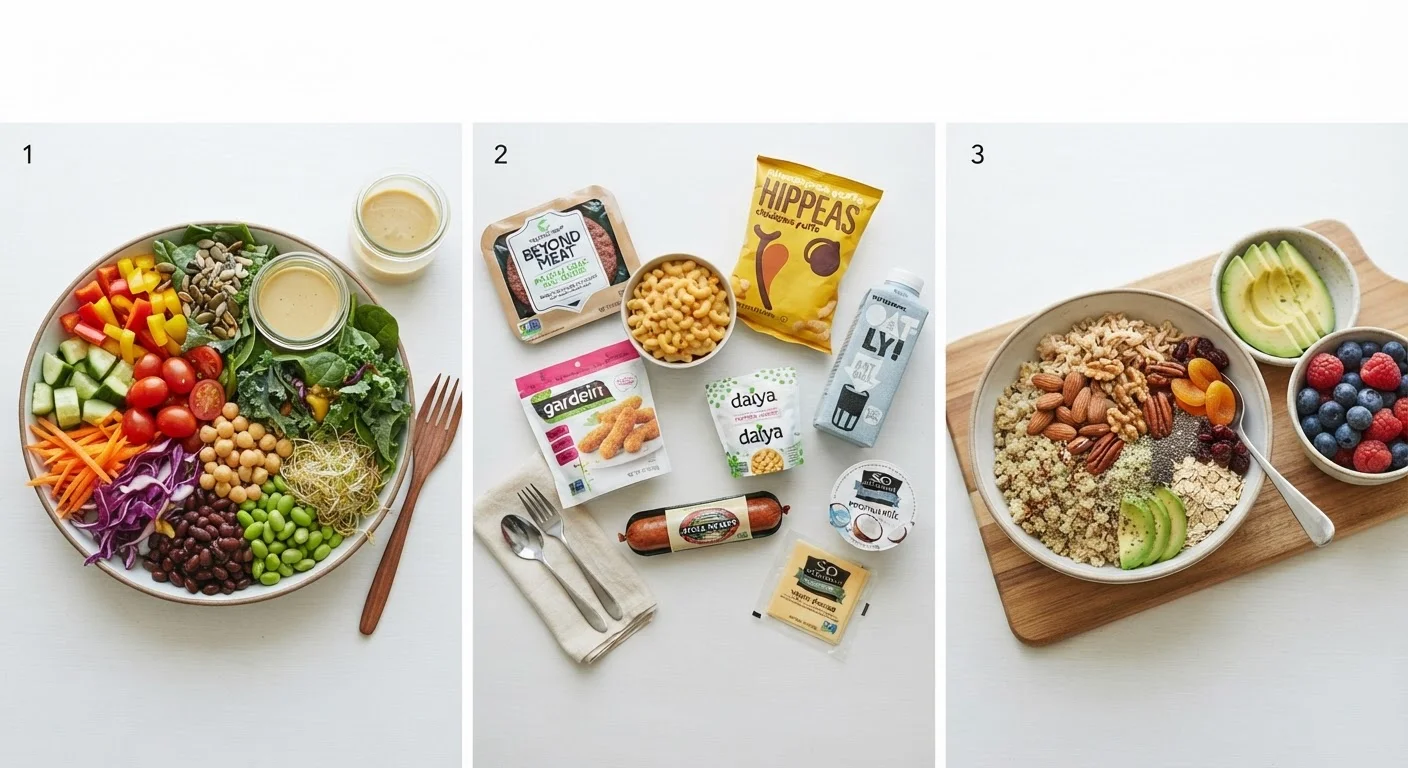
A diet built on French fries, refined white bread, vegan cookies, and plant-based processed nuggets is technically vegan. It is also nutritionally quite different from a diet built on lentils, leafy greens, whole grains, and nuts. This distinction matters because some population-level research on vegan diets captures the health outcomes of people eating the latter, not necessarily the former. The nutritional vulnerabilities associated with vegan eating — particularly vitamin B12, long-chain omega-3 fatty acids, calcium, and iron — require deliberate planning regardless of how much produce is consumed. For a closer look at one of those nutrients, see our article on plant iron versus animal iron absorption.
What Whole-Food Means — and Why It Cuts Across Other Labels
A whole-food diet is organized around the degree of processing rather than the origin of ingredients. It prioritizes foods in their natural or minimally altered state: vegetables, fruits, legumes, whole grains, nuts, seeds, eggs, unprocessed meats, and dairy without heavy additives. It explicitly deprioritizes or excludes ultra-processed products — items with long ingredient lists featuring refined starches, industrial oils, added sugars, and synthetic additives.
This framework is not inherently plant-exclusive or animal-exclusive. A person eating wild salmon, roasted sweet potato, and a spinach salad is eating a whole-food meal that is not vegan. A person eating a heavily processed oat-based vegan bar is eating a vegan product that does not qualify as whole food. Understanding where the line falls between whole foods and ultra-processed products is a foundational skill for applying this framework effectively.
Nutritional Implications of Each Framework
Each label carries different nutritional strengths and gaps. Plant-based diets — broadly defined — tend to be associated with higher fiber intake and a better overall dietary diversity score in observational research, though results vary widely depending on the specific foods consumed. Vegan diets, when well-planned, can meet most nutrient needs, but require supplementation or fortified foods for vitamin B12 and often for vitamin D and long-chain omega-3s (EPA and DHA). For more on those fatty acids, see our explainer on ALA, EPA, and DHA.
Whole-food diets — regardless of whether they include animal products — tend to reduce exposure to the additives, sodium, and refined carbohydrates that characterize ultra-processed eating. Fortification can partially bridge nutrient gaps in processed foods, though it is not always equivalent to the nutrient matrix found in unprocessed sources. See our comparison of whole foods versus fortified foods for a fuller picture.
This article provides general nutrition information and is not a substitute for personalized medical or dietary advice. If you are considering a significant change to your diet, please consult a qualified healthcare professional or registered dietitian.