

Key Takeaways
- Tea tree oil has credible evidence for treating mild acne and fungal skin conditions when applied correctly.
- It must always be diluted before skin contact — undiluted oil causes chemical burns and irritation.
- Several popular uses, including wound healing and scalp treatments, have much weaker research support.
- Allergic contact dermatitis is a real and underreported risk, especially with repeated or oxidized oil exposure.
- Tea tree oil is toxic if swallowed and must be kept away from children and pets.
What Tea Tree Oil Actually Is
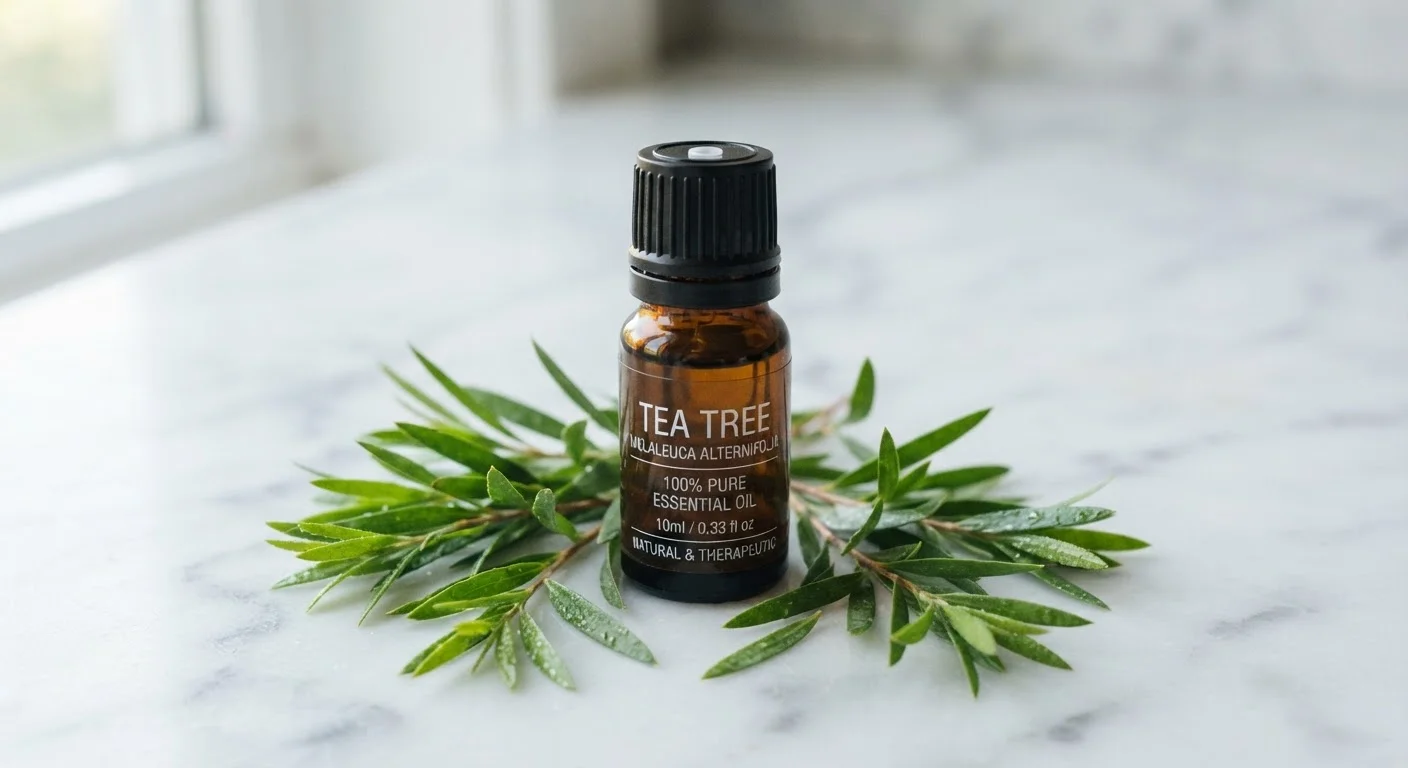
Tea tree oil is an essential oil steam-distilled from the leaves of Melaleuca alternifolia, a plant native to Australia. Its primary active constituent is terpinen-4-ol, which has demonstrated antimicrobial and anti-inflammatory properties in laboratory settings. This is a meaningful starting point — but lab results don't automatically translate into clinical results on human skin, which is why a careful look at the actual evidence matters.
As part of a broader category of plant-based topicals, tea tree oil sits alongside remedies like calendula and honey — all of which carry some evidence but also considerable hype. See our overview of plant-based topicals for minor wounds for a fuller comparison.
Myth
Tea tree oil can be applied directly to skin — the stronger, the better.
Fact
Undiluted tea tree oil is an irritant and can cause chemical burns, redness, and blistering even on a single application.
Essential oils are highly concentrated compounds. Tea tree oil at 100% concentration is documented to cause significant skin damage. Effective topical preparations studied in clinical research typically use dilutions between 1% and 5%, not neat application. Diluting in a carrier oil or formulated cream is not optional — it's a basic safety requirement.
Myth
Tea tree oil heals wounds and prevents infection better than conventional antiseptics.
Fact
Evidence for tea tree oil as a wound treatment is very limited, and it may actually impair healing in some contexts.
While terpinen-4-ol shows antimicrobial activity in lab conditions, clinical trials testing tea tree oil on actual wounds are sparse and generally small. Some case reports suggest it may slow the healing process or trigger sensitization in wound skin. Conventional wound care — cleaning, appropriate dressings, and medical guidance for anything beyond a minor scrape — remains the evidence-based standard.
Myth
Tea tree oil is completely safe because it's natural.
Fact
Natural origin does not equal safety. Tea tree oil causes allergic reactions in a meaningful proportion of users and is toxic if ingested.
Contact dermatitis from tea tree oil is well documented in dermatology literature. Sensitization risk increases with oxidized oil and repeated exposure. Internally, tea tree oil is classified as toxic — ingestion has been associated with drowsiness, confusion, loss of coordination, and in severe cases, more serious neurological effects. The 'natural equals safe' assumption is one of the most persistent and consequential myths in complementary health.
Myth
Tea tree oil effectively treats all skin conditions, from eczema to psoriasis.
Fact
Tea tree oil has no reliable clinical evidence supporting its use for chronic inflammatory skin conditions like eczema or psoriasis.
Eczema and psoriasis are complex immune-mediated conditions. No adequately powered clinical trials support tea tree oil as an effective treatment for either. Applying it to compromised skin barriers — common in both conditions — may actually worsen irritation or trigger sensitization. People managing these conditions should work with a dermatologist rather than relying on unproven topical remedies.
Myth
A few drops of tea tree oil in shampoo will cure dandruff.
Fact
There is limited, low-quality evidence that tea tree oil shampoo may modestly reduce dandruff symptoms, but it is not a proven cure.
One small, industry-funded trial suggested a 5% tea tree oil shampoo reduced dandruff severity compared to placebo. However, dandruff caused by Malassezia yeast often requires sustained antifungal treatment, and a few drops in a standard shampoo likely produces concentrations far below what was studied. The results are preliminary and should not be treated as confirmation of effectiveness.
What the Research Actually Supports
Two applications of tea tree oil stand on reasonably solid clinical ground: mild to moderate acne and superficial fungal infections such as tinea pedis (athlete's foot) and onychomycosis (nail fungus).
For acne, several small randomized controlled trials have compared tea tree oil gels (typically at 5% concentration) to benzoyl peroxide. Results generally show meaningful reductions in acne lesion counts, though with slower onset and potentially fewer side effects than benzoyl peroxide. The evidence is promising but not definitive — trial sizes are small and methodologies vary.
For fungal conditions, studies on diluted tea tree preparations have shown measurable improvement, particularly for athlete's foot. However, it's worth noting these are typically adjunctive findings, and antifungal medications remain the standard of care for persistent or severe infections.
5%
Concentration used in acne trials
Small randomized controlled trials comparing tea tree oil gel to benzoyl peroxide typically used a 5% concentration formulation.
~1–5%
Recommended dilution range for topical use
Dermatologists and essential oil safety guidelines generally cite this dilution range as appropriate for most adult skin applications.
For a broader look at how this kind of evidence is weighed across herbal remedies, see our guide on herbs with meaningful evidence behind them.
Safety: The Part Most Guides Skip
Tea tree oil's safety profile is frequently understated in enthusiast content. The most common risk is allergic contact dermatitis — an immune-mediated skin reaction that can develop with repeated exposure, especially to oxidized oil. Tea tree oil oxidizes readily when exposed to air and light, and older or improperly stored oil is significantly more sensitizing than fresh, properly stored product.
Never Apply Tea Tree Oil Undiluted
Applying undiluted tea tree oil directly to skin is a documented cause of chemical burns and severe irritation. Always dilute to an appropriate concentration in a carrier oil or formulated base before any topical use. If you experience redness, swelling, or blistering after use, discontinue immediately and seek medical advice.
Undiluted application is one of the most common misuses. A standard safe dilution for topical use is generally cited in the range of 1–5% in a carrier oil or water-based product, though individual skin sensitivity varies. For guidance on suitable carrier oils and how they interact with skin, see our carrier oils guide.
Tea tree oil is also toxic when ingested — even small amounts can cause serious neurological symptoms. It must never be used in or near the mouth, and should be stored well out of reach of children and pets. People who are pregnant, breastfeeding, or managing chronic skin conditions should consult a healthcare professional before using it.
Putting It in Perspective
Tea tree oil shares something in common with many popular natural remedies: the enthusiasm surrounding it consistently outpaces what the evidence can firmly support. This doesn't make it useless — it makes it a remedy worth using thoughtfully, for the right applications, in the right form.
If you're exploring other remedies through the same evidence-first lens, our article on ginger, turmeric, and inflammation applies the same framework to two other widely debated naturals. And for a comprehensive reference on topical application practices generally, the Natural Topical Remedies complete guide is a useful companion resource.
This article is for general informational purposes only and does not constitute medical advice. Always consult a qualified healthcare professional before using tea tree oil or any topical remedy, particularly if you have a skin condition, are pregnant, or are treating a child.