

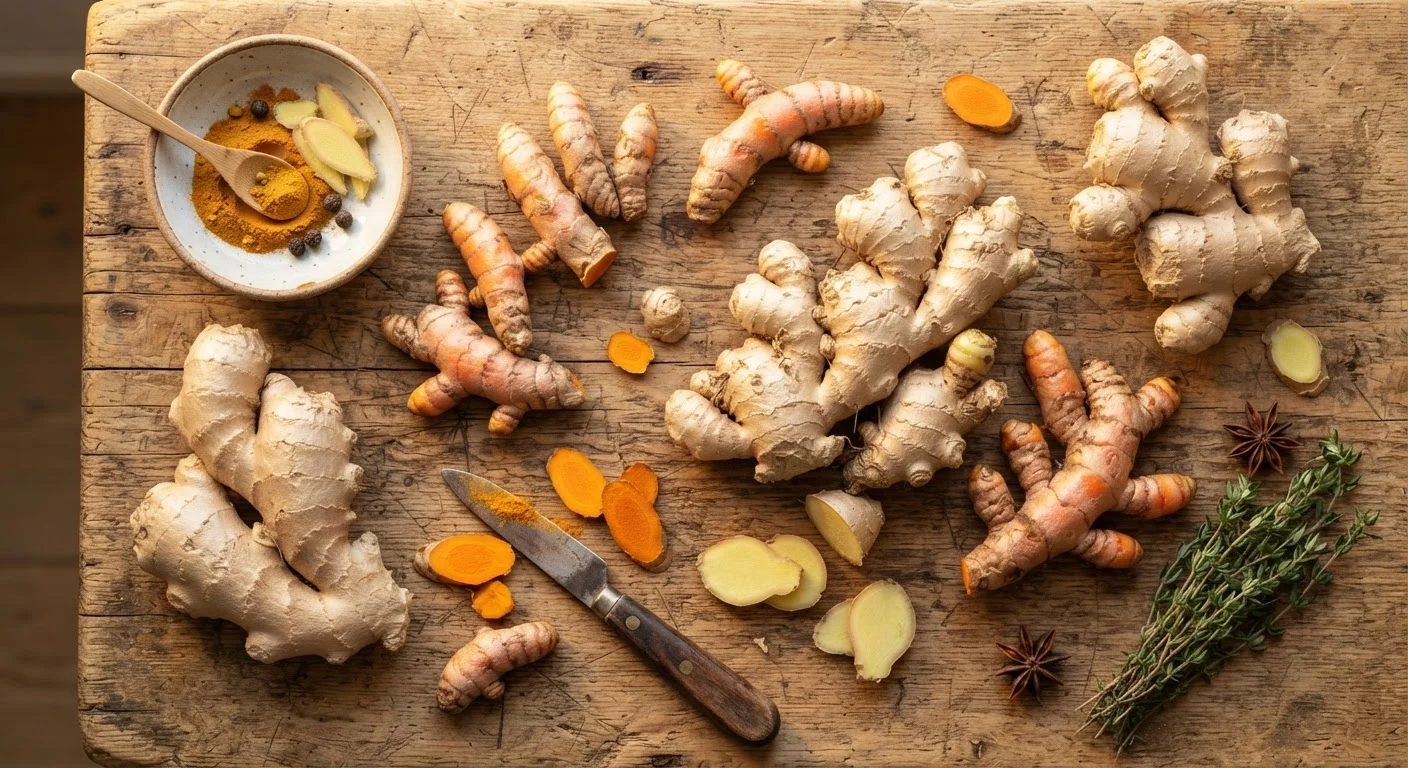
Key Takeaways
- Both ginger and turmeric contain active compounds with measurable anti-inflammatory properties in laboratory studies.
- Human clinical trials show modest, real-world benefits — but results are often smaller than popular claims suggest.
- Bioavailability is a genuine limiting factor: curcumin from turmeric is poorly absorbed without formulation aids.
- Neither spice replaces prescribed anti-inflammatory treatments for diagnosed inflammatory conditions.
- Food-level consumption is generally safe; high-dose supplements carry real risks and require professional guidance.
Why Ginger and Turmeric Dominate the Inflammation Conversation
Few kitchen staples have attracted more wellness attention than ginger and turmeric. Both are deeply rooted in Ayurvedic and traditional Chinese medicine, and both have accumulated a meaningful body of laboratory and clinical research. That combination — ancient credibility plus modern interest — makes them unusually susceptible to overstatement.
Inflammation itself is a term worth clarifying. Acute inflammation is a normal, protective response to injury or infection. Chronic low-grade inflammation, however, is associated with conditions ranging from cardiovascular disease to type 2 diabetes and arthritis. It is this chronic form that most wellness claims about ginger and turmeric target — and where the evidence, while real, is more nuanced than headlines suggest.
For a broader view of how herbal evidence is evaluated, see our guide to herbs with meaningful research behind them.
Myth
Turmeric is a proven anti-inflammatory that works the same way as ibuprofen or other NSAIDs.
Fact
Curcumin acts on some overlapping inflammatory pathways, but clinical evidence does not support equivalence to pharmaceutical anti-inflammatories in strength or reliability.
Laboratory studies confirm that curcumin inhibits NF-κB and COX-2 pathways — both implicated in inflammation — but the leap from cell culture to clinical outcomes is significant. Human trials have not demonstrated that turmeric performs comparably to NSAIDs in acute or chronic inflammatory conditions. Using turmeric in place of a prescribed medication for a diagnosed condition is not supported by available evidence and could delay appropriate care.
Myth
Adding turmeric to your food gives you the same anti-inflammatory dose used in clinical studies.
Fact
Most positive clinical studies use concentrated, bioavailability-enhanced curcumin extracts — far beyond what dietary turmeric delivers.
A typical teaspoon of ground turmeric contains roughly 200 mg of curcumin, and standard cooking absorption is low. Studies demonstrating measurable anti-inflammatory effects generally use 500–1,000 mg of curcumin combined with piperine or lipid carriers to enhance uptake. Culinary turmeric contributes flavor and may offer mild antioxidant benefit, but it should not be assumed equivalent to the formulations studied in trials.
Myth
Ginger supplements are always safe because ginger is a natural food.
Fact
High-dose ginger supplements can interact with blood-thinning medications and may not be appropriate for everyone, including people preparing for surgery.
Ginger consumed as a spice in normal culinary amounts has a strong safety record. However, concentrated supplements — often standardized to high levels of gingerols — can inhibit platelet aggregation and may amplify the effects of anticoagulants such as warfarin. People scheduled for surgery, those on blood-thinning therapy, and pregnant individuals should consult a healthcare provider before using ginger supplements. "Natural" does not mean risk-free at supplemental doses.
Myth
If ginger and turmeric are good for inflammation, taking more will produce better results.
Fact
Higher doses of both supplements increase the risk of side effects without a proportional increase in benefit, and safe upper limits have not been firmly established in long-term human trials.
With curcumin, doses above approximately 1,500 mg per day have been associated with gastrointestinal discomfort in some trial participants. High-dose ginger can cause heartburn, bloating, and mouth irritation. More critically, long-term safety data for megadose supplementation of either compound is limited. A dose-response relationship that clearly favors higher amounts has not been established in clinical populations, making dose escalation a risk without clear reward.
Myth
Taking ginger or turmeric supplements will visibly reduce inflammation within a few days.
Fact
The modest effects seen in clinical trials generally emerge over weeks to months, and many participants see no significant change.
Systematic reviews of curcumin and ginger for conditions like osteoarthritis typically measure outcomes over 8–12 weeks minimum. Even within these trials, response rates vary considerably, and mean effects — while sometimes statistically significant — are often modest in practical terms. Expecting rapid, dramatic symptom relief sets an unrealistic benchmark and may lead people to abandon remedies that could offer incremental benefit, or to overlook more effective interventions.
What the Research Actually Supports — and Where It Falls Short
Ginger's primary active compounds — gingerols and shogaols — inhibit inflammatory pathways in cell and animal studies with reasonable consistency. Human trials on joint pain in osteoarthritis show modest but statistically significant benefits in some reviews, though effect sizes are generally small and study quality is mixed. Ginger's best-evidenced application remains nausea relief; our deep dive into ginger's stomach-soothing properties covers that evidence in detail.
Turmeric's story centers almost entirely on curcumin, the compound responsible for its yellow color. Curcumin is a potent anti-inflammatory agent in laboratory models. The clinical problem is bioavailability: on its own, curcumin is poorly absorbed from the digestive tract. Most positive human trials use enhanced formulations — combined with piperine from black pepper, or using lipid-based delivery systems — which are not equivalent to cooking with turmeric. For a fuller look at turmeric's evidence base, see what the research actually says about turmeric.
Special Populations Should Seek Guidance First
Pregnant individuals, people with gallbladder disease, and those scheduled for surgery are among the groups for whom high-dose ginger or curcumin supplements may carry specific risks. Evidence on safety in these populations is limited. Always consult a qualified healthcare professional before using either supplement if you fall into a higher-risk category.
It is also useful to compare these spices with other kitchen staples. Cloves, cinnamon, and cardamom each carry distinct studied properties — see how their health profiles differ for context. Similarly, the pattern of enthusiasm outrunning evidence is not unique to spices — our piece on antioxidant science versus superfood marketing examines the same dynamic in nutrition broadly.
This article is for informational purposes only and is not a substitute for professional medical advice. Always consult a qualified healthcare provider before starting any supplement regimen, especially if you have a diagnosed condition or take medications.