
Herbs with Meaningful Evidence Behind Them—and What That Evidence Actually Shows

Key Takeaways
- Several common herbs have genuine clinical trial data, though most research involves small or short-term studies.
- Evidence quality varies widely — traditional use and scientific confirmation are not the same thing.
- Herb–drug interactions and contraindications exist even for well-studied herbs; always consult a healthcare provider.
- Standardisation of herbal products affects how well real-world use matches study conditions.
- No herb discussed here should replace prescribed treatment or professional medical guidance.
Why Evidence Quality Matters With Herbs
The herbal supplement market is vast, and the gap between marketing claims and documented research is often wide. A handful of herbs, however, have accumulated enough controlled trial data to warrant serious attention — not as miracle cures, but as agents with plausible, measurable effects under specific conditions.
Understanding what the evidence actually shows matters because the same herb can have strong support in one area and almost no data in another. Our everyday herb cabinet reference covers traditional uses broadly; this article focuses narrowly on where credible research exists, what it demonstrates, and where meaningful gaps remain.
It's also worth noting that study populations, dosing protocols, and product standardisation vary enormously across herbal trials, which makes direct comparisons difficult. Keep that caveat in mind as you read each entry below.
How to Read Herbal Evidence Honestly
Seeing 'clinical trials support' in marketing does not tell you whether those trials were well-designed, large enough, or replicated. A single small trial with positive results is very different from a body of consistent evidence across independent research groups. When evaluating any herb's research profile, look for systematic reviews or meta-analyses rather than individual studies alone, and note whether the same preparation and dose were used across studies. The natural-equals-safe reasoning error article offers a useful framework for thinking critically about herbal claims.
Herbs With Credible Research: What Trials Have Found
Ginger (Zingiber officinale) — Nausea and Inflammation
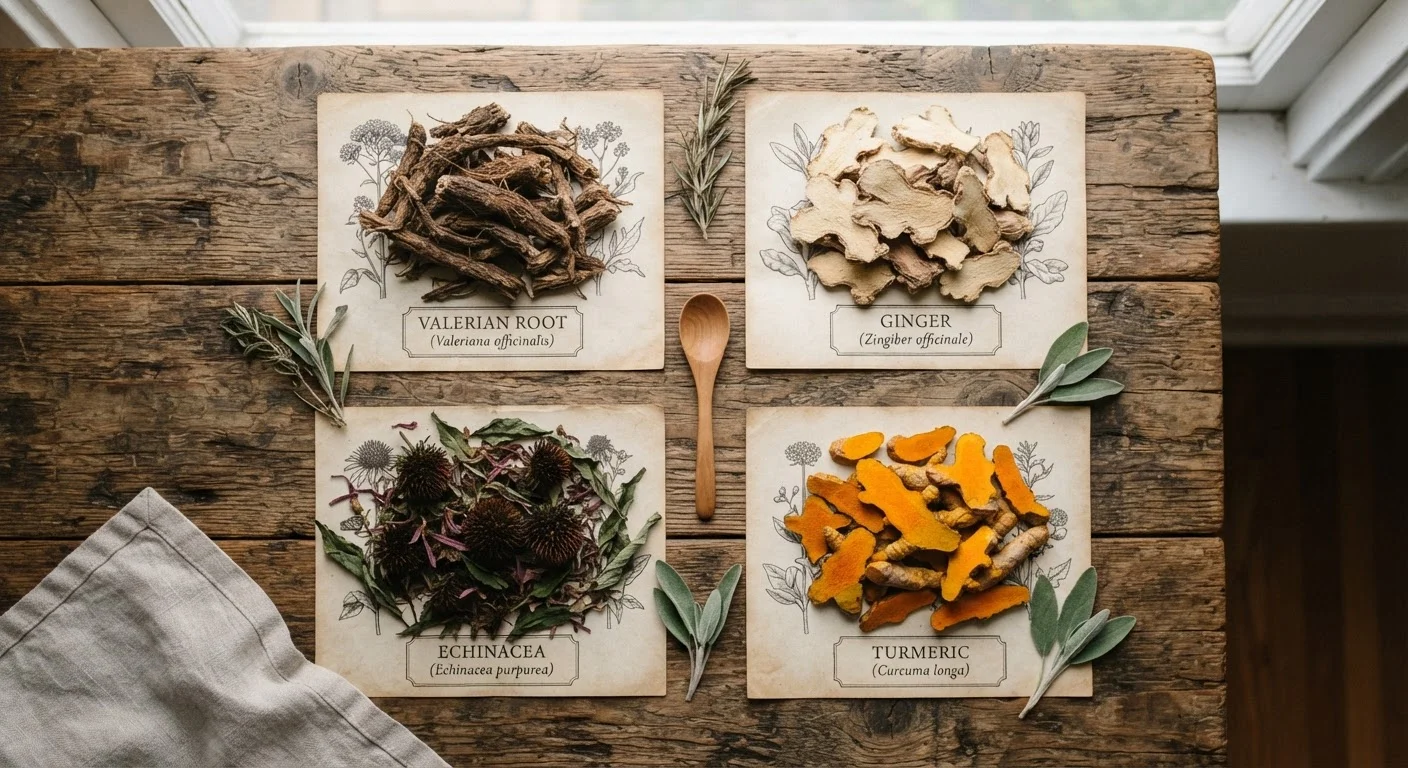
Ginger is one of the better-studied culinary herbs in clinical settings. Multiple randomised controlled trials have examined its effects on nausea — particularly pregnancy-related nausea, chemotherapy-induced nausea, and post-operative nausea — with generally positive findings, though effect sizes vary across studies.
Its proposed anti-inflammatory activity, linked to compounds called gingerols and shogaols, has been explored in trials involving osteoarthritis. Some studies report modest reductions in pain and stiffness, though results are not uniform and longer-term evidence remains limited.
At culinary amounts, ginger is widely regarded as safe for most adults. Higher supplemental doses may affect platelet aggregation, which is relevant for people taking blood thinners.
Ginger has some of the most replicated clinical data for nausea among all commonly used herbs.
Echinacea — Upper Respiratory Infections
Echinacea is one of the most purchased herbal supplements in the US, and the research behind it is genuinely mixed. A subset of well-designed trials suggests that certain Echinacea preparations may modestly reduce the duration or severity of common cold symptoms when taken at onset. However, the results depend heavily on the species used (E. purpurea, E. angustifolia, or E. pallida), the plant part, and the preparation method.
Meta-analyses have reached varying conclusions, and the inconsistency largely reflects product heterogeneity across studies. Preventive use — taking Echinacea to avoid getting sick — has weaker and less consistent support than use during an active infection.
Side effects are generally mild, but those with autoimmune conditions or allergies to plants in the daisy family should consult a provider before use.
Echinacea's evidence is real but conditional — species, plant part, and preparation matter significantly.
Valerian (Valeriana officinalis) — Sleep Quality
Valerian root is widely used for sleep difficulties, and several randomised trials have investigated it for this purpose. Results are inconsistent: some trials report improved sleep quality or reduced time to fall asleep compared to placebo, while others show no significant effect.
The heterogeneity of study designs, valerian preparations, and outcome measures makes firm conclusions difficult. A 2006 review in the American Journal of Medicine concluded that valerian may improve sleep quality without producing side effects, while acknowledging that evidence was not yet sufficient to make definitive claims.
Valerian is generally considered well-tolerated for short-term use. Its interactions with sedative medications and alcohol warrant attention, and long-term safety data remain sparse.
Valerian's sleep research is promising but inconsistent — short-term use appears low-risk for most adults.
Ashwagandha (Withania somnifera) — Stress and Cortisol
Ashwagandha is an adaptogen — a term describing herbs traditionally used to help the body respond to stress. Several controlled trials have examined its effects on self-reported stress, anxiety scores, and cortisol levels. Results from some well-designed studies suggest that standardised ashwagandha extract may reduce perceived stress and cortisol compared to placebo over 8–12 weeks.
Research into other proposed benefits — including physical performance and hormonal effects — is growing. Our full-spectrum herbal medicine guide provides broader context on how adaptogens fit into the evidence landscape. For a more focused look, see our article on adaptogens and stress.
Ashwagandha should be used with caution by people with thyroid conditions or autoimmune diseases, and is not recommended during pregnancy.
Ashwagandha has some of the strongest adaptogen trial data, particularly for stress and cortisol outcomes.
Turmeric / Curcumin (Curcuma longa) — Inflammation Markers
Turmeric's active compound, curcumin, has been extensively studied in laboratory and animal models for anti-inflammatory properties. Human clinical trials, however, present a more complicated picture. Curcumin is poorly absorbed on its own (low bioavailability), and many early studies used formulations that the body could not effectively utilise.
Newer research using enhanced formulations — such as those combined with piperine (black pepper extract) or lipid-based delivery systems — has shown more promising results for markers of inflammation and joint discomfort, particularly in osteoarthritis populations. Evidence for other proposed uses (cardiovascular health, cognitive function) is preliminary at best.
Curcumin at higher supplemental doses may interact with anticoagulants and certain chemotherapy drugs. At typical culinary levels in food, it poses minimal risk for most people.
Curcumin's human trial results hinge on formulation — bioavailability issues have clouded much of the earlier research.
Peppermint (Mentha × piperita) — IBS and Tension Headache
Peppermint oil has two areas where clinical evidence is notably stronger than for many other herbs. First, enteric-coated peppermint oil capsules have been evaluated in multiple randomised trials for irritable bowel syndrome (IBS) symptoms — particularly abdominal pain and spasm — with several meta-analyses finding meaningful benefit over placebo.
Second, topically applied peppermint oil (diluted in a carrier) has been compared to acetaminophen in small trials for tension-type headaches, with some evidence of comparable short-term pain reduction. This is a narrow finding and should not be extrapolated broadly.
Peppermint oil is not appropriate for young children, particularly near the face, and oral formulations can worsen gastroesophageal reflux (GERD) in susceptible individuals. If you use peppermint as a tea, our guide to making herbal teas and infusions covers preparation methods that affect how much you extract.
Enteric-coated peppermint oil for IBS pain is one of the cleaner evidence stories in herbal medicine.
Check for Standardised Extracts
When reviewing herbal research, notice whether trials used a standardised extract — one with a defined percentage of a key active compound. Products sold without standardisation may deliver highly variable amounts of those compounds. This is one reason study results don't always translate to off-the-shelf products. Our companion article on supplement forms explains what standardisation means in practice.
Putting the Evidence Into Practice
Even for herbs with the strongest evidence base, real-world use rarely mirrors controlled trial conditions. Product quality, preparation method, and individual biology all introduce variability. If you're considering herbal supplements, our guide to forms of herbal supplements explains how tinctures, capsules, and teas differ in potency and bioavailability.
Herb–drug interactions are a legitimate safety concern, not a hypothetical one. St. John's Wort, for example, is one of the most documented herb–drug interaction risks in clinical literature. For a broader overview, see our article on herb–drug interactions before combining any supplement with prescription medications. Those who are pregnant should review herbal use during pregnancy, as safety profiles can shift significantly in that context.
This article is for general informational purposes only and does not constitute medical advice. Always consult a qualified healthcare professional before starting any herbal supplement, particularly if you take prescription medications or have an existing health condition.