
Plant-Based Topicals for Minor Wounds and Skin Irritation: An Evidence Overview

Key Takeaways
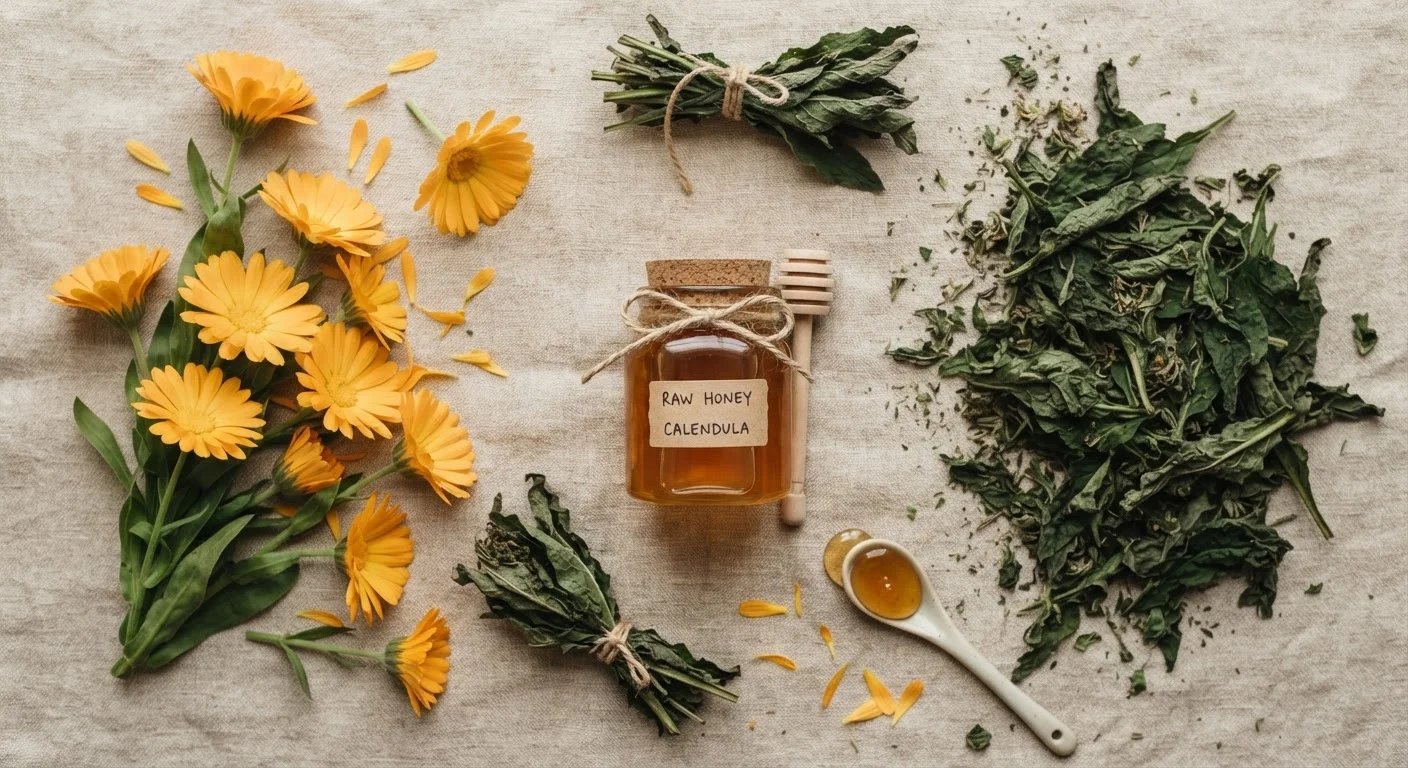
- Honey and calendula have the strongest clinical evidence for supporting minor wound healing.
- Comfrey shows promise for bruises and inflammation but carries safety concerns for open wounds.
- Dilution, patch testing, and sourcing matter as much as the remedy itself.
- No plant-based topical replaces proper wound cleaning or professional care for infected wounds.
- Evidence strength varies widely — traditional use does not always equal clinical proof.
What the Research Actually Tells Us
Interest in plant-based topicals for minor cuts, abrasions, and skin irritation has grown steadily, and so has the research evaluating them. A handful of botanicals — calendula, honey, comfrey, aloe vera, and tea tree oil among them — have accumulated enough study data to make meaningful comparisons possible. What follows is an evidence-graded look at each, distinguishing what clinical trials support from what remains rooted in tradition alone.
One consistent finding across this literature: the quality of preparation matters enormously. Concentration, carrier medium, and application method all affect outcomes. A well-made calendula-infused oil applied to a clean, closed wound behaves very differently from a dilute, mass-produced cream applied to an infected abrasion. For readers interested in making their own preparations, the guide to infused oils and herbal salves covers foundational technique. Before applying any homemade remedy, working through a topical remedy safety checklist is a practical first step.
This article is general health information only and is not medical advice. Always consult a qualified healthcare provider for any wound that shows signs of infection, deepens beyond the skin surface, or does not improve within a few days.
Medical-Grade Honey
Honey has the most robust clinical evidence of any plant-derived wound topical. Its wound-healing properties stem from several well-documented mechanisms: a low pH environment that inhibits bacterial growth, osmotic action that draws fluid away from damaged tissue, and the enzymatic production of hydrogen peroxide at concentrations active against pathogens but low enough to avoid tissue damage.
Randomized controlled trials have examined honey — particularly Manuka honey — for partial-thickness burns, post-surgical wounds, and chronic ulcers. A systematic review published in the Cochrane Database found honey may shorten healing time in mild to moderate burns compared with conventional dressings, though evidence for chronic wounds is more mixed. For minor cuts and abrasions at home, raw honey (not commercial table honey) is what traditional use has long favored, though medical-grade preparations offer standardized activity levels.
Key limitation: Raw honey is not sterile. It should not be used on deep, puncture, or heavily contaminated wounds, and individuals with diabetes should consult a healthcare provider before using honey-based wound care.
Honey's low pH and osmotic action create a wound environment measurably hostile to bacterial growth.
Calendula (Calendula officinalis)
Calendula flower preparations — typically as infused oils, creams, or compresses — have a long history in wound and skin care, and a growing body of clinical research supports several applications. The plant's active constituents include flavonoids, triterpenoids, and polysaccharides, which appear to contribute to anti-inflammatory and tissue-remodeling effects.
A frequently cited clinical trial compared calendula cream to a standard petroleum-based barrier cream in patients undergoing radiation therapy for breast cancer. Calendula performed significantly better in reducing acute dermatitis, a finding that has driven interest in its use for other forms of skin irritation. Smaller studies have also examined calendula in the context of episiotomy wound healing, with results suggesting faster healing and reduced discomfort compared to controls.
Key limitation: Calendula belongs to the Asteraceae (daisy) family. Individuals with known allergies to ragweed, chrysanthemums, or related plants should perform a patch test before use and may wish to avoid it entirely. See the herbal remedies hub for additional plant-family allergy context.
Clinical trials support calendula for radiation-induced skin irritation — one of its more evidence-backed applications.
Aloe Vera Gel
Aloe vera is one of the most recognizable topical botanicals, and its evidence base — while imperfect — is genuine. The gel from Aloe barbadensis leaves contains acemannan (a polysaccharide), glycoproteins, and anthraquinones that collectively demonstrate anti-inflammatory, moisturizing, and mild antimicrobial properties in laboratory studies.
Clinical evidence is strongest for minor burns and sunburn relief, where multiple small trials show improved healing speed and reduced pain compared to no treatment. Evidence for wound healing is more mixed: some studies show benefit for superficial wounds; others show no significant difference from standard care. Aloe's value for everyday skin irritation — dryness, contact dermatitis, minor abrasions — is supported more by consistent traditional use and its well-established safety profile than by large-scale trials.
Key limitation: Fresh aloe gel from a live plant differs substantially from processed commercial products, which often contain added ingredients. For topical use, pure gel with minimal additives is preferable.
Aloe vera's evidence is strongest for minor burns — its everyday wound benefits rely more heavily on traditional use.
Comfrey (Symphytum officinale)
Comfrey root and leaf contain allantoin, a compound that promotes cell proliferation and has a plausible biological rationale for wound healing. Topical comfrey preparations have been studied for bruises, sprains, and muscle pain — areas where the evidence is reasonably encouraging. A number of controlled trials, particularly in European research, have found comfrey root extract cream reduces pain and swelling from ankle sprains and blunt injuries faster than placebo.
However, comfrey also contains pyrrolizidine alkaloids (PAs), compounds associated with liver toxicity when ingested. Regulatory agencies in several countries have restricted internal comfrey products. For topical use on intact skin, PA absorption is considered low, but comfrey should never be applied to open wounds or broken skin, and it should not be used for extended periods. The detailed comfrey and arnica comparison covers these safety distinctions in depth.
Key limitation: Not appropriate for open wounds; avoid during pregnancy. Use only standardized, PA-reduced topical preparations.
Comfrey shows real evidence for bruises — but its pyrrolizidine alkaloid content means open wounds are a firm contraindication.
Tea Tree Oil (Melaleuca alternifolia)
Tea tree oil is among the most studied essential oils for antimicrobial activity. Laboratory studies consistently demonstrate broad-spectrum antibacterial and antifungal effects, and some small clinical trials support its use for conditions like mild acne and fungal nail infections. For minor skin irritation and wound hygiene, tea tree oil is used as a diluted antiseptic application.
The critical word is diluted. Undiluted tea tree oil frequently causes contact dermatitis, and allergic sensitization is a documented risk with repeated exposure. Concentrations of 5% or lower in a carrier oil are generally used in studies showing tolerability. It is also toxic if ingested, meaning storage away from children is essential. For a thorough evidence review of this particular topical, the evidence overview of tea tree oil on skin provides important nuance about where its antimicrobial reputation holds up and where it doesn't.
Key limitation: Always dilute before skin application. Not suitable for use near eyes, mucous membranes, or on large wound areas.
Tea tree oil's antimicrobial credentials are real — but undiluted application routinely causes the irritation it's meant to prevent.
Putting the Evidence to Practical Use
Across these botanicals, a clear hierarchy emerges. Honey and calendula sit at the top — supported by controlled clinical trials, not just tradition. Aloe vera holds a solid middle position for burns and irritation. Comfrey is promising for bruising and intact skin but requires caution. Tea tree oil is effective for antimicrobial purposes but demands careful dilution to avoid contact dermatitis.
Match the Remedy to the Wound Type
Honey and calendula are better suited to superficial cuts and mild irritation on intact or nearly intact skin. Comfrey is more appropriate for bruising and closed-skin inflammation. Tea tree oil's role is primarily antiseptic, not healing. Using the right botanical for the right situation improves both safety and the likelihood of benefit.
For deeper context on two of the most commonly confused topicals, the comparison of arnica and comfrey is worth reading alongside this overview. And if you're exploring the broader landscape of external plant-based applications, the complete guide to natural topical remedies provides a thorough foundation. The goal isn't to replace conventional wound care — it's to understand which plant-based options have enough evidence behind them to be reasonable, informed additions to a minor first-aid approach.