
Evening Yoga Wind-Down: Building a Pre-Sleep Routine That Actually Sticks

Key Takeaways
- Evening yoga works best when it prioritizes nervous system calming over physical exertion.
- Consistency in timing and environment matters more than the duration of your practice.
- A sequence of 4–6 gentle poses held for several breaths shifts your body toward sleep readiness.
- Pairing slow breathwork with movement amplifies the parasympathetic relaxation response.
- Habit stacking — attaching yoga to an existing bedtime ritual — dramatically improves follow-through.
What you will need
Why Evening Yoga Is Different From Any Other Practice
Most yoga classes are designed to energize, strengthen, or challenge you. Evening yoga has the opposite goal: it exists to help your nervous system downshift from the day's demands so sleep comes more easily. That distinction matters when you're building a routine.
Research on the autonomic nervous system shows that deliberate slow movement combined with extended exhalations activates the parasympathetic branch — sometimes called the "rest and digest" state — which counteracts the cortisol and adrenaline accumulated during a busy day. The emphasis here is on mental relaxation, not physical performance. You don't need advanced poses; you need intentional stillness and breath.
This is also why the complete guide to yoga for calm recommends floor-based, supported postures for evening practice — they remove the muscular effort that keeps the nervous system alert. If you're curious how restorative and yin approaches compare for this purpose, restorative yoga vs yin yoga breaks down the key differences clearly.
Setting Up for Success Before You Even Unroll the Mat
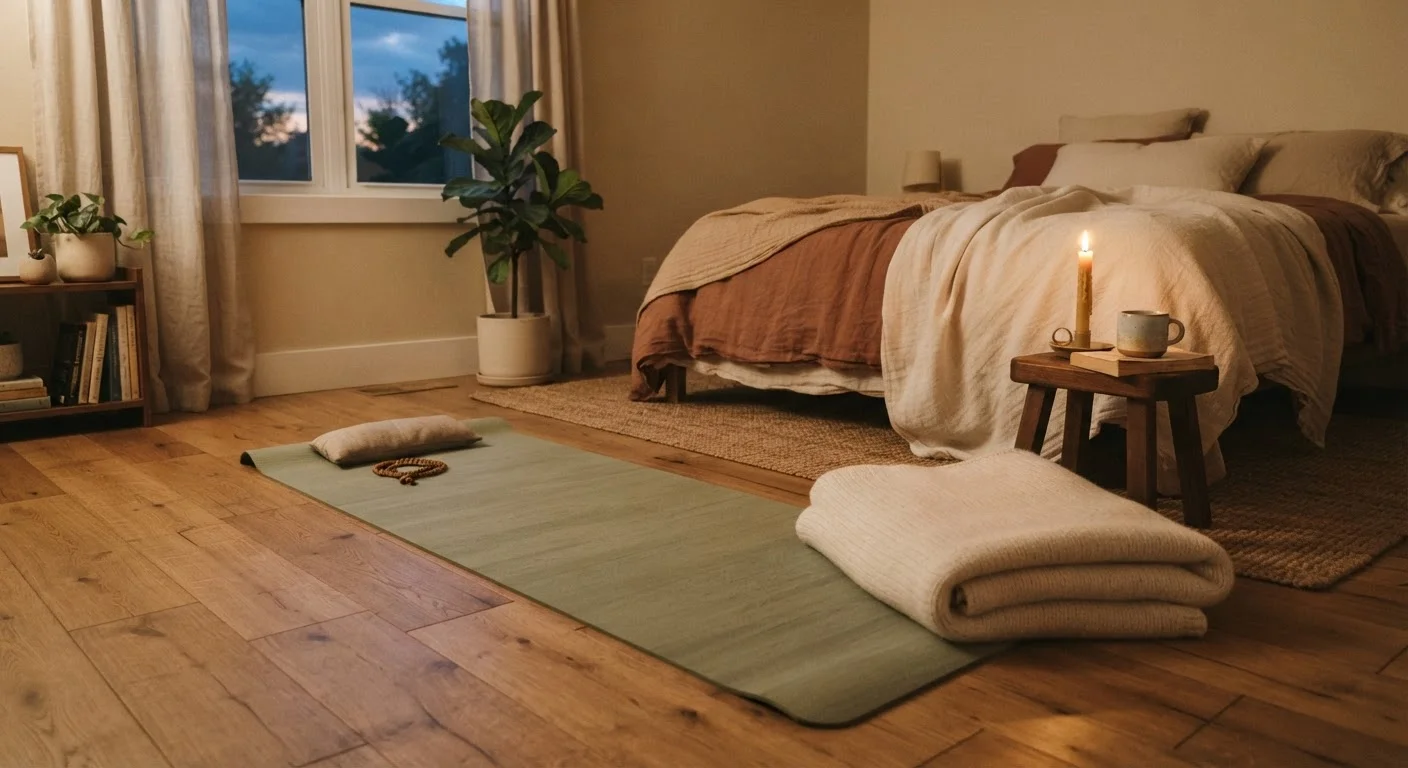
The environment you practice in signals your brain that it's time to wind down — or it doesn't. Dim lighting, a consistent space, and minimal clutter all reduce cognitive stimulation before you begin. A detailed preparation checklist is available in Before You Roll Out the Mat, but the core principle is simple: reduce sensory input so your nervous system has less to process.
Equally important is timing. Practicing within the same 30-minute window each evening — rather than "whenever I have time" — builds a conditioned relaxation response over weeks. If you want to understand the habit science behind this, our article on building a consistent meditation routine covers the same anchoring principles and translates well to yoga.
What you will need
Your Evening Yoga Wind-Down: Step by Step
The sequence below takes 15–20 minutes on most nights. Each step can be shortened on difficult evenings — even five minutes of intentional breathwork is meaningful. For nights when time is genuinely short, practising yoga in just ten minutes offers a condensed alternative.
Begin with 2 minutes of seated breathing
Sit comfortably on your mat — cross-legged, kneeling, or with your back against a wall. Close your eyes and take five natural breaths to arrive. Then begin to extend your exhalation: inhale for a count of four, exhale for a count of six or eight. This extended exhale is the primary driver of parasympathetic activation and is more important than any pose you'll do.
Move through a gentle seated spinal warm-up
Remaining seated, place your hands on your knees and slowly circle your torso in wide, easy rounds — three times in each direction. Follow with seated side stretches: reach one arm overhead and lean gently to the opposite side, hold for three breaths, then switch. These movements release tension accumulated from sitting or standing during the day without raising your heart rate.
Hold Child's Pose for 10–15 slow breaths
From kneeling, fold forward and extend your arms ahead or rest them alongside your body. Let your forehead rest on the mat or a folded blanket. Child's Pose (Balasana) gently compresses the front of the body while creating a mild stretch through the lower back and hips — two common sites of daily tension. Focus entirely on the feeling of your belly pressing into your thighs with each inhale.
Transition to Legs-Up-the-Wall (Viparita Karani)
Scoot close to a wall, lie on your back, and extend both legs up the wall so your body forms an L-shape. Rest your arms at your sides with palms facing up. This mild inversion encourages venous return (blood flow back toward the heart), reduces swelling in the lower legs, and has a notable calming effect. Stay here for two to five minutes, continuing the extended exhale breathing from Step 1.
Settle into Supine Twist
Lie flat on your back. Draw your right knee to your chest, then guide it across your body to the left while extending your right arm out to the side. Turn your gaze gently to the right. Hold for five to eight breaths, feeling the rotation release through your mid and lower back. Return to center and repeat on the other side. Twists help decompress the spine and stimulate the vagus nerve — a pathway strongly associated with the relaxation response.
Close with Savasana and a body scan
Lie flat on your back with your legs slightly apart and arms comfortably away from your sides. Close your eyes. Spend three to five minutes systematically releasing tension: start at your feet and slowly move your awareness upward — feet, calves, thighs, abdomen, chest, shoulders, hands, face — consciously softening each area as you notice it. There's no performance here. If your mind wanders, gently return attention to wherever you left off in the body scan.
Keep Your Sequence the Same Each Night
Predictability is a feature, not a flaw. Repeating the identical sequence night after night trains your brain to associate those specific movements and sensations with sleep readiness. Resist the urge to vary poses frequently — novelty keeps the mind engaged, which is the opposite of what you want at bedtime.
Making the Routine Stick Long-Term
The most common reason evening yoga routines collapse isn't laziness — it's overambition. Starting with a 45-minute sequence seven nights a week sets an unsustainable expectation. Begin with three nights a week and a 15-minute session, then expand once the habit feels automatic rather than effortful.
Habit stacking is particularly effective here: pair your yoga session with something you already do every night, such as brushing your teeth or turning off overhead lights. That existing action becomes the trigger for your practice. You can layer this wind-down into a broader sleep hygiene approach — the pre-sleep recovery checklist offers complementary evening habits that support better overnight rest. For broader stress management tools that reinforce this practice, explore the Stress Relief Tools hub.
This article is for informational purposes only and is not a substitute for professional medical advice. If you have any health concerns, injuries, or conditions that may affect your ability to practice yoga, please consult a qualified healthcare professional before beginning.