

Key Takeaways
- Yoga reduces physiological stress markers by activating the parasympathetic nervous system.
- Supported, slow-paced poses are more effective for mental calm than vigorous sequences.
- Breath control (pranayama) amplifies the relaxation response of every pose.
- A consistent 10–20 minute daily practice can deliver measurable mental wellness benefits.
- Yoga complements but does not replace professional care for clinical anxiety or depression.
Why Yoga Is Especially Effective for Mental Relaxation
Yoga stands apart from most physical exercise because its architecture is built around the relationship between body, breath, and mind. Where a high-intensity workout primarily targets cardiovascular or muscular systems, a well-designed yoga practice deliberately engages the parasympathetic nervous system — the branch responsible for rest, digestion, and recovery.
Research published in peer-reviewed journals has consistently linked yoga practice with reduced cortisol levels, lower self-reported anxiety, and improved sleep quality. The mechanism is relatively well understood: slow movement paired with controlled breathing sends signals to the brain that the environment is safe, which dials down the stress response. For evidence-backed stress relief that integrates movement and mindfulness, yoga offers an unusually complete toolkit.
38%
Reduction in perceived stress scores
A 2018 meta-analysis in the Journal of Clinical Psychology found yoga interventions reduced self-reported stress by an average of 38% compared to control groups.
10–20 min
Daily practice linked to measurable calm
Multiple controlled studies suggest sessions as brief as 10–20 minutes are sufficient to produce acute reductions in anxiety and cortisol.
27%
Lower cortisol after restorative yoga
Research at the University of California found restorative yoga participants showed meaningfully lower salivary cortisol compared to passive rest controls.
Importantly, yoga's mental benefits do not depend on flexibility or athletic ability. The practices most beneficial for calm — restorative yoga, yin yoga, and gentle hatha — are accessible to beginners and require no prior experience.
Core Principles of a Calm-Focused Yoga Practice
Not all yoga is created equal when mental relaxation is the goal. A performance-oriented class emphasizing complex poses or rapid sequences can actually elevate stress hormones. A calm-focused practice is guided by several distinct principles:
- Slow, intentional movement: Poses held for longer periods (30 seconds to several minutes) allow the nervous system to register safety and release muscular guarding.
- Non-striving attitude: The goal is ease, not achievement. Pushing to edge of discomfort undermines the relaxation response.
- Breath primacy: Movement follows the breath rather than the other way around. Each inhale and exhale guides transitions.
- Sensory withdrawal (pratyahara): Minimising external stimulation — dimmed lights, soft sounds, eyes closed — deepens inward focus.
- Consistency over intensity: A short daily practice produces more durable benefits than occasional long sessions.
If you only have time for one thing, prioritize the exhale. Deliberately lengthening your out-breath by even two counts — in any pose — activates the vagal brake more reliably than any complicated sequence.
The vagus nerve, which governs the parasympathetic response, is most directly stimulated by slow exhalation, making breath length a higher-leverage variable than pose selection for mental calm.
Use props generously in restorative poses, especially under the knees in Savasana and under the chest in reclined poses. When the body feels fully supported, the nervous system stops bracing and lets go.
Proprioceptive support reduces the low-level muscular tension the body maintains when it anticipates needing to move, which is one of the main physical barriers to deep rest in yoga.
These principles align closely with what mindfulness researchers describe as a deliberate shift of attention to present-moment experience without judgment — the same quality cultivated in meditation basics.
Key Poses That Quiet the Nervous System
Several categories of yoga poses have particularly strong associations with reduced physiological arousal:
Supported Forward Folds
Poses like Paschimottanasana (seated forward fold) and Uttanasana (standing forward fold) gently compress the torso and encourage blood flow toward the head. Holding these with soft knees and a relaxed neck tends to produce noticeable calming within 30–60 seconds.
Inversions Done Gently
Viparita Karani (legs-up-the-wall) is among the most widely recommended poses for stress relief. It requires no prior yoga experience, needs minimal space, and research suggests it may reduce heart rate and lower perceived tension.
Restorative Poses
Supta Baddha Konasana (reclined bound angle) and Savasana (corpse pose) are fully supported on the floor, often with props like bolsters or folded blankets. These poses can be held for 5–20 minutes, giving the body extended time in deep rest.
Child's Pose (Balasana)
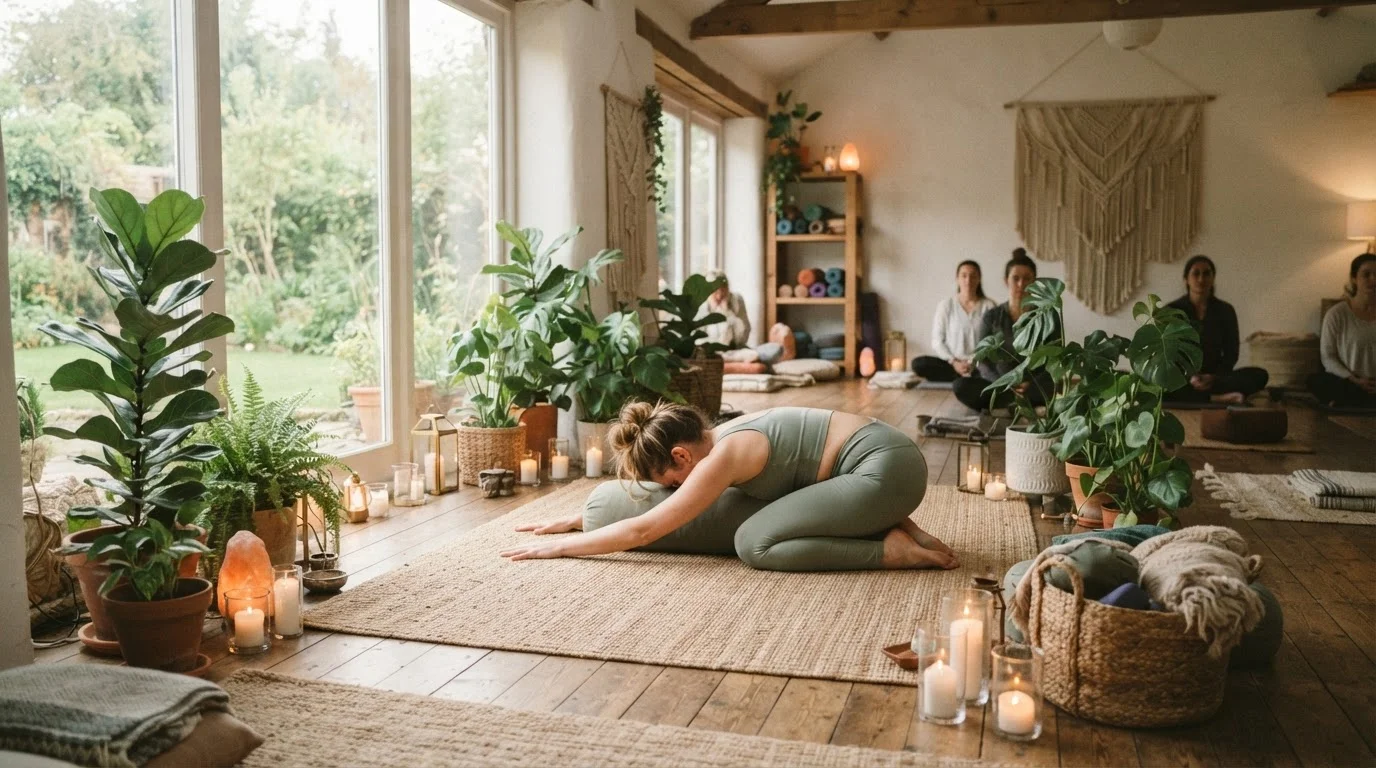
Simple, deeply familiar even to beginners, child's pose gently compresses the belly against the thighs, activating baroreceptors that signal the brain to downshift arousal. It is an ideal reset during any practice.
Avoid Pushing Through Discomfort
In a calm-focused yoga practice, the instruction to 'find your edge' is counterproductive. Any sensation of sharp pain, strain, or breath-holding is a signal to ease back, not push through. The goal is a pose that feels sustainable for several minutes, not one that tests your limits. If a pose consistently causes discomfort, use more support or choose a gentler variation.
Sequencing matters: beginning with gentle movement, moving toward longer-held poses, and closing with 5–10 minutes of Savasana mirrors the natural arc toward stillness and makes the practice feel complete rather than cut short.
Breathwork: The Hidden Engine of Calm
Breath is the single most direct lever practitioners have over their autonomic nervous system. Extending the exhale relative to the inhale — for example, breathing in for four counts and out for six — is one of the most well-supported techniques for shifting the body toward parasympathetic dominance.
Several foundational breathing patterns are worth learning:
- Diaphragmatic breathing: Breathing so the belly rises on the inhale rather than the chest. This deepens tidal volume and slows respiratory rate, both markers of calm.
- Nadi Shodhana (alternate nostril breathing): A traditional pranayama technique that research suggests may support cardiovascular coherence and reduce anxiety symptoms.
- 4-7-8 breathing: Inhale for four counts, hold for seven, exhale for eight. Often used as a pre-sleep or acute stress tool.
For a deeper understanding of how breath and movement reinforce each other in yoga, the principles of breathwork in calming yoga are worth exploring in detail.
Building a Sustainable Practice at Home
Consistency is the most important variable. A 15-minute home practice done most days will outperform a 90-minute studio class attended twice a month. Here is a practical starting framework:
- Choose a fixed time: Morning or evening both work. Morning practice sets a calm tone; evening practice aids sleep onset.
- Designate a small space: Even a mat-sized area signals to the brain that this is a transition into intentional rest.
- Start with five minutes: Lower the barrier to entry so the habit forms before the length increases.
- Use guided audio or video: External guidance reduces the mental effort of sequencing, making it easier to stay present.
- Pair yoga with sitting practice: Even five minutes of seated breath awareness after your poses deepens the calm. If distraction is a recurring challenge, strategies for a restless mind can help.
If your environment is noisy, note that meditation adapted for noisy spaces offers practical workarounds that translate equally well to yoga sessions. Similarly, understanding the science behind how stillness calms the mind can strengthen your motivation to keep showing up.
When to Seek Additional Support
Yoga is a valuable complement to mental wellness, but it is general health education — not a substitute for professional care. If you are experiencing persistent anxiety, depression, trauma responses, or any other clinical concern, please speak with a qualified healthcare provider or licensed mental health professional. Yoga can be a supportive part of a broader care plan, but that plan should be guided by someone with the training to assess your individual needs.
Special populations — including pregnant individuals, older adults, and people with cardiovascular or musculoskeletal conditions — should consult a healthcare professional before beginning or substantially changing a yoga practice.
This article is for general informational and educational purposes only and does not constitute medical advice. Always consult a qualified healthcare professional regarding personal health decisions, symptoms, or concerns.