

Key Takeaways
- Ten minutes of intentional, breath-focused yoga can activate the parasympathetic nervous system and reduce perceived stress.
- Calming yoga prioritizes slow breath and gentle holds over physical challenge or flexibility.
- A consistent short sequence practiced daily tends to be more beneficial than longer sessions done rarely.
- No special equipment is required — a clear floor space and willingness to slow down are enough.
- This practice complements rather than replaces other stress-relief strategies or professional mental health support.
What you will need
Why Ten Minutes Is Enough — If You Use Them Intentionally
Many people assume a yoga practice only counts if it fills an entire hour. Research tells a more encouraging story. Studies examining brief, mindfulness-based movement sessions suggest that even short exposures to slow breath and gentle body awareness can measurably shift physiological stress markers. The key variable isn't duration — it's intention.
The sequence described here is built around one principle: calming yoga targets the nervous system first and the body second. That means slower transitions, longer holds, and consistent attention to the exhale over any concern with how a pose looks or how far you stretch. If you're new to this framing, the complete guide to practices that quiet the mind offers useful background on why this distinction matters.
Ten focused minutes practiced consistently — even three or four days a week — tends to produce more noticeable benefit than infrequent longer sessions. Regularity reinforces the neural pathways associated with the relaxation response, making it easier to access calm on demand over time.
What you will need
The Ten-Minute Sequence: What You'll Do and Why
The steps below follow a deliberate arc: arrive and settle, mobilize gently, hold restoratively, then transition to stillness. This mirrors the structure used in longer restorative yoga classes, simply compressed. Each pose is chosen because it is accessible to most adults with no prior yoga experience and requires no flexibility. If you're completely new to yoga, starting yoga for stress relief as a complete beginner walks through foundational expectations before your first session.
Yoga mat or non-slip surface
Provides cushioning and grip for floor-based poses.
Folded blanket or firm cushion
Supports the hips in seated poses and makes holds more comfortable.
Timer or phone
Tracks your session so your attention stays on the practice, not the clock.
Eye pillow or folded cloth
Blocks light during the final resting pose to deepen relaxation.
Arrive in a comfortable seat and set an intention (1 minute)
Sit cross-legged or on your heels. Rest your hands on your thighs, close your eyes, and take three slow breaths. On each exhale, consciously release tension from your jaw and shoulders. Set a simple intention — not a goal, just a direction. Something like "I am here to rest" or "I choose to slow down" gives the nervous system a clear signal that safety is available right now.
Establish your breathing pattern (1 minute)
Before moving, anchor your breath. Inhale slowly through the nose for a count of four, then exhale through the nose for a count of six. This extended exhale ratio is a simple way to engage the parasympathetic branch of the autonomic nervous system. You'll maintain this rhythm — or a variation that feels comfortable — throughout the sequence. For a deeper look at why breath pacing matters, see breathwork principles for calming yoga.
Seated neck and shoulder release (1.5 minutes)
Remaining seated, slowly drop your right ear toward your right shoulder and hold for three breaths. Return to centre, then repeat on the left. Next, roll your shoulders backward three times in slow circles. These small movements release the muscles most commonly tensed during stress — the trapezius and levator scapulae — without demanding flexibility or core strength.
Cat-Cow on all fours (1.5 minutes)
Come onto all fours with wrists under shoulders and knees under hips. On an inhale, let your belly drop, lift your chest and tailbone (Cow). On an exhale, round your spine toward the ceiling, tuck chin and tailbone (Cat). Move slowly — far more slowly than feels natural. The goal is to synchronize movement with breath rather than chase range of motion. Complete six to eight full cycles.
Child's Pose (2 minutes)
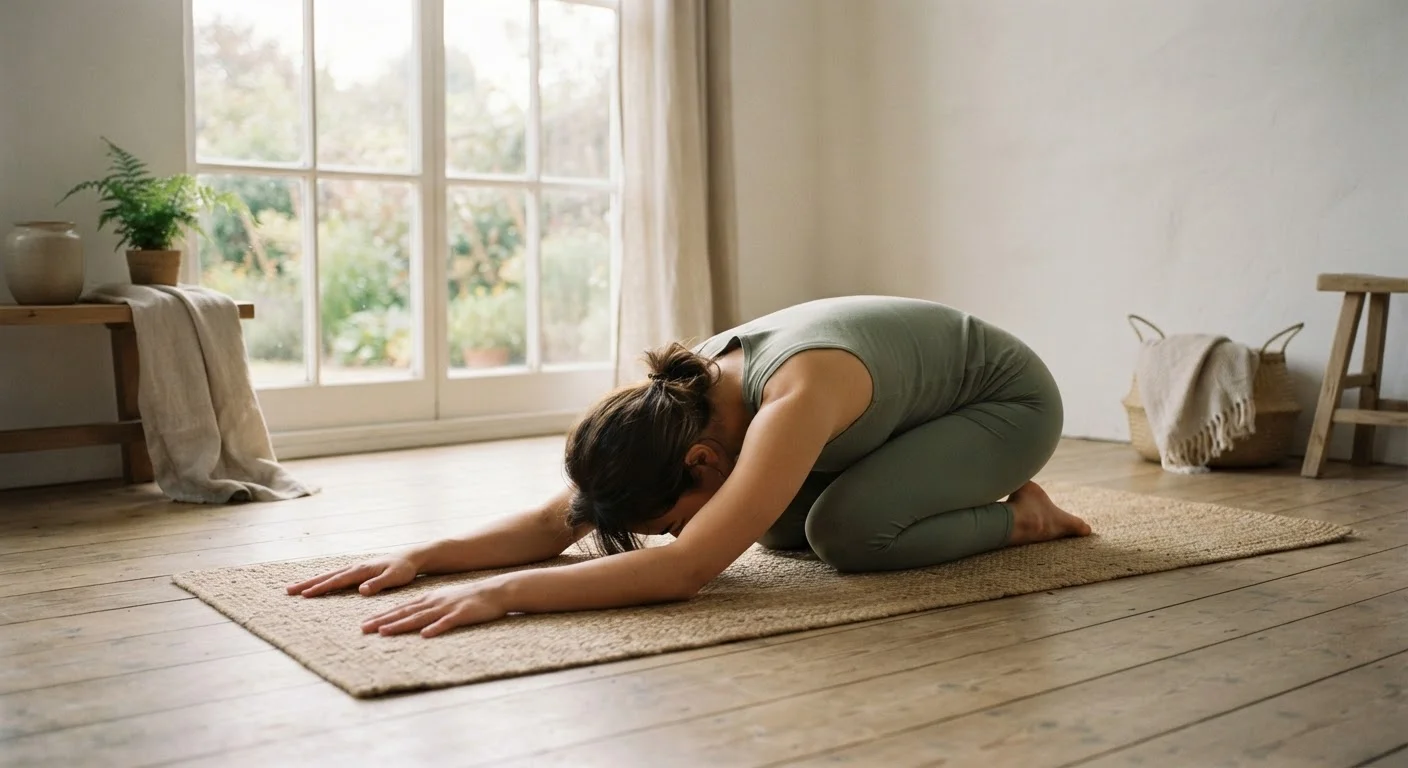
From all fours, sink your hips back toward your heels, extend your arms forward or rest them alongside your body, and let your forehead lower to the mat. This is the sequence's centrepiece. Child's Pose (Balasana) gently compresses the belly to encourage diaphragmatic breathing and provides mild proprioceptive input that many people find calming. Stay here for six to eight slow breaths, doing nothing except noticing the rhythm of your own inhale and exhale.
Supine twist (1.5 minutes — 45 seconds each side)
Roll onto your back. Draw your right knee toward your chest, then guide it across your body to the left while extending your right arm out wide. Turn your gaze gently to the right. Hold for three full breath cycles, then switch sides. Supine twists create a gentle traction through the thoracic spine and can help release accumulated muscular tension from long periods of sitting. These poses pair well with the calming yoga poses for desk workers if you spend hours at a screen.
Legs-up-the-wall or Savasana (2 minutes)
For the final pose, choose one of two options. Legs-up-the-wall (Viparita Karani): Lie on your back and rest your legs vertically against a wall, forming an L-shape. This gentle inversion encourages venous return and is widely reported to ease a busy mind. Savasana: Simply lie flat, arms slightly away from the body, palms facing up. Place an eye pillow over your eyes if available. In either option, stop directing the breath and allow it to return to its natural rate. This closing stillness is not optional — it's where the nervous system integrates the practice.
Breath Is the Real Practice
Research on yoga's stress-reducing effects consistently highlights slow, diaphragmatic breathing as the primary driver of calm — not the poses themselves. If you can only focus on one thing during this sequence, make it the quality of your exhale. Longer exhales stimulate the vagus nerve and help downregulate the stress response.
Move Within a Comfortable Range
None of these poses should produce sharp or shooting pain. If you feel discomfort beyond mild stretching, ease out of the pose immediately. Modify or skip any pose that does not feel safe for your body on a given day.
Making This Habit Stick Without Willpower
The most common reason short yoga practices get abandoned is not lack of motivation — it's lack of a consistent trigger. Behavioral research on habit formation suggests that attaching a new behavior to an existing routine (called "habit stacking") dramatically improves follow-through. Consider anchoring your ten-minute sequence to something you already do daily: immediately after your morning coffee, directly before a lunch break, or as a bridge between work and evening.
If evenings work better for your schedule, this practice pairs naturally with a longer wind-down approach. See building an evening yoga wind-down routine for guidance on extending this into a pre-sleep ritual. Alternatively, if you find your mind is too busy to settle into movement, pairing this practice with a brief meditation may help — five-minute meditation formats for busy days offers compact options that work well before or after this sequence.
Finally, resist the urge to judge individual sessions. On some days the practice will feel deeply settling; on others your mind will stay busy throughout. Both are normal. The benefit accumulates across consistent effort, not from any single perfect session. For a broader toolkit of evidence-backed stress-reduction strategies, explore the Stress Relief Tools hub.
This article is for general informational and educational purposes only and does not constitute medical advice. If you are experiencing significant stress, anxiety, pain, or any health concern, please consult a qualified healthcare professional before starting a new practice.