

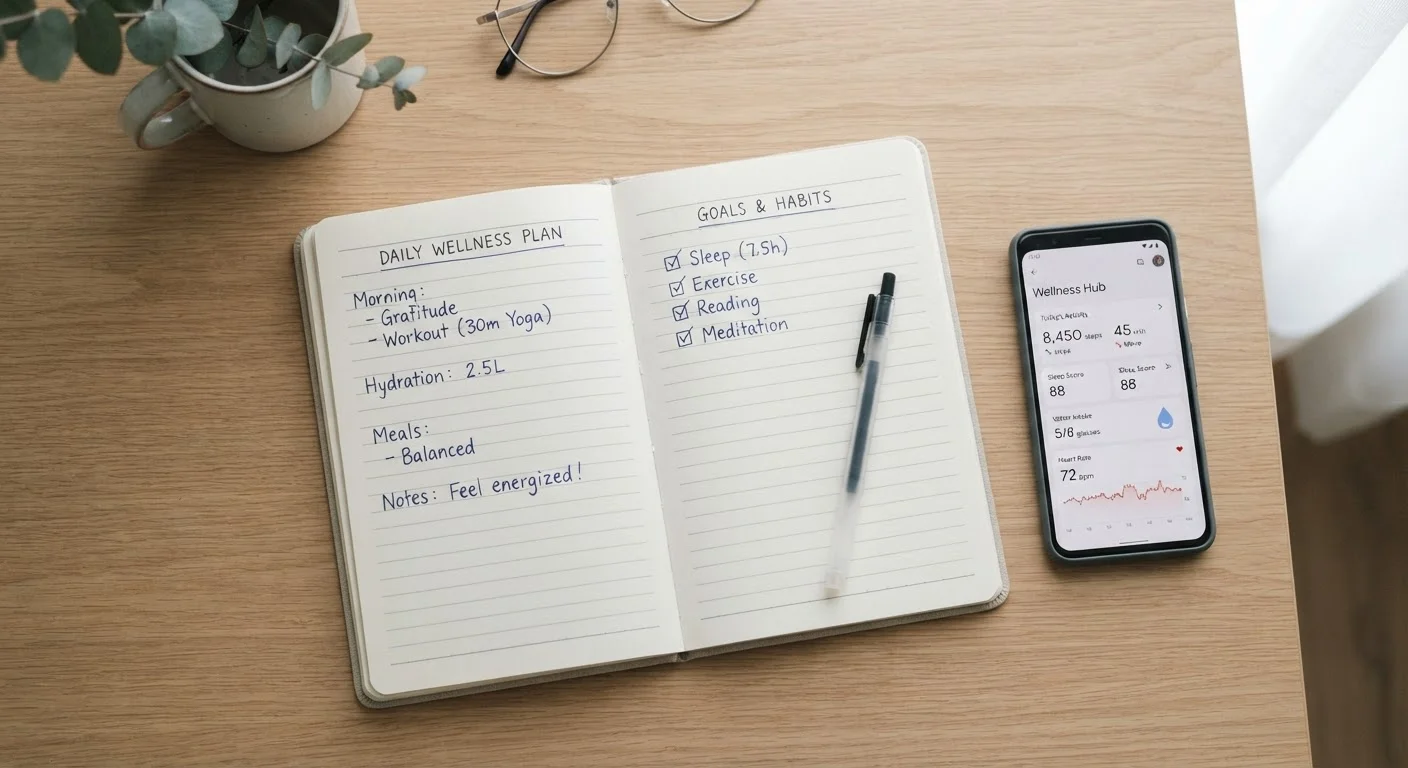
Key Takeaways
- Paper diaries offer full data privacy and encourage reflective, open-ended entries with no technical barriers.
- Digital apps provide reminders, pattern visualization, and exportable reports that can support clinical conversations.
- Consistency matters more than format — the best tool is whichever one you'll use every day.
- Apps may collect personal health data; reviewing privacy policies before use is an important step.
- Some trackers combine both approaches — brief digital logging supplemented by weekly paper reflection.
Option A
Paper Diary
The tactile, distraction-free classic.
Best for: Readers who prefer writing by hand, want complete data privacy, or tend to reflect more deeply during offline moments.
Option B
Digital App
The structured, always-with-you modern option.
Best for: Readers who want automated reminders, visual trend analysis, and the ability to export records for healthcare appointments.
If you value privacy above all else
Paper Diary
A physical notebook stores no data on servers, requires no account, and cannot be accessed by third parties — making it the most private option available.
If you struggle with remembering to log symptoms
Digital App
Scheduled push notifications reduce the risk of missed entries, which is one of the most common barriers to building a reliable symptom record.
If you want to share records with your doctor
Digital App
Many apps generate shareable summaries or PDF exports that make it easier to present a clear, organized symptom history at appointments.
If screen fatigue or tech anxiety is a real concern
Paper Diary
Writing by hand removes digital friction entirely and is associated with slower, more mindful self-reflection, which can surface nuanced symptoms.
If you want to spot trends across weeks or months
Digital App
Automated charts and frequency summaries make long-term pattern recognition far faster than manually scanning handwritten pages.
Why Your Tracking Format Shapes What You Actually Capture
Choosing between a paper diary and a digital app isn't just a matter of personal preference — it directly influences what information you record, how honestly you record it, and whether the habit sticks. As explored in Symptom Trackers Explained, the core value of any symptom log comes from its consistency and completeness, not from any particular technology.
A format that feels burdensome will produce sparse, irregular entries. A format that feels natural tends to encourage fuller, more honest reporting. That's why the paper-versus-digital question deserves careful thought rather than a default assumption that one is obviously better.
| Criterion | Paper Diary | Digital App |
|---|---|---|
| Setup required | None — pen and notebook | Account creation, app install |
| Data privacy | Full — no servers involved | Varies by app and policy |
| Reminders & prompts | Manual habit only | Automated push notifications |
| Trend analysis | Manual, time-consuming | Automated charts and summaries |
| Entry flexibility | Fully open-ended | Often structured fields |
| Sharing with clinician | Manual transcription needed | Exportable reports available |
| Risk of loss or damage | Physical loss, no backup | Cloud backup, device dependency |
| Tech comfort required | None | Basic smartphone proficiency |
The Case for a Paper Diary
Paper requires no account setup, no software updates, and no battery. There's a low barrier to starting: a basic notebook and a pen are all you need. This simplicity makes it accessible to anyone, regardless of their comfort level with technology.
Writing by hand also encourages more descriptive, contextual entries. Rather than tapping a pre-set severity slider, you can note that your headache came on after skipping lunch and sitting through a stressful meeting — qualitative details that structured app fields often can't capture. Research on the cognitive effects of handwriting suggests it may promote deeper processing of information, which could translate to more thorough self-observation.
Privacy is another significant advantage. A physical notebook doesn't sync to the cloud, doesn't share data with advertisers, and doesn't require you to agree to terms of service. For readers tracking sensitive symptoms — those related to mental health, reproductive health, or chronic pain — this can be a meaningful consideration. That said, a paper diary can be lost, damaged, or seen by others in your household, so physical security matters too.
The main limitation is search and analysis. Finding patterns across three months of handwritten entries takes real effort. If you're preparing for a specialist appointment, distilling weeks of notes into a usable summary is a time-consuming manual task. For guidance on what's worth recording regardless of format, see What to Record in a Symptom Log.
The Case for a Digital App
Digital symptom tracking apps address the consistency problem head-on. Scheduled reminders prompt you to log at set times — after meals, before bed, or at whatever cadence you choose. For people whose symptom tracking tends to fall off after the first enthusiastic week, this kind of scaffolding can make a measurable difference.
Apps also handle the analytical heavy lifting. Most generate visual summaries — charts, heat maps, frequency counts — that would take hours to reconstruct from a paper diary. When a pattern emerges (a migraine that reliably appears two days before a menstrual cycle, or fatigue that clusters around poor sleep nights), an app surfaces it clearly. This kind of insight is precisely what makes symptom logs useful in clinical conversations.
76%
Adults who own a smartphone in the US
Pew Research Center data indicates smartphone ownership is near-universal among US adults under 50, making app-based tools broadly accessible for most demographics.
3x
More likely to spot patterns with visual data tools
Health informatics literature consistently notes that visual trend displays help patients identify patterns that are difficult to detect from unstructured text records alone.
The trade-off is data privacy. Health apps vary widely in how they handle personal information. Some are designed with strong encryption and explicit data-minimization policies; others monetize anonymized user data. Before committing to any app, it's worth reading its privacy policy — specifically how it stores, shares, and protects your health entries. This is especially important given that health data can be sensitive in both personal and legal contexts.
A digital log also requires a charged device and some baseline comfort with apps. For older adults, individuals with visual impairments, or anyone experiencing tech-related fatigue, these aren't trivial obstacles. As discussed in Wellness Tracking: When It Helps and When It Becomes Its Own Stressor, constant digital monitoring can itself become a source of anxiety for some users.
Making the Right Choice — or Combining Both
No single format is universally superior. The most practical approach is to match the tool to your daily rhythm. If you keep a bedside notebook, paper may be the path of least resistance. If your phone is already on you all day, a quick app entry may be more sustainable than finding your journal.
Some people find that a hybrid approach works well: brief daily app entries for consistency and searchability, combined with a weekly paper reflection that captures nuance the app fields don't allow. This combination can offer the best of both worlds, though it does require maintaining two habits simultaneously.
Whatever format you choose, the goal is to build an accurate, ongoing record that you can actually use — whether for personal awareness or to support a conversation with a healthcare provider. If you're new to the process, Starting a Symptom Journal: A Practical First-Timer's Walkthrough offers a clear step-by-step approach that applies equally to paper and digital methods. You may also want to consider whether a general log or a condition-specific tracker better fits your health goals.
This article is for general informational purposes only and does not constitute medical advice. Always consult a qualified healthcare professional for guidance specific to your health situation.