

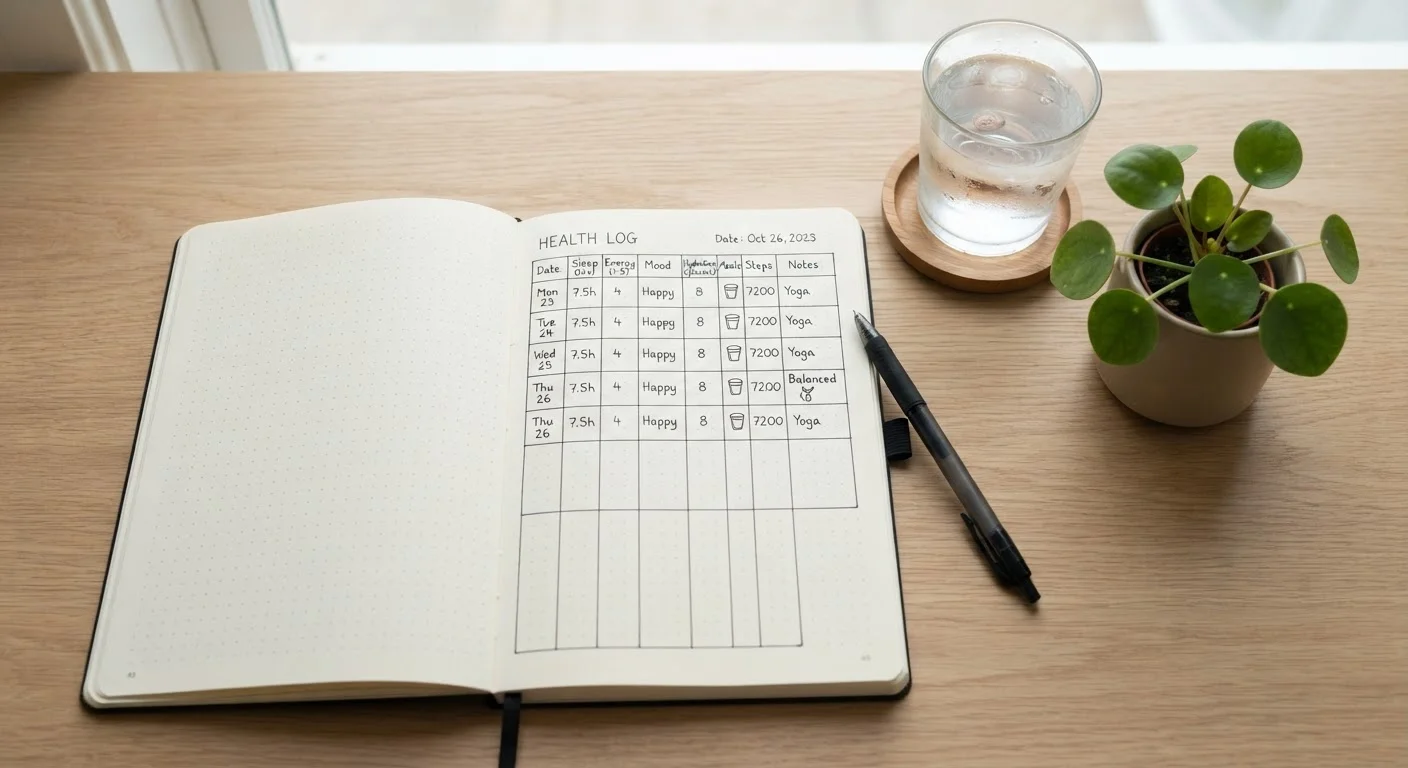
Key Takeaways
- A symptom journal converts vague feelings into concrete, reviewable data over time.
- Consistency matters more than completeness — brief daily entries beat sporadic detailed ones.
- Recording context (sleep, meals, stress) alongside symptoms reveals useful connections.
- Reviewing entries weekly or monthly is what turns raw logs into actionable insight.
- A symptom journal is a communication tool, not a diagnostic one — share it with your doctor.
Start here
Why Start a Symptom Journal at All?
Next
Choosing Your Format
Then
What to Record in Each Entry
Practice it
Building the Daily Habit
Apply it
Reviewing Your Journal for Patterns
Why Start a Symptom Journal at All?
Memory is a poor health recorder. When a doctor asks how often your headaches occur or whether your fatigue worsens after certain foods, most people can only guess. A symptom journal solves this by converting day-to-day experience into a structured, reviewable record you can actually use.
The core value is pattern detection. A single bad day tells you very little. Thirty days of logged entries can reveal that your energy dips every afternoon, that joint stiffness follows poor sleep, or that a particular food reliably precedes digestive discomfort. That kind of insight is difficult — often impossible — to reconstruct from memory alone. For a broader overview of how these tools work, see Symptom Trackers Explained.
Importantly, a symptom journal is a communication aid, not a diagnostic tool. It gives your healthcare provider a more accurate picture of your health between appointments, which often leads to more productive conversations. This article is for informational purposes only and does not constitute medical advice.
Symptom journal
A structured record — paper or digital — where you log how you feel each day, including what symptoms occurred, their severity, and relevant context like sleep or diet.
Baseline
Your normal, symptom-free state. Establishing a baseline makes it easier to recognize when something changes or worsens over time.
Trigger
A factor — such as a food, activity, or stressor — that appears to precede or worsen a symptom. Triggers are identified by comparing context notes across multiple entries.
Severity scale
A simple rating system (such as 1–10 or mild/moderate/severe) used to measure how intense a symptom feels. Consistent use of the same scale across entries makes comparison meaningful.
Context factors
Surrounding circumstances recorded alongside a symptom — things like recent meals, stress level, sleep quality, or physical activity — that help explain why a symptom may have occurred.
Habit stacking
A behavioral strategy where you attach a new habit (like journaling) to an existing daily routine so it becomes automatic rather than requiring deliberate effort each time.
Choosing Your Format
Before your first entry, decide where you'll log. The two practical options are a dedicated paper notebook and a digital app or spreadsheet. Neither is objectively superior — what matters is which format you'll actually use every day.
A notebook is low-friction, requires no technology, and suits people who find handwriting reflective. A digital format offers automatic date-stamping, easy searching, and the ability to spot trends in a table or chart. For a detailed trade-off analysis, the paper vs. digital comparison walks through consistency, privacy, and usability considerations.
Whichever format you choose, create a consistent structure from day one. A simple template — date, symptom description, severity rating, and context notes — prevents entries from varying so wildly that comparison becomes difficult later.
Start with a One-Week Trial Template
Before committing to a format, run a seven-day trial using a basic five-field template: date, symptom, severity, duration, and one context note. After a week, assess whether the fields feel useful or burdensome and adjust before the habit solidifies. A format that fits naturally into your day is far more likely to survive past the first month.
What to Record in Each Entry
Good symptom entries are specific but brief. Aim to capture four core data points:
- Date and time: Timing reveals whether symptoms are time-of-day dependent or linked to specific activities.
- Symptom description: Use plain language. 'Dull ache behind the left eye' is more useful than 'headache.'
- Severity: A simple 1–10 scale or a three-tier label (mild / moderate / severe) is enough. The goal is consistency, not precision.
- Context factors: Note relevant circumstances — recent meals, sleep duration, stress level, physical activity, or menstrual cycle phase if applicable. These become the clues that explain why a symptom appears.
Not everything needs to go in. Overly granular logging often collapses under its own weight. For guidance on trimming the noise, see what to record and what to skip.
Building the Daily Habit
Consistency is the single biggest predictor of a useful journal. An entry written every day — even if it's just two lines — is far more valuable than thorough entries written three times a week.
Attach logging to an existing routine: right after brushing your teeth at night, with your morning coffee, or immediately following lunch. This 'habit stacking' approach reduces the chance that logging feels like an extra task. Set a phone reminder for the first few weeks until the routine feels automatic.
On symptom-free days, write that explicitly. 'No notable symptoms, slept well, low stress' is meaningful data. It establishes your baseline and makes symptomatic days easier to identify in retrospect.
Don't Use Your Journal to Self-Diagnose
Noticing a pattern in your journal can feel significant, but patterns are starting points for conversations with your doctor — not conclusions. Symptom clusters can have multiple causes, and many conditions share overlapping signs. If any symptom is severe, sudden, or worsening, seek prompt medical attention rather than continuing to log and wait.
Reviewing Your Journal for Patterns
Logging without reviewing is like collecting data without ever opening the file. Schedule a brief review — ten to fifteen minutes — at the end of each week. Look for recurring symptoms, their timing, and what context factors appear alongside them.
After a month, scan for broader trends: Do symptoms cluster on certain days? Do they follow particular foods, sleep patterns, or stress events? Reviewing is where the journal earns its keep. For a structured approach to this analysis, spotting patterns in your symptom data offers practical methods.
Bring your journal to healthcare appointments. A concise summary — 'I've had this symptom X times in the past four weeks, usually in the evening, and it seems linked to Y' — gives your provider far more to work with than an approximate verbal account. If you plan to make this a sustained practice, the complete symptom tracking guide covers how to keep the habit going long term.
This article is for informational purposes only and is not a substitute for professional medical advice, diagnosis, or treatment. Always consult a qualified healthcare professional with questions about your health or symptoms.