

Key Takeaways
- Symptom trackers record daily health details to reveal patterns over time, not just isolated moments.
- Consistent, specific entries are far more useful than occasional or vague notes.
- Tracked data supports more productive, evidence-based conversations with healthcare providers.
- Trackers are health tools, not diagnostic instruments — a professional must interpret results.
- Both paper logs and digital apps can be effective depending on your habits and goals.
Symptom Tracker
A symptom tracker is any structured method — a notebook, spreadsheet, or digital app — used to record how you feel over time. You log details such as pain level, energy, sleep quality, mood, and potential triggers on a regular basis. The goal is to build a personal health record that reveals patterns you might otherwise miss.
In clinical research, symptom trackers are used as patient-reported outcome measures (PROMs), capturing subjective health data that objective tests alone cannot provide.
What a Symptom Tracker Actually Does
At its core, a symptom tracker is a structured record of how your body feels across days, weeks, or months. Unlike a general diary, it applies a consistent format — the same categories logged at the same intervals — so that individual entries can be compared meaningfully over time.
Think of it as converting subjective experience into data. Instead of telling a doctor "I've been tired a lot," you can show a log demonstrating that fatigue rated 7 out of 10 occurred on 14 of the last 21 mornings, often following fewer than six hours of sleep. That specificity transforms a vague complaint into something a clinician can work with.
A tracker typically captures: the symptom itself, its severity, when it occurred, how long it lasted, and any context that might be relevant — what you ate, your activity level, stress, or medications. Over time, these entries surface patterns: triggers, cycles, improvements, or deterioration that would be invisible in memory alone.
80%
Patients whose care improved with self-reported data
Research cited in patient-centered outcomes literature suggests a substantial majority of clinicians find structured patient-reported symptom data clinically useful during consultations.
2–4 weeks
Minimum tracking period for useful patterns
General clinical guidance indicates that at least two to four weeks of consistent daily entries are typically needed before meaningful trends become visible.
1 in 3
Adults who track health data regularly
Pew Research Center health data studies have found approximately one-third of U.S. adults track a health indicator such as weight, sleep, or symptoms on a regular basis.
Why the Format Matters More Than You Might Think
Not all tracking methods are equally effective. The value of a symptom log depends almost entirely on consistency and specificity. Logging every day, even briefly, beats logging in detail only when symptoms are severe. Irregular entries create gaps that distort the pattern — making it look like you only feel unwell on certain days when the reality may be more nuanced.
Specificity is equally important. "Headache" tells you little. "Throbbing pain behind the left eye, severity 6/10, lasted three hours, onset after skipping lunch" is actionable. Understanding the vocabulary used in tracking — terms like baseline, trigger, and flare — helps you structure entries that are genuinely informative rather than just a list of complaints.
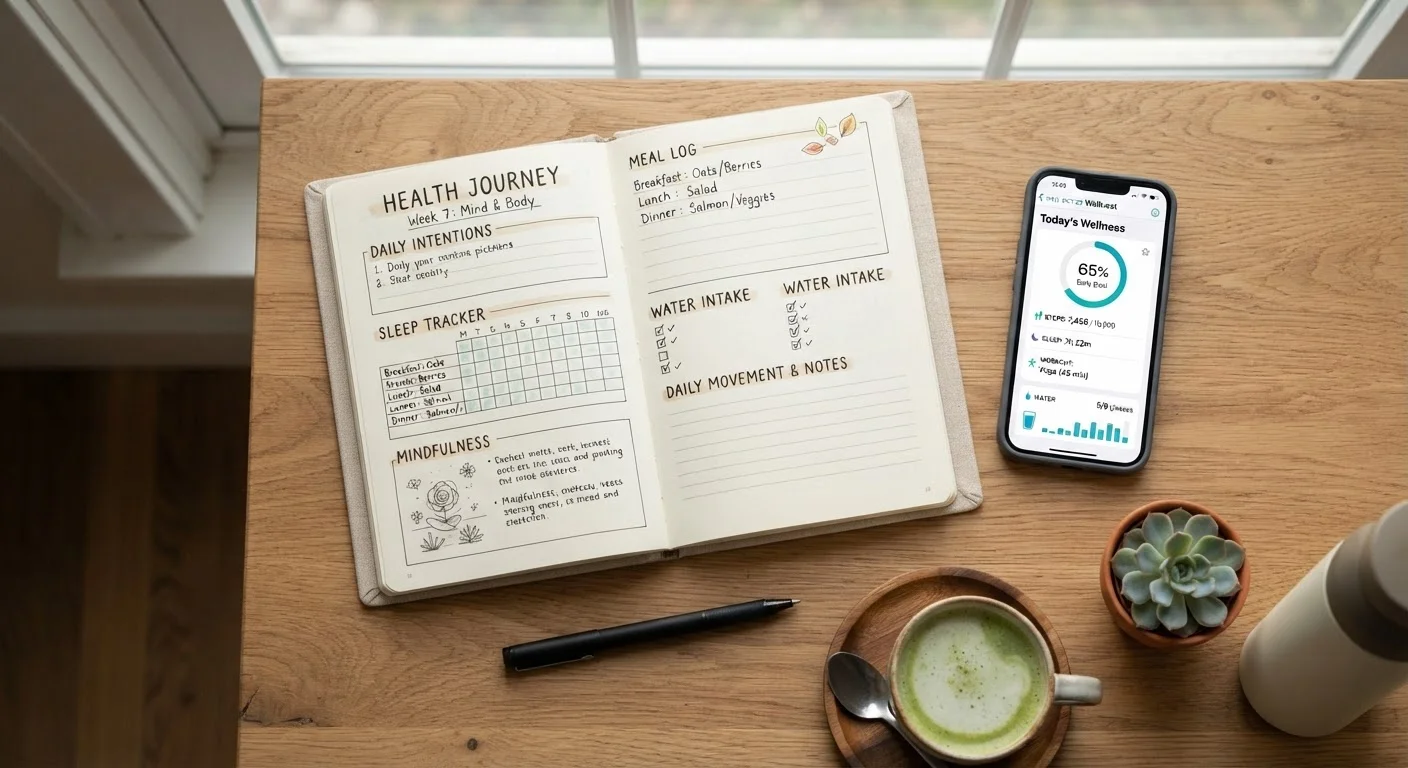
Whether you use a paper journal or a smartphone app is largely a matter of preference. Apps often include reminders, severity scales, and visual graphs; paper is tactile, requires no battery, and suits people who find typing on a phone disruptive. What matters is that the format fits your routine well enough to sustain the habit.
Start Small — One Symptom at a Time
If tracking feels overwhelming, begin with just one symptom that concerns you most. Log its severity and timing daily for two weeks. Once that habit is established, you can add more data points without disrupting your routine. Sustainable consistency beats comprehensive but abandoned logs every time.
How Symptom Tracking Supports Your Healthcare
One of the most practical benefits of symptom tracking is what it brings to a medical appointment. Clinicians often have limited time and rely on patients to describe recent health history accurately. Memory, however, is unreliable — we tend to recall peak experiences (the worst day) rather than representative ones. A written or digital log provides an objective reference point.
Research published in medical literature consistently notes that patient-reported data improves diagnostic accuracy and helps providers spot trends they would not otherwise see in a short office visit. For people managing conditions like migraines, irritable bowel syndrome, or mood disorders — where symptoms fluctuate — this context is especially valuable.
It is important to understand what a tracker cannot do: it cannot diagnose a condition, confirm or rule out a disease, or replace a clinical evaluation. Even the most meticulous log is observational data. See the real limits of self-tracking for a clear breakdown of where the data's usefulness ends.
Getting Started Without Overcomplicating It
A common barrier to starting is the feeling that tracking must be elaborate to be useful. It does not. A simple daily note — symptom, time, severity, and one or two contextual details — is more than sufficient for building a meaningful record over two to four weeks.
Begin with whatever tool you already use: a notes app on your phone, a small notebook, or a dedicated health journal. Commit to logging at the same time each day (morning reviews of the previous day work well for many people) to build the habit. If you find your log isn't generating useful insights after a few weeks, common recording habits that muddy your data are worth reviewing before you give up on the practice entirely.
For a deeper look at matching tracker formats to specific health goals, see general vs. condition-specific symptom trackers. And if you want to build tracking into a sustainable long-term habit, the complete picture of symptom tracking from start to ongoing practice is a useful next step.
This article is for informational purposes only and does not constitute medical advice. Always consult a qualified healthcare professional for guidance on your specific health concerns.