

Key Takeaways
- Raw honey retains more enzymes, antioxidants, and pollen than heat-processed commercial honey.
- Processing extends shelf life and creates a uniform texture but degrades some bioactive compounds.
- Both types share the same basic sugars and caloric content; neither is a low-sugar food.
- Raw honey carries a small risk of Clostridium botulinum spores — it should never be given to infants under 12 months.
- Current evidence supports honey's role as a soothing agent, not a treatment for medical conditions.
- Consult a healthcare professional before using honey as a targeted wellness remedy, especially with existing health conditions.
Option A
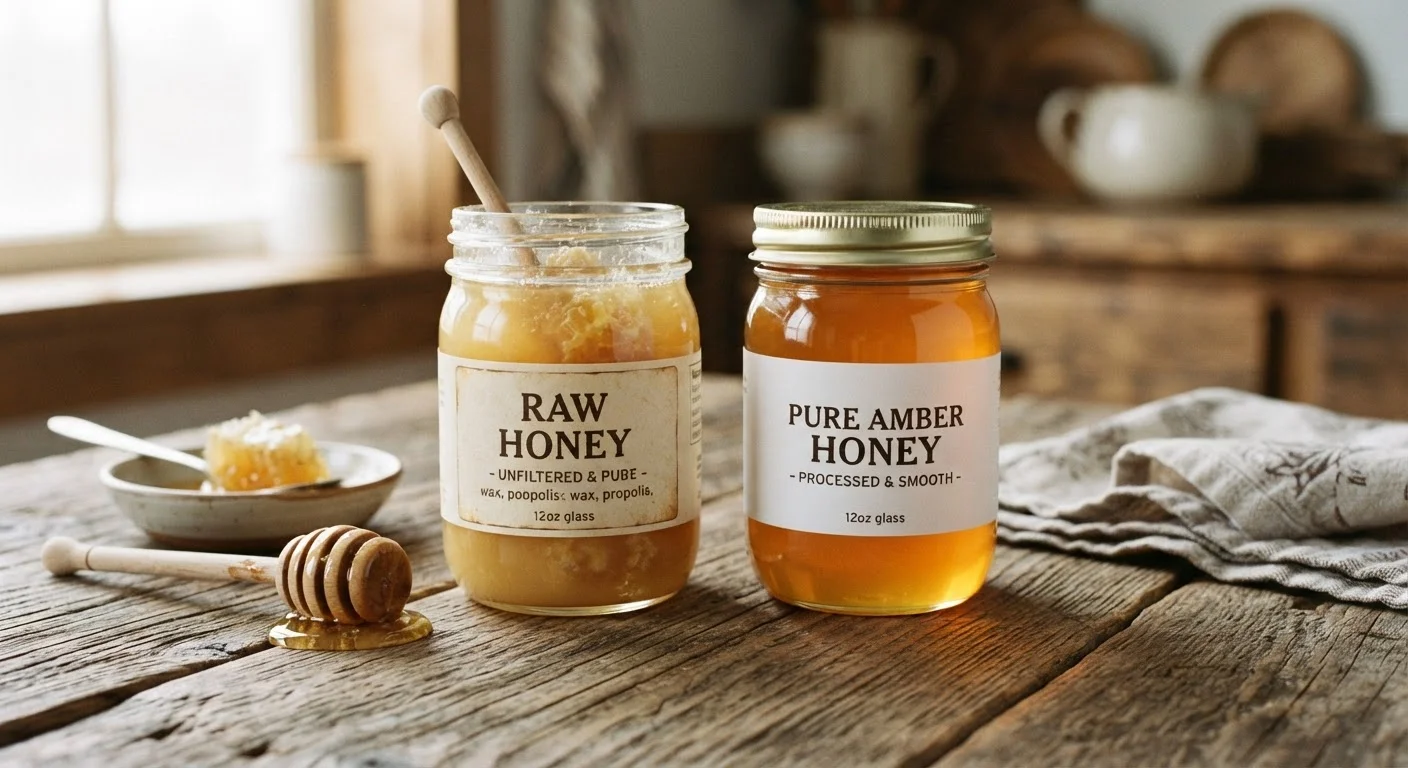
Raw Honey
The minimally processed, nutrient-intact option.
Best for: Those seeking honey's full spectrum of natural compounds, including enzymes, pollen, and antioxidants, for wellness support.
Option B
Processed (Commercial) Honey
The shelf-stable, consistent everyday sweetener.
Best for: General culinary use where smooth texture and long shelf life matter more than preserving heat-sensitive compounds.
If you want maximum retention of natural bioactive compounds
Raw Honey
Raw honey preserves enzymes like diastase and glucose oxidase, along with propolis and bee pollen, which are largely reduced or eliminated by commercial heat treatment.
If you need a versatile, consistent everyday sweetener
Processed (Commercial) Honey
Its uniform texture, clear appearance, and long shelf stability make it practical for cooking, baking, and daily kitchen use.
If you are using honey to soothe a sore throat or minor cough
Raw Honey
Research on honey's soothing properties often uses minimally processed varieties; raw honey's residual antimicrobial activity from hydrogen peroxide production may offer a modest advantage.
If you are preparing food for infants or immunocompromised individuals
Neither — consult a healthcare professional
All honey, raw or processed, may contain Clostridium botulinum spores and is contraindicated for infants under 12 months. Immunocompromised individuals should seek medical guidance before consuming raw honey specifically.
What Processing Actually Does to Honey
Commercial honey typically undergoes two key treatments: heating (pasteurization, usually at temperatures above 140°F/60°C) and fine filtration. Heating prevents fermentation and dissolves crystals for a smooth, pourable product. Filtration removes particles — including pollen, beeswax fragments, and propolis residue — for visual clarity and extended shelf life.
Raw honey, by contrast, is minimally processed. It may be coarsely strained to remove large debris but is not heated above hive temperatures (around 95°F/35°C) and retains its natural particulate matter. This distinction is where the wellness debate begins.
As a reference point, the same processing trade-off applies in other natural products — what processing does to aloe's active compounds follows a similar pattern of convenience versus bioactive retention.
| Criterion | Raw Honey | Processed Honey |
|---|---|---|
| Heat treatment | None (below hive temp) | Pasteurized (140°F+/60°C+) |
| Filtration | Coarse strain only | Fine-filtered, particle-free |
| Enzyme activity | High (intact) | Reduced significantly |
| Antioxidant content | Higher (varies by source) | Lower (heat-degraded) |
| Pollen & propolis | Present | Removed by filtration |
| Texture & appearance | Cloudy, may crystallize | Clear, smooth, pourable |
| Shelf stability | Good (may crystallize faster) | Excellent, longer liquid shelf life |
| Botulinum spore risk | Present (avoid in infants) | Present (avoid in infants) |
| Sugar & calorie content | Equivalent | Equivalent |
What the Research Says About Bioactive Compounds
Studies published in journals such as Food Chemistry and Nutrients consistently find that raw honey contains measurably higher levels of:
- Polyphenols and flavonoids — antioxidants associated with reduced oxidative stress in laboratory and small human studies
- Enzymes (diastase, invertase, glucose oxidase) — glucose oxidase is directly responsible for producing hydrogen peroxide, honey's primary antimicrobial mechanism
- Bee pollen — contains trace amino acids, vitamins, and plant compounds, though quantities in honey are small
Heat treatment measurably reduces enzyme activity and polyphenol content. One frequently cited finding is that commercial honey can lose 30–50% of its antioxidant activity compared to raw equivalents, though results vary considerably by floral source and processing method.
That said, both types retain their basic sugar composition (primarily fructose and glucose) and their caloric density. Neither form is appropriate for frequent, large-quantity consumption from a blood sugar management standpoint.
~30–50%
Antioxidant activity lost in processing
Multiple peer-reviewed studies in Food Chemistry report this range, though variation by floral source is significant.
2021
Year of key systematic review on honey for coughs
A BMJ Evidence-Based Medicine systematic review found honey modestly superior to usual care for upper respiratory symptom relief in adults and children over 12 months.
95°F / 35°C
Approximate natural hive temperature
Raw honey processors aim to stay at or below hive temperature to preserve heat-sensitive enzymes and antioxidants.
Practical Wellness Uses — and Their Real Limits
The most evidence-supported wellness application for honey — regardless of processing — is soothing coughs and sore throats. A 2021 systematic review in BMJ Evidence-Based Medicine found honey was modestly superior to usual care (including some over-the-counter remedies) for upper respiratory tract symptom relief in otherwise healthy adults and children over 12 months. Raw honey was not exclusively studied, but its higher enzyme activity is thought to offer a slight edge.
For topical wound care, medical-grade Manuka honey is the most researched option, used in clinical settings under professional supervision — this is distinct from kitchen honey, raw or otherwise. Do not apply household honey to open wounds without professional guidance.
Understanding honey in context is easier when you consider how minimally processed foods broadly compare to their more refined counterparts — the distinction between whole and ultra-processed foods highlights why processing decisions matter across many food categories.
This article provides general health information only and is not a substitute for professional medical advice. Always consult a qualified healthcare provider before using honey or any natural remedy to address a specific health condition.