

Key Takeaways
- Third-party testing verification is the single most important label check for herbal products.
- Standardized extracts list a marker compound percentage — this matters for potency consistency.
- Regulation of herbal supplements differs significantly from pharmaceutical drugs in the US.
- Country of origin and manufacturing facility details signal quality control rigor.
- Proprietary blends obscure individual ingredient amounts, limiting meaningful comparison.
Summary
22 items · 20–40 minutes
Why Label Literacy Matters for Herbal Buyers
In the US, herbal supplements are regulated as dietary supplements under the Dietary Supplement Health and Education Act (DSHEA) of 1994. This means manufacturers do not need FDA approval before bringing a product to market. The burden of proving a product is unsafe falls on regulators after the fact — not on the company before sale. That regulatory gap makes your own label-reading skills a meaningful line of defense.
If you're new to herbal remedies, the volume of products and the complexity of label language can feel overwhelming. This checklist breaks the evaluation process into concrete, sequential steps — so you know exactly what to look for and what the information actually means.
It's also worth noting upfront: the word "natural" on a label carries no regulatory definition and offers no safety guarantee. For a clearer framework on that specific issue, see our article on the natural-equals-safe reasoning error.
Supplements Are Not Reviewed for Safety Before Sale
Unlike prescription drugs, dietary supplements — including all herbal products — do not require FDA approval before reaching store shelves in the US. The manufacturer is responsible for product safety, and recalls happen reactively. Third-party testing seals are currently the most reliable independent signal that a product has been evaluated for identity, purity, and potency. Do not assume a product is safe or accurately labeled simply because it is legally sold.
What You'll Need Before You Start
This checklist works best when you have the physical product — or a high-resolution image of all label panels — in front of you. Some information (such as third-party certificates of analysis) may require a quick online search or a scan of a QR code on the packaging. Budget 5–10 minutes per product for a thorough review.
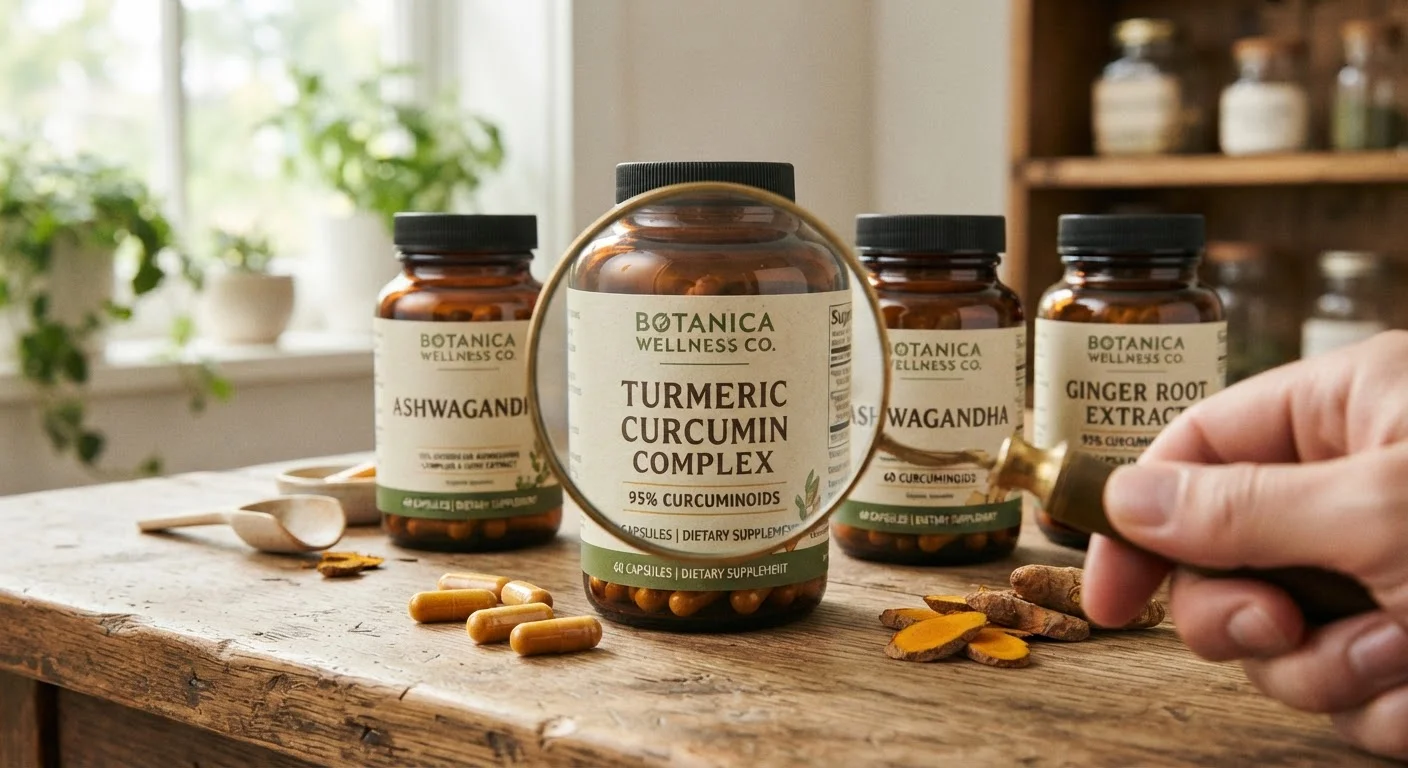
Magnifying glass or smartphone camera zoom
Allows you to read fine-print ingredient lists, lot numbers, and certification text clearly.
ConsumerLab, USP, or NSF International verification lookup
Lets you independently confirm whether a product or brand holds a current third-party certification.
NIH National Center for Complementary and Integrative Health (NCCIH) website
Provides evidence summaries for specific herbs to cross-reference label claims against available research.
FDA Dietary Supplement Label Database
A free public database where you can look up label contents for many products already on the US market.
Product QR code scanner (phone camera)
Accesses batch-specific Certificates of Analysis or the manufacturer's sourcing disclosures directly from the packaging.
Using This Checklist
Work through each group in order. The first two groups — identity verification and third-party testing — are non-negotiable checks that address safety. The remaining groups cover quality signals and sourcing factors that help you compare products meaningfully. Understanding how the supplement is formulated also depends on the delivery format; for context on how capsules, tinctures, teas, and standardized extracts differ in practice, see our comparison of herbal supplement forms.
Identity & Botanical Accuracy
Third-Party Testing & Certification
Standardization & Extract Information
Ingredient Transparency
Manufacturing & Sourcing
Claims, Warnings & Expiry
Proprietary Blends Limit Your Ability to Evaluate Dose
When a label groups multiple herbs under a single "proprietary blend" total weight, you cannot determine how much of any individual ingredient is present. This makes it impossible to assess whether a meaningful amount of the key herb is actually included. Prioritize products that list each ingredient's amount individually, especially if an herb's safe use is dose-dependent.
This article is for general informational and educational purposes only and does not constitute medical advice. Always consult a qualified healthcare professional before starting, stopping, or changing any supplement regimen, particularly if you are pregnant, nursing, caring for a child, or managing a medical condition.