
Forms of Herbal Supplements: Tinctures, Capsules, Teas, and Standardised Extracts Compared

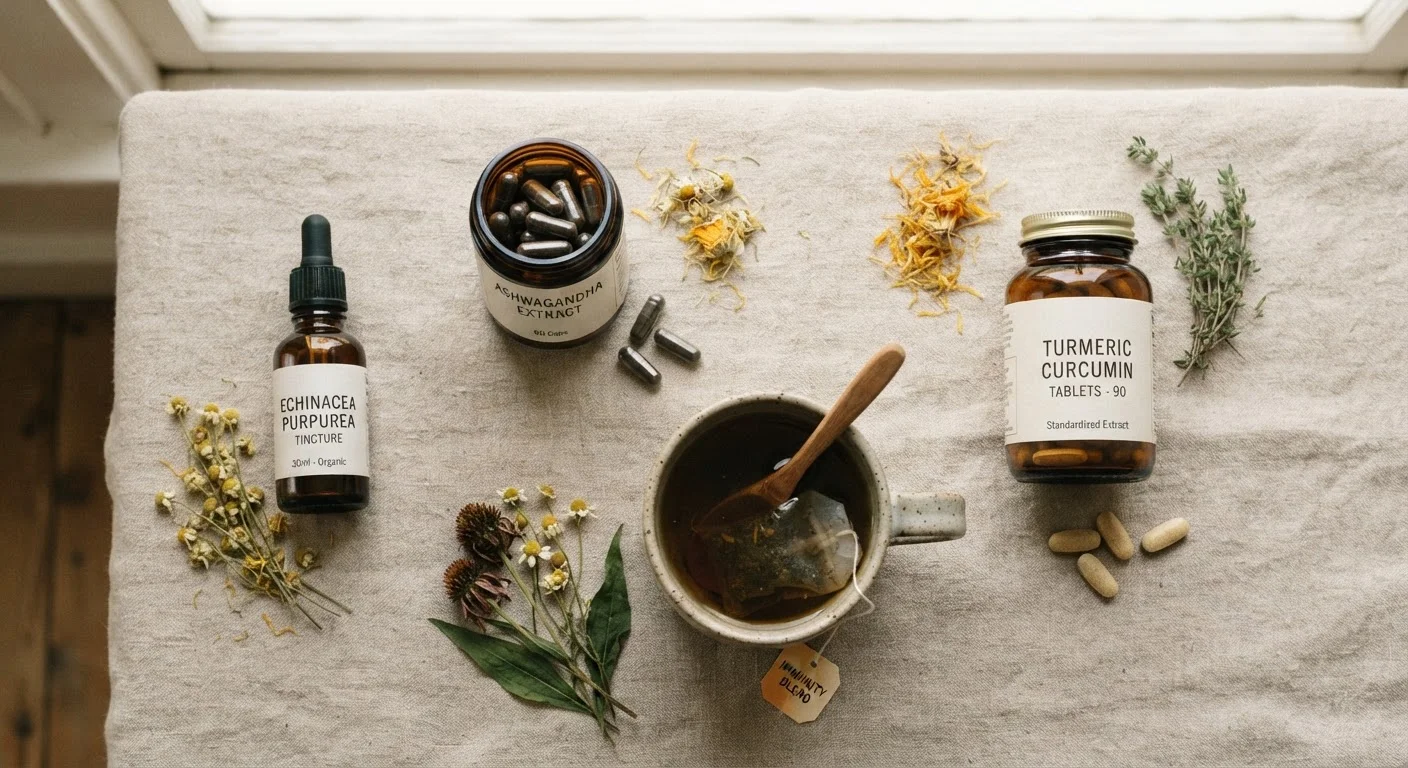
Key Takeaways
- The same herb in different forms can vary significantly in potency, absorption speed, and active compound concentration.
- Standardised extracts offer the most consistent dosing, making them the closest to what clinical studies typically evaluate.
- Tinctures absorb quickly and allow flexible dosing, but alcohol content and taste are practical considerations.
- Herbal teas are mild, accessible, and ritualistic, but water-insoluble compounds may not transfer well to the cup.
- Capsules are convenient and tasteless, though quality varies widely depending on whether the herb is standardised or simply powdered.
- No single form is universally superior — the right choice depends on the herb, intended use, and individual preference.
Our Verdict
Each herbal form has a legitimate place depending on your goal. Standardised extracts provide the most reproducible potency and are best supported by clinical research. Tinctures offer flexibility and fast uptake. Teas suit mild, water-soluble herbs and daily ritual. Capsules win on convenience when they contain a standardised or well-characterised extract rather than raw powder alone.
| Best for | Recommended |
|---|---|
| Those who want consistent, research-aligned potency | Standardised Extracts |
| Those who want fast absorption and adjustable amounts | Tinctures |
| Those who prefer a gentle, ritualistic daily habit | Herbal Teas |
| Those prioritising convenience and taste-free intake | Capsules (standardised) |
Why the Form of an Herb Actually Matters
Walking into a health food store, you'll often find the same herb — valerian, echinacea, ashwagandha — available as a tea, a liquid tincture, a capsule, and a standardised extract tablet. These aren't interchangeable. The preparation method determines which plant compounds are extracted, how concentrated they are, how quickly your body absorbs them, and how reliably you get the same amount each time.
If you're new to herbal remedies, understanding these distinctions is foundational. For experienced users, it's often the key to explaining why a remedy seemed to work in one form but not another.
| Tinctures | Capsules | Herbal Teas | Standardised Extracts | |
|---|---|---|---|---|
| Potency consistency | Moderate — varies by batch | Low to high — depends on type | Low — variable by prep | High — guaranteed marker level |
| Absorption speed | Fast (sublingual or liquid) | Moderate (capsule breakdown) | Moderate (liquid form) | Moderate (tablet/capsule) |
| Compound range extracted | Broad (alcohol solvent) | Whole plant or partial | Water-soluble only | Targeted to key constituents |
| Ease of dosing | Flexible (drops/mL) | Fixed per capsule | Variable (steep/quantity) | Fixed per tablet or capsule |
| Taste and palatability | Often strong/bitter | Tasteless | Pleasant to mild | Tasteless (tablet/capsule) |
| Research alignment | Partial | Partial (if standardised) | Rarely matches studies | Closest to clinical evidence |
| Suitability for alcohol avoidance | Limited (check solvent) | Yes | Yes | Yes |
Tinctures: Fast-Acting and Flexible
A tincture is a concentrated liquid extract made by soaking plant material in a solvent — typically alcohol, glycerin, or a combination. Alcohol is the most common because it pulls a wider range of plant constituents than water alone, including resins and alkaloids that wouldn't dissolve in a tea.
Tinctures are typically absorbed more rapidly than capsules or tablets because the liquid is taken under the tongue or swallowed without the delay of capsule breakdown. This makes them a practical option when faster onset is desirable. Dosing is also flexible — measured in drops or millilitres — allowing gradual adjustment.
The drawbacks are real: many tinctures taste intensely bitter or astringent, and those made with alcohol are unsuitable for people avoiding alcohol, including those in recovery or with certain health conditions. Glycerin-based alternatives exist but may extract a narrower compound profile. Always check the solvent type on the label.
Matching the Form to the Herb
Some herbs are well-suited to specific forms based on their chemistry. Peppermint and chamomile work well as teas because their active volatile compounds are water-soluble. Herbs like ashwagandha and milk thistle are more reliably delivered as standardised extracts, since their key compounds require more than hot water to extract consistently. Before choosing a form, it's worth checking what delivery method was used in the research supporting that herb's claimed benefits.
Capsules and Tablets: Convenient but Variable
Capsules are arguably the most familiar form — they're tasteless, portable, and easy to incorporate into an existing supplement routine. However, the term "capsule" covers a wide spectrum. A capsule may contain raw dried herb powder, a simple dried extract, or a fully standardised extract. These are meaningfully different products.
Raw herb powder in a capsule delivers the whole-plant profile but with naturally variable potency — the concentration of active compounds fluctuates depending on the plant's growing conditions and harvest time. A standardised extract capsule, by contrast, is adjusted during processing to guarantee a specified level of a key marker compound (such as 5% withanolides in ashwagandha). This is far more reproducible.
When evaluating any capsule product, reading the label carefully is essential. Look for whether the herb is standardised, what compound it's standardised to, and whether third-party testing is indicated.
Herbal Teas and Infusions: Gentle and Accessible
Hot water extraction — the basis of any herbal tea — is one of the oldest preparation methods in existence. It works well for herbs whose beneficial compounds are water-soluble: volatile aromatic oils, many polyphenols, and mucilaginous compounds. Chamomile, peppermint, and lemon balm are good examples of herbs that translate well into tea form.
The limitation is that water cannot extract fat-soluble or alcohol-soluble compounds. Some herbs widely consumed as tea — such as valerian or St. John's Wort — yield relatively low concentrations of their clinically studied constituents through simple steeping. For these herbs, a tea may provide a pleasant ritual with mild effects, but is unlikely to match the potency studied in clinical trials.
Preparation also makes a difference. Steeping time, water temperature, and herb quantity all affect how much you extract. A weakly brewed tea from a low-quality herb source may deliver very little of what you're seeking.
Standardised Extracts: The Closest to Clinical Evidence
Standardised extracts are processed to guarantee a minimum concentration of one or more specific marker compounds. For example, ginkgo biloba extracts used in research are typically standardised to 24% flavone glycosides and 6% terpene lactones. When a study tests "ginkgo," it almost always uses a standardised extract — which is worth bearing in mind when interpreting that research for non-standardised forms.
Standardisation has critics: some argue that isolating a single marker compound ignores the synergistic effect of the whole plant. This is a legitimate debate in herbal pharmacology, and the science is genuinely unsettled for many herbs. Nonetheless, standardised extracts currently offer the best available bridge between research findings and consumer products.
For a broader perspective on how herbal medicine sits within the evidence landscape, see the full-spectrum guide to herbal medicine.
This article is for general informational purposes only and does not constitute medical advice. Always consult a qualified healthcare professional before starting any herbal supplement, particularly if you are pregnant, nursing, taking medications, or managing a chronic health condition.