

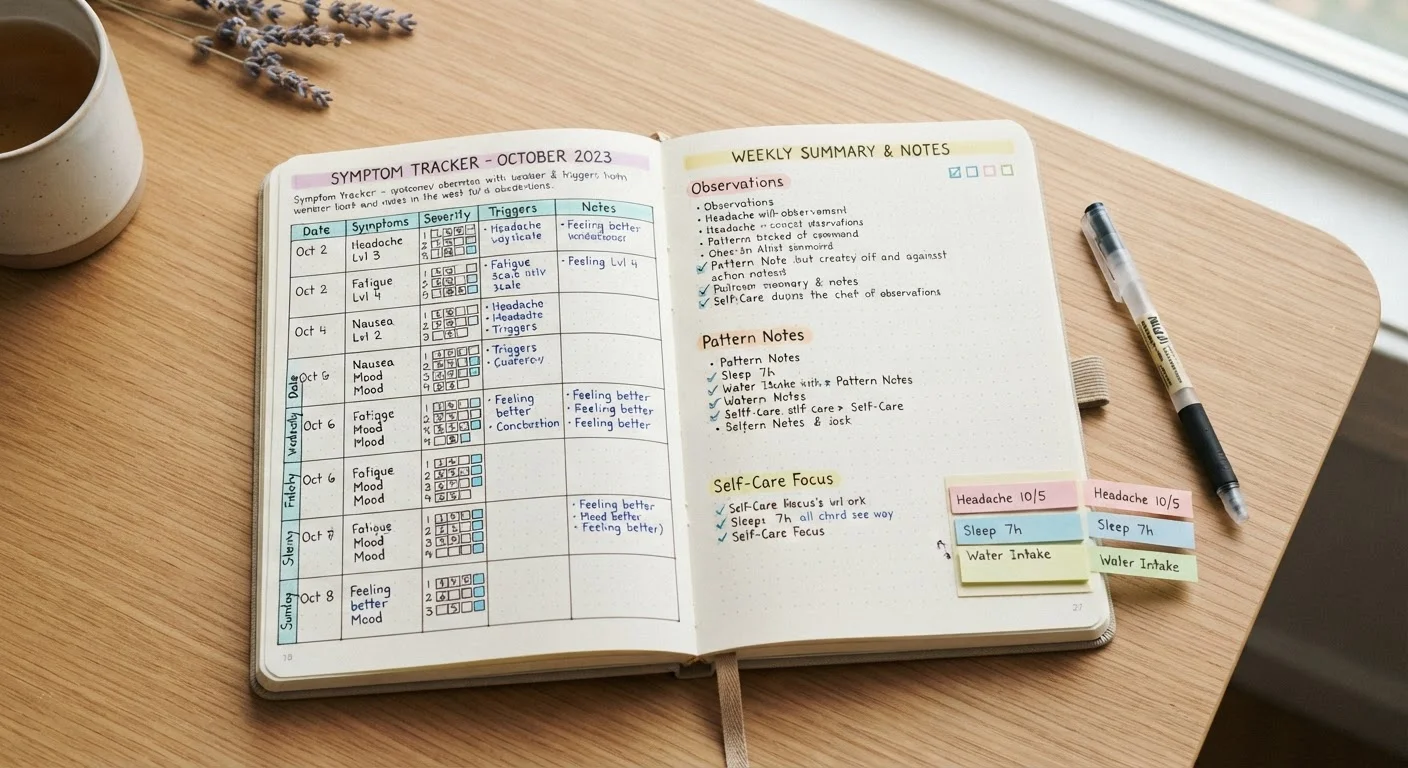
| Primary purpose of symptom tracking | Identify patterns in how you feel over time |
| Recommended tracking frequency | Daily entries produce the most reliable patterns |
| Most commonly tracked variables | Severity, onset time, duration, and potential triggers |
| Minimum log period for pattern detection | Typically 2–4 weeks of consistent entries |
| Who benefits most | People managing chronic or recurring conditions |
Why Symptom Tracking Has Its Own Vocabulary
If you've ever opened a health app or a symptom tracking guide and hit a wall of unfamiliar terms—baseline, flare, trigger, prodrome—you're not alone. Symptom tracking has developed its own shorthand, borrowed partly from clinical medicine and partly from patient communities. Knowing what these words mean helps you log information more precisely and get more out of your data when you review it.
This glossary covers the terms you're most likely to encounter, whether you're using a dedicated app, a paper journal, or a spreadsheet. For a broader overview of how symptom tracking works and why it's worth doing, see our guide to symptom trackers.
Baseline
Your personal 'normal'—the typical state of your health when no active symptoms are present. Establishing a baseline gives you a meaningful comparison point so you can recognize when something has genuinely changed.
Symptom
Any subjective change in how your body or mind feels that you notice and can report, such as pain, fatigue, nausea, or brain fog. Symptoms differ from signs, which are objective measurements a clinician observes.
Trigger
A factor—food, activity, stress, environment, or another variable—that appears to provoke or worsen a symptom. Identifying triggers is one of the core goals of consistent symptom tracking.
Severity
A measure of how intense a symptom feels, often rated on a numeric scale (such as 1–10) or descriptive range (mild, moderate, severe). Tracking severity over time shows whether a condition is improving, stable, or worsening.
Onset
The moment or time period when a symptom first appears. Recording onset precisely helps identify time-of-day patterns and connections to recent activities or exposures.
Duration
How long a symptom lasts from onset to resolution. Duration data helps distinguish brief, self-limiting episodes from longer-lasting or recurring problems.
Flare
A period when symptoms become noticeably more intense or frequent than your baseline, often after a period of relative calm. The term is commonly used in the context of chronic conditions.
Prodrome
Early warning sensations that precede a full symptom episode—such as visual disturbances before a migraine. Recognizing your prodrome can give you a window to take action before symptoms peak.
Resolution
The point at which a symptom ends or returns to your baseline. Logging resolution alongside onset completes the arc of an episode and makes duration easy to calculate.
Frequency
How often a symptom occurs within a given time frame (e.g., twice a week, three times a month). Frequency trends can signal whether a condition is changing even when individual episodes feel similar.
Comorbid Symptom
A symptom that occurs at the same time as another, often related symptom. Tracking co-occurring symptoms helps uncover connections that might otherwise go unnoticed.
Aggravating Factor
Anything that makes an existing symptom worse without necessarily causing it. Distinguishing aggravating factors from triggers helps you manage symptoms more precisely.
Using These Terms to Build Clearer Logs
Knowing the vocabulary is only half the value—the other half is applying it consistently in your entries. A few practical tips:
- Record your baseline early. Before patterns emerge, note what a typical, low-symptom day feels like for you. This becomes your reference point for everything else.
- Label severity every time. Whether you use a 1–10 scale or descriptive words (mild, moderate, severe), apply the same scale consistently so your data stays comparable across weeks.
- Capture suspected triggers immediately. Memory fades fast. Noting what you ate, where you were, or how you slept right after a symptom appears is far more reliable than reconstructing it later.
- Note onset and duration separately. When a symptom started and how long it lasted are different data points, and both matter when you're looking for patterns.
Once your log has a few weeks of entries, terms like prodrome and resolution become genuinely useful—they let you describe the full arc of a symptom episode, not just its peak. That fuller picture is what makes your notes valuable when sharing with a healthcare provider.
For guidance on exactly which details to include in each entry, see our log-building reference. When you're ready to start spotting meaningful patterns across your entries, this pattern-analysis walkthrough can help.
These Terms Are Starting Points, Not Diagnoses
Using precise vocabulary in your symptom log makes your notes clearer and more useful—but the terms themselves don't explain why a symptom is happening. Symptom tracking is a tool for gathering information, not for reaching medical conclusions. Always discuss patterns you notice with a qualified healthcare provider who can interpret them in the context of your full health history.
This article is for informational purposes only and is not medical advice. If you are experiencing persistent or severe symptoms, consult a qualified healthcare professional.