

Key Takeaways
- Consistent symptom tracking turns vague feelings into concrete, reviewable data your provider can act on.
- You don't need a complex app — a simple notebook with date, symptom, and severity is a valid starting point.
- Contextual details like sleep, stress, and food often reveal triggers that symptoms alone won't show.
- Bringing organized logs to appointments significantly shortens diagnostic timelines.
- Tracking should reduce health anxiety, not amplify it — recognize when logging becomes counterproductive.
- Start small, stay consistent, and refine your method over time rather than aiming for perfection immediately.
Why Symptom Tracking Matters
Memory is a surprisingly unreliable health tool. When a doctor asks how often your headaches occur or how severe last week's fatigue felt, most people can only offer rough guesses. Symptom tracking replaces those guesses with a factual record — dates, intensities, durations, and surrounding circumstances that no amount of trying-to-remember can replicate.
Research consistently shows that patients who arrive at appointments with organized symptom logs receive more targeted evaluations. They are better positioned to distinguish a pattern — say, bloating that reliably follows specific meals — from a random bad day. Over time, this kind of structured self-observation is foundational to identifying triggers, monitoring the progression of a chronic condition, and evaluating whether a lifestyle change is actually working.
Before diving into methods, it helps to understand the vocabulary. Our plain-language glossary of symptom tracking terms explains concepts like baseline, trigger, and flare in everyday language.
~80%
Diagnoses aided by patient history
Clinical literature widely estimates that a thorough patient history — including symptom patterns — contributes to approximately 80% of diagnoses, underscoring the value of accurate self-reporting.
2–4 weeks
Minimum useful data window
Most clinicians suggest at least two to four weeks of consistent entries before symptom logs reveal actionable patterns for common episodic conditions.
1 in 3
Chronic condition patients using digital tracking
Survey data from the Pew Research Center found roughly one in three U.S. adults with chronic conditions tracked a health indicator digitally — a figure that has grown with smartphone adoption.
What to Track and How to Start
The most common beginner mistake is trying to log everything at once. Start with three core data points for each entry:
- What: Name the symptom as specifically as you can — not just "pain" but "dull pressure behind my left eye."
- When and how long: Time of onset and approximate duration.
- How bad: A simple 1–10 severity scale applied consistently is far more useful than descriptive words that shift in meaning day to day.
Once those three feel routine — typically after one to two weeks — add one or two contextual variables that seem relevant to your situation: sleep hours the night before, stress level, meals, physical activity, or menstrual cycle phase if applicable. Context is where patterns emerge. A headache that reliably scores 7 or higher after fewer than six hours of sleep tells a very different story than one with no detectable pattern at all.
Use a single, fixed severity scale from your very first entry and never change it mid-log — even if it feels imprecise at first. Consistency across entries matters far more than precision on any individual day.
A shifting scale makes trend analysis meaningless. A stable 1–10 rating applied over months allows you and your provider to spot genuine changes rather than artifacts of how you happened to describe things that week.
Log a potential trigger at the same time you log the symptom, not after you have already decided there is a connection. Recording both simultaneously keeps the data honest and prevents confirmation bias from shaping your entries.
Retrospective trigger attribution is a well-documented source of error in self-reported health data. Capturing context in real time produces a more accurate picture of what actually precedes your symptoms.
Choosing Your Tracking Method
There is no universally superior format. The best method is the one you will actually use consistently. Common options include:
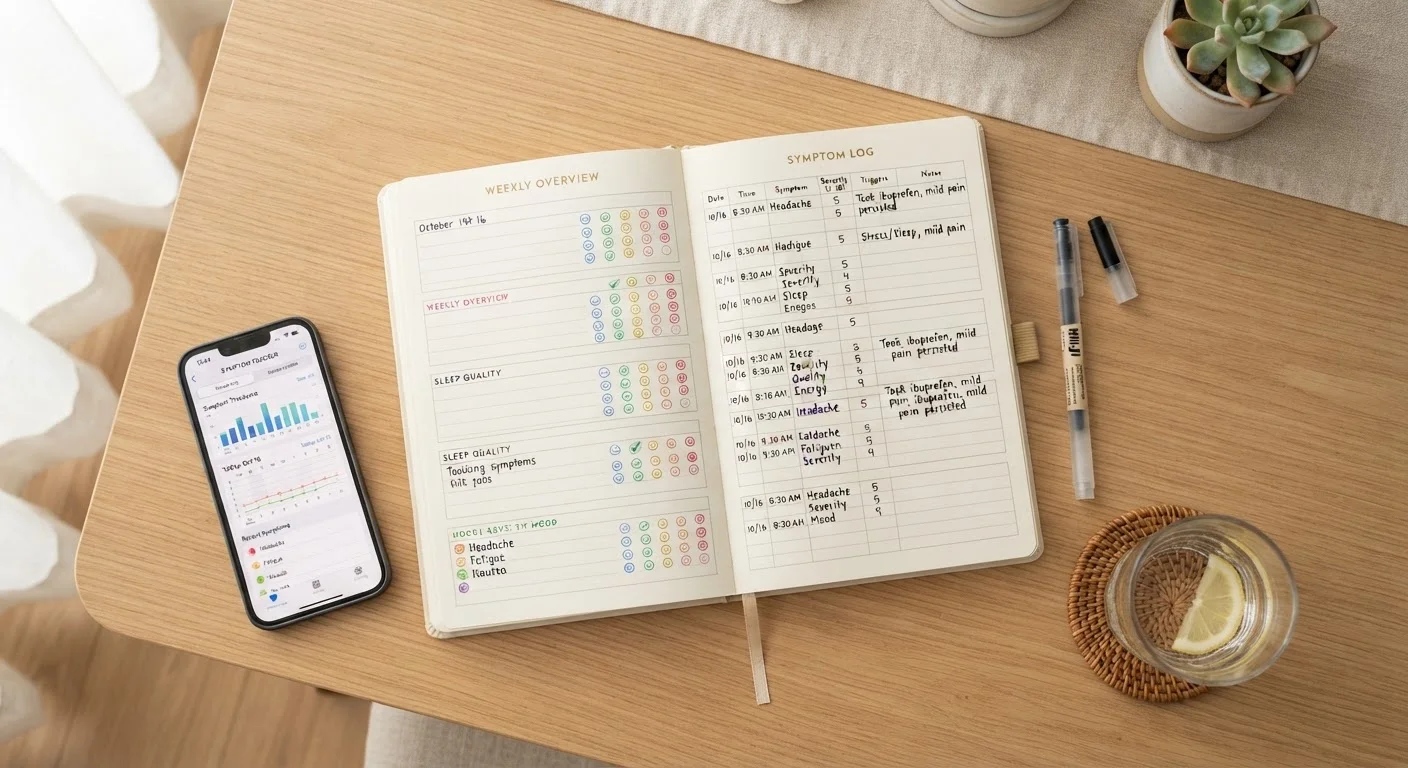
- Paper journal or notebook
- Low friction, no battery, fully private. A dedicated small notebook kept on a nightstand works well for end-of-day logging.
- Spreadsheet
- Easy to sort, filter, and share with a provider. Useful if you are tracking multiple variables across time.
- Health apps
- Many general wellness apps allow custom symptom fields. Condition-specific apps (for migraines, gut health, or joint pain, for example) include built-in prompts that reduce the mental load of deciding what to record each day.
Whichever format you choose, set a consistent daily logging time — not necessarily the moment a symptom strikes, but a predictable anchor like after dinner or before bed. Habitual timing dramatically improves follow-through.
Reading Your Own Patterns
After two to four weeks of entries, step back and look for patterns rather than individual data points. Ask:
- Do symptoms cluster around certain days of the week, times of day, or life events?
- Do severity scores trend up or down over time?
- Is there a consistent gap between a potential trigger (a food, a stressful event, a poor night's sleep) and symptom onset?
Color-coding entries by severity or using a simple weekly summary table can make patterns visible at a glance. Note what is absent as well — symptom-free days are data too, and understanding what preceded them is just as informative as understanding what preceded a flare.
Be careful not to over-interpret short stretches of data. Two weeks of entries is a useful starting point, but most meaningful patterns require at least a month — and for conditions with monthly cycles, even longer.
Sharing Data With Your Healthcare Provider
A symptom log is most powerful when it bridges your daily experience and your provider's clinical assessment. Before an appointment, distill your log into a one-page summary: the top two or three symptoms you want to discuss, their frequency and severity ranges, and any patterns or triggers you have noticed.
Providers generally find summarized data more actionable than raw logs. Saying "I had 11 headache episodes over six weeks, nine of them following fewer than six hours of sleep, with an average severity of 6.5" is far more clinically useful than handing over a notebook and asking them to find the thread.
Urgent Symptoms Require Immediate Care
Symptom tracking is designed for monitoring ongoing or recurring patterns — it is not a substitute for emergency medical evaluation. If you experience sudden chest pain, shortness of breath, signs of stroke, or any symptom that feels severe and unfamiliar, contact emergency services or go to an emergency room immediately. Do not wait to log it first.
If your symptoms are new, sudden, or severe — chest pain, difficulty breathing, sudden vision changes, or neurological symptoms — do not rely on a tracking log. Seek immediate medical attention.
Sustaining Tracking as a Long-Term Habit
The hardest part of symptom tracking is not starting — it is continuing past the first month. Motivation is high at the beginning; sustaining the habit through uneventful stretches or busy periods requires a different approach.
Tie logging to an existing daily ritual rather than treating it as a standalone task. Keep your method as simple as possible — a two-line entry beats a detailed log you abandon. Review your entries weekly rather than just adding to them; the act of looking back reinforces the habit's value. And give yourself explicit permission to log "nothing notable today" rather than skipping an entry, which preserves the chain without demanding unnecessary effort.
For those managing a chronic condition, periodic provider check-ins that reference your log can sustain motivation by making the effort feel purposeful and connected to real care decisions.
Knowing When to Adjust or Step Back
Symptom tracking is a tool, not a moral obligation. If logging begins to feel compulsive, if you notice it amplifying worry rather than reducing it, or if reviewing your entries consistently raises anxiety without producing useful insight, that is a signal worth taking seriously.
Our related articles explore both sides of this boundary. When symptom tracking becomes counterproductive covers the signs that your logging habit may be working against you. For a broader look at the trade-offs, wellness tracking: when it helps and when it becomes its own stressor weighs the benefits against the risks of daily health monitoring.
Adjusting is not quitting. Scaling back to weekly entries, switching formats, or pausing and resuming around symptom flares are all legitimate strategies. The goal is a sustainable practice that genuinely supports your wellbeing — not a perfect log.
This article is for general informational and educational purposes only and does not constitute medical advice. Always consult a qualified healthcare professional for guidance specific to your health situation.