

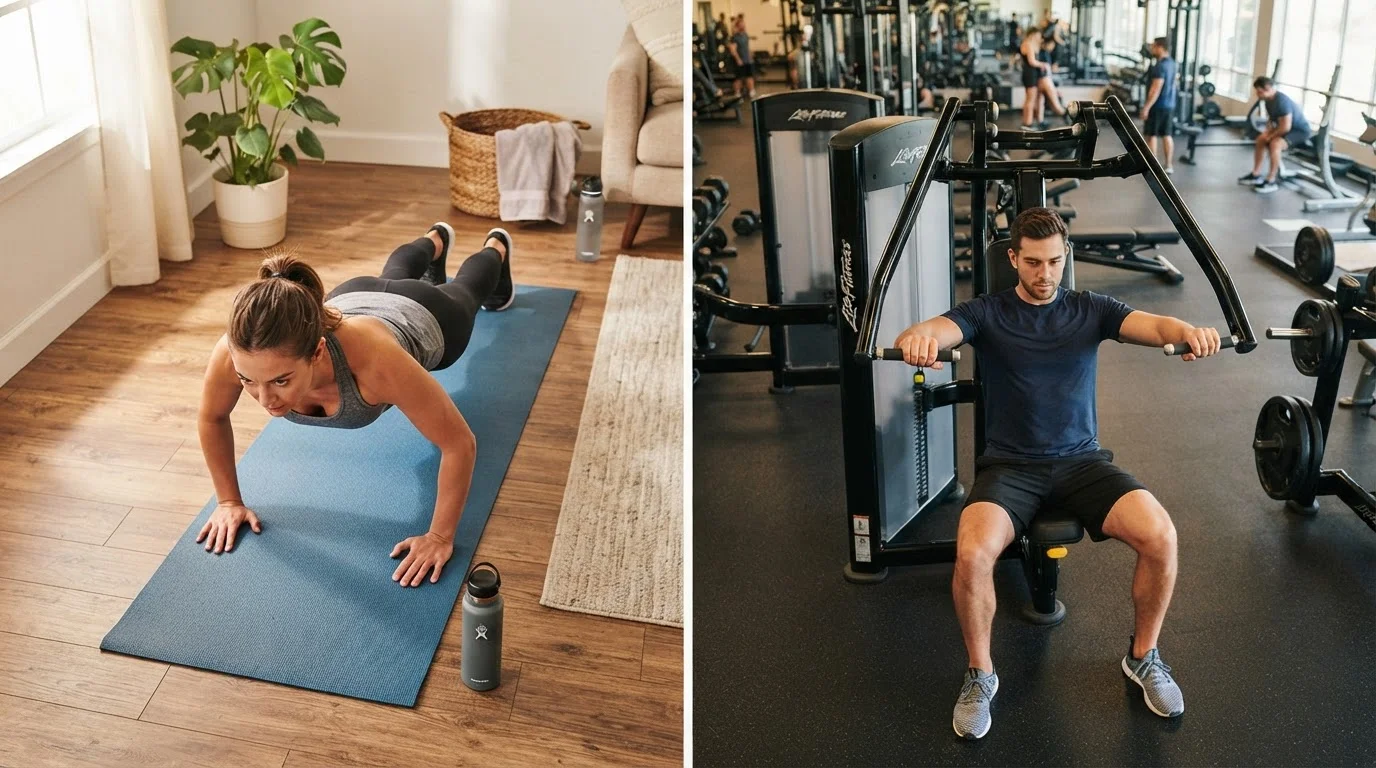
Key Takeaways
- Effective fitness is achievable at home with no equipment — bodyweight training covers the core movement patterns.
- Gyms offer equipment variety and social energy, but cost and commute time are real barriers for many people.
- Convenience is a major driver of consistency; the environment you'll actually use regularly is the right one.
- Home training suits most fitness goals, from fat loss to strength, when programmed with intention.
- Neither setting is universally superior — your schedule, budget, and motivation style should guide the choice.
Our Verdict
For most busy adults, home training is a fully viable path to lasting fitness — lower cost, zero commute, and consistent access remove common barriers to exercise. Gyms still offer genuine advantages in equipment range and social atmosphere, particularly for those pursuing advanced strength goals or who need external accountability. The honest answer is that the best training environment is the one you'll show up to consistently.
| Best for | Recommended |
|---|---|
| Those prioritizing cost savings and convenience | Home Training |
| Those who thrive on social energy and need access to heavy loads | Gym Training |
| Beginners building a routine from scratch | Home Training |
| Athletes targeting specific strength or sport performance benchmarks | Gym Training |
The Real Question: What Actually Drives Results?
Before comparing settings, it helps to know what actually produces fitness gains. Exercise science consistently points to a handful of variables: progressive overload (gradually increasing challenge), movement variety, adequate recovery, and — most critically — consistency. Neither a gym membership nor a spare bedroom guarantees those outcomes. Your environment shapes how easily you can deliver them.
The framing that a gym is necessary for serious training doesn't hold up. Bodyweight exercises like push-ups, squats, lunges, and hip hinges cover the foundational movement patterns that build functional strength, cardiovascular fitness, and mobility. If you're starting out or maintaining general health, these patterns are sufficient. The question becomes more nuanced for people with advanced performance goals — but for the majority of busy adults, home training closes the gap more than most expect.
For a structured approach to training from home, see The Complete Framework for Home-Based Fitness, which covers programming, progression, and recovery in full.
Side-by-Side: Home vs. Gym Across Key Criteria
The comparison below breaks down both environments across the factors that matter most to everyday exercisers — cost, convenience, equipment access, motivation, and flexibility.
| Home Training | Gym Training | |
|---|---|---|
| Monthly Cost | $0–$20 (minimal or no gear) | $30–$80+ (membership fees) |
| Convenience | Highest — no commute, 24/7 access | Moderate — commute and hours required |
| Equipment Range | Limited without investment | Extensive — barbells, cables, machines |
| Social Motivation | Low — self-directed | High — ambient energy and community |
| Space Required | Minimal — 6×6 ft sufficient | None at home — gym provides it |
| Flexibility of Schedule | Total flexibility | Constrained by gym hours and crowds |
| Beginner Friendliness | High — low intimidation | Variable — can feel overwhelming |
A few of these rows deserve closer attention. Cost is where home training wins decisively: average gym memberships in the US range from roughly $30 to $60 per month, before factoring in initiation fees, travel, or childcare. Home training can start at zero. Convenience is similarly lopsided — eliminating a commute removes one of the most common reasons people skip workouts.
Equipment range is where gyms hold a genuine edge. Barbells, cable machines, and heavy dumbbells enable loading patterns that bodyweight alone cannot fully replicate — particularly for lower-body strength beyond a moderate level. That said, creative programming (single-leg variations, tempo manipulation, isometric holds) extends bodyweight training further than most beginners realize.
Motivation, Accountability, and the Social Factor
One underrated gym advantage is ambient motivation — being surrounded by people exercising can make it easier to start and stay focused. For some, this social energy is genuinely important. Research in exercise psychology consistently shows that perceived social support improves exercise adherence, and a gym environment can provide that passively.
Home training, by contrast, places more responsibility on self-directed motivation. Distractions are higher: household tasks, family members, screens. This doesn't make home training inferior, but it does mean structure matters more. A designated space and a fixed schedule help significantly. If you're ready to create that structure, Starting Home Workouts When You've Never Had a Routine walks through the process from zero experience.
Build a Consistent Trigger at Home
One effective strategy for home motivation is anchoring your workout to an existing daily habit — like exercising immediately after your morning coffee or before your lunch break. A fixed start cue reduces the mental effort of deciding when to train. Laying out your workout clothes the night before is a small action that meaningfully lowers the threshold to start.
It's also worth being honest about gym motivation patterns: many people pay for memberships they use inconsistently. The social benefit only materializes if you actually go. Home training, once the habit is formed, often achieves higher weekly frequency simply because friction is lower.
Practical Considerations: Space, Safety, and Progress Tracking
Home training doesn't require a dedicated room. A 6×6 foot clear floor area covers the majority of bodyweight movements. If you're unsure how to set up a functional space, Setting Up a Home Workout Space That Won't Frustrate You offers practical, no-fuss guidance for small spaces.
Safety at home is a valid consideration — there's no staff or trained spotter if something goes wrong. For most bodyweight and light-resistance training, risks are low. Using proper form and progressing gradually remains sound advice regardless of location.
Tracking progress without gym machines is straightforward: rep counts, timed holds, movement quality, and consistency logs all provide reliable feedback. Tracking Progress Without a Gym Machine or Fitness Tracker covers these methods in detail. And if you want a candid picture of where home-only training has real limits, The Hidden Downsides of Only Training at Home is worth reading alongside this comparison.
This article is for general informational purposes only and does not constitute medical or professional fitness advice. Consult a qualified healthcare provider before beginning any new exercise program, particularly if you have existing health conditions.