

Key Takeaways
- Effective home workouts require no equipment, gym membership, or dedicated workout space.
- Five fundamental movement patterns — push, pull, hinge, squat, and carry — cover most of what your body needs.
- Short, consistent sessions beat occasional intense ones for building lasting fitness habits.
- Structuring workouts around your existing schedule dramatically improves follow-through.
- Soreness and slow progress are normal early signs that your body is adapting, not failing.
Start here
Why Home Workouts Work for Beginners
Build your foundation
The Five Movement Patterns You Actually Need
Plan it out
Building Your First Realistic Routine
Make it stick
How to Stay Consistent Without Willpower
Set expectations
What to Expect in Your First Few Weeks
Why Home Workouts Work for Beginners
The gym can feel overwhelming when you're starting from zero — unfamiliar machines, unwritten etiquette, and the pressure of working out around experienced exercisers. Home removes all of that friction. You control the environment, the schedule, and the pace.
More importantly, research consistently shows that exercise adherence — actually sticking to movement over time — is the single strongest predictor of fitness outcomes. A modest routine you follow reliably produces far better results than an ambitious program you abandon. Home workouts lower the barrier to entry enough that beginners are more likely to keep going.
For a broader picture of how home training fits into an overall fitness approach, see the complete framework for home-based fitness.
Progressive overload
Gradually increasing the challenge of an exercise over time — through more reps, slower tempo, or harder variations — so your body continues to adapt and strengthen.
DOMS
Delayed onset muscle soreness: the aching feeling in muscles 24–48 hours after exercise. It's a normal, temporary response to new or increased movement demands.
Movement pattern
A category of motion your body performs — like pushing or squatting — that a wide range of individual exercises belong to. Training patterns ensures balanced whole-body development.
Bodyweight training
Exercise that uses your own body as the only resistance, requiring no equipment. Squats, push-ups, and planks are common examples.
Habit loop
The cue-routine-reward cycle that makes a behavior automatic over time. Building a habit loop around exercise makes consistency far less dependent on motivation.
Neutral spine
The natural, slightly curved alignment of your back when it's neither rounded nor over-arched. Maintaining it during exercise reduces injury risk.
The Five Movement Patterns You Actually Need
You don't need dozens of exercises. Most effective training is built on five fundamental movement patterns that your body uses every day.
- Push — moving load away from your body (e.g., push-ups, wall push-ups)
- Pull — drawing load toward your body (e.g., doorframe rows, resistance band rows)
- Hinge — bending at the hips while keeping a neutral spine (e.g., good mornings, single-leg deadlifts with no weight)
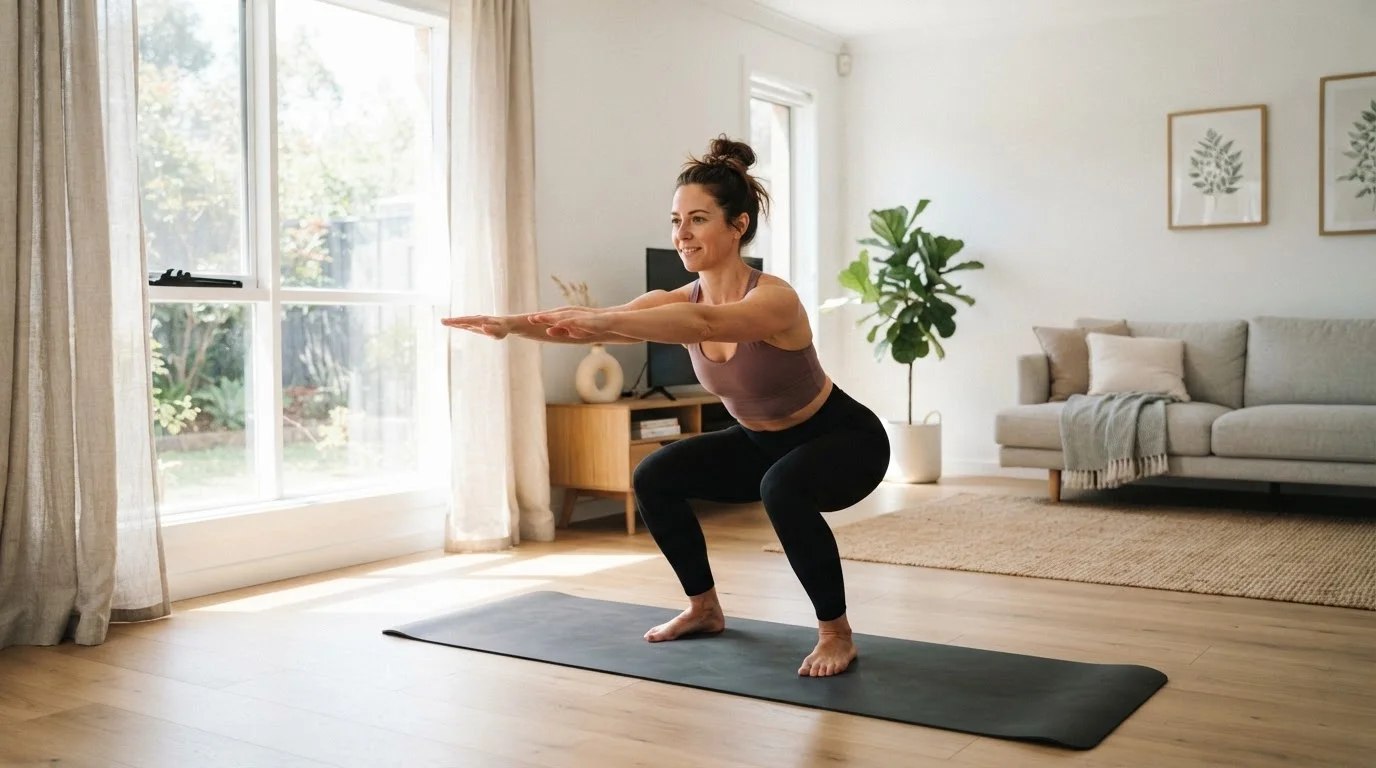
- Squat — bending knees and hips to lower and raise your body (e.g., bodyweight squats, sit-to-stand from a chair)
- Carry / Core stability — stabilizing your trunk under load or movement (e.g., planks, dead bugs, farmer carries with household objects)
A workout that touches each of these patterns trains your whole body in a balanced, functional way. Many exercises also overlap categories — which is why movements that combine cardio and strength are particularly efficient for time-pressed beginners.
Start With Easier Variations, Not Fewer Reps
Many beginners try standard push-ups from day one and struggle, then feel discouraged. A better approach is choosing an easier variation — like a wall push-up or an incline push-up — that you can perform with good form. Once that feels controlled, progress to a harder version. This builds correct movement patterns from the start and keeps early sessions feeling successful rather than defeating.
Building Your First Realistic Routine
A sustainable beginner routine has three qualities: it's short enough to actually complete, simple enough to not require instruction mid-session, and structured enough to create a habit loop.
A practical starting structure looks like this:
- Warm-up (3–5 min): Light movement like marching in place, arm circles, and leg swings to raise your heart rate and loosen joints.
- Main work (10–15 min): Choose one exercise from each movement pattern above. Do 8–12 repetitions of each, rest briefly, and repeat for two rounds.
- Cool-down (3–5 min): Slow breathing and gentle stretching for the muscles you used.
Before you begin, it's worth running through a readiness check — our home workout readiness checklist walks you through what to assess in your space, schedule, and movement baseline before your first session.
How to Stay Consistent Without Willpower
Motivation fades — that's not a character flaw, it's just how human psychology works. Consistency comes from design, not discipline. Here's what actually helps:
- Anchor workouts to existing habits. Pair exercise with something you already do daily — right after your morning coffee, or before your evening shower.
- Keep the session short enough to feel easy. A 15-minute workout you do every week beats a 60-minute one you postpone indefinitely.
- Reduce setup friction. Leave your mat out, choose your exercises the night before, or wear workout clothes during your lunch break. The less deciding you have to do in the moment, the more likely you are to start.
- Track completion, not performance. In early weeks, simply noting that you showed up builds the identity of someone who exercises. Performance metrics can come later.
If you prefer a different starting point — more focused on daily movement than structured workouts — starting movement from scratch offers a complementary approach grounded in everyday activity.
What to Expect in Your First Few Weeks
Understanding what's normal early on prevents discouragement from derailing your progress before it starts.
Week 1–2: You'll likely feel sore after sessions — this is delayed onset muscle soreness (DOMS), a normal response to new movement demands. Energy levels may dip slightly as your body adjusts. Focus only on showing up.
Week 3–4: Soreness decreases noticeably. Movements start to feel more familiar and controlled. You may notice you can complete more repetitions or hold positions longer than when you started — that's real adaptation happening.
Beyond week 4: This is when habit formation becomes more durable and you can start adding variety or volume. Explore movement fundamentals to understand how to progress safely from here.
Home Training Has Real Limits Too
Home workouts are an excellent starting point, but they're not without trade-offs. As you progress, you may encounter limitations in exercise variety, equipment access, or external accountability. Our article on the hidden downsides of home-only training gives an honest look at those gaps and practical ways to address them.
This article is for general informational purposes only and is not a substitute for professional medical advice. If you have any health conditions, injuries, or concerns, please consult a qualified healthcare provider before beginning a new exercise program.