

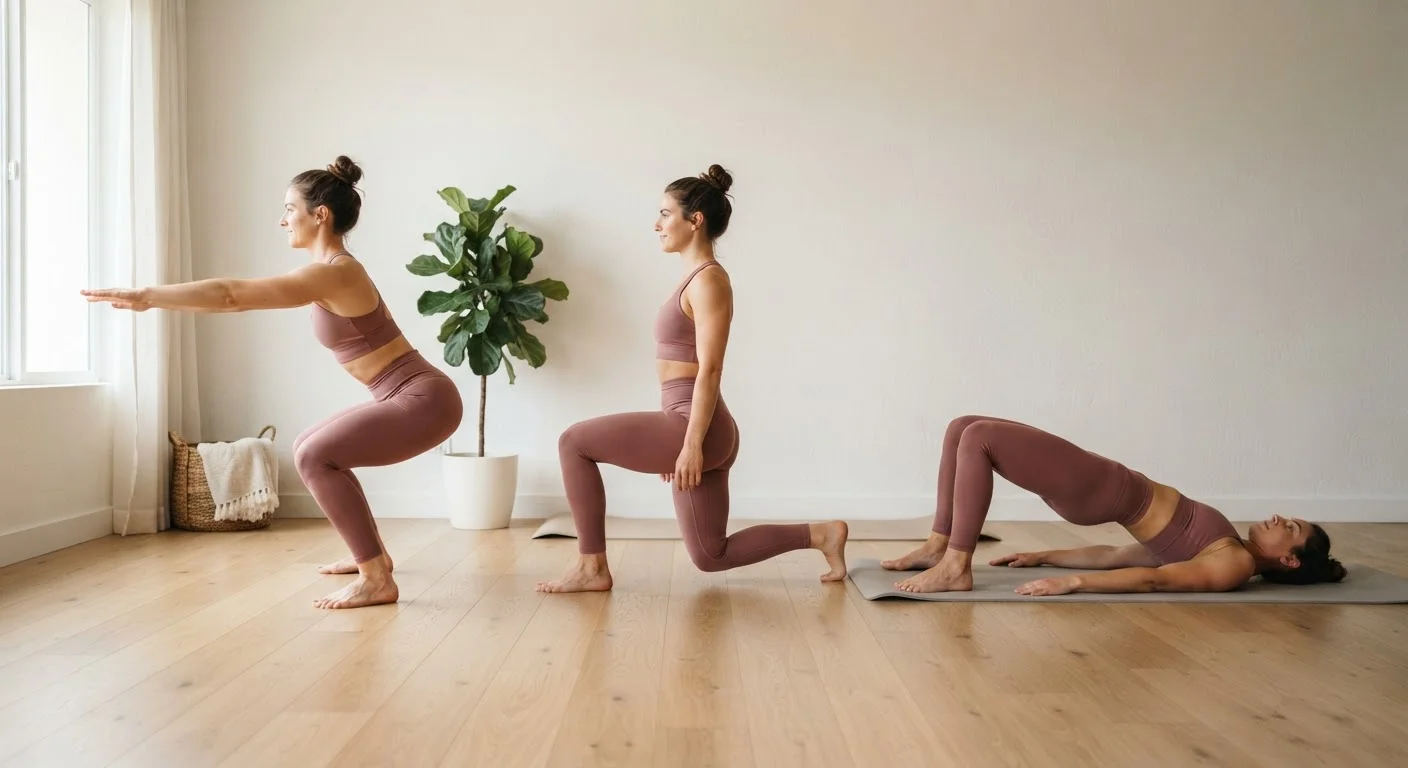
| Primary pattern — squat | Knee-dominant bilateral push |
| Primary pattern — lunge | Unilateral knee-dominant push |
| Primary pattern — glute bridge | Supine hip extension (hinge) |
| Equipment required | None — bodyweight only |
| Key shared muscles | Glutes, quadriceps, core stabilizers |
| Unique advantage of lunges | Corrects left-right strength imbalances |
Why These Three Moves Belong in Every Routine
Squats, lunges, and glute bridges collectively cover almost every major muscle group in the lower body. Together, they represent two of the seven foundational movement patterns — the squat pattern and the hip-hinge pattern — which underpin everyday tasks like sitting, climbing stairs, and carrying groceries.
Unlike machine-based exercises that isolate one muscle at a time, these three moves train muscles in coordinated groups, building the kind of functional strength that transfers to real life. They also require zero equipment, making them accessible anywhere. If you want to understand why equipment-free training can be genuinely effective, see No Gym, No Problem: Understanding Equipment-Free Fitness.
| Primary pattern — squat | Knee-dominant bilateral push |
| Primary pattern — lunge | Unilateral knee-dominant push |
| Primary pattern — glute bridge | Supine hip extension (hinge) |
| Equipment required | None — bodyweight only |
| Key shared muscles | Glutes, quadriceps, core stabilizers |
| Unique advantage of lunges | Corrects left-right strength imbalances |
Bodyweight Squat: The Knee-Dominant Lower-Body Staple
The squat is a bilateral, knee-dominant movement — meaning both legs work simultaneously and the knee joint does the bulk of the bending. It primarily trains the quadriceps (front of the thigh), glutes, and adductors (inner thigh). The core and erector spinae muscles stabilize the spine throughout.
Form Cues
- Stand feet roughly shoulder-width apart, toes angled slightly outward (10–30 degrees).
- Push hips back and down simultaneously — avoid collapsing forward at the chest.
- Track knees over the second and third toes; do not let them cave inward.
- Lower until thighs are roughly parallel to the floor, or as far as mobility allows with a neutral spine.
- Drive through the full foot to return to standing.
Common Variations
- Sumo squat: Wider stance emphasizes the adductors and inner glutes more.
- Pulse squat: Small rhythmic pulses at the bottom increase time-under-tension.
- Jump squat: Adding a vertical leap increases power demand and heart rate.
Lunge: Unilateral Training with Balance Demand
The lunge is a unilateral (single-leg) movement that challenges each leg independently, which helps correct strength imbalances between sides. The primary muscles trained are the quadriceps of the front leg and the glutes and hamstrings of both legs. Because your base of support narrows, the hip abductors and core work overtime to maintain balance.
Form Cues
- Step one foot forward far enough that your front shin stays roughly vertical at the bottom.
- Lower your back knee toward the floor without letting it slam down.
- Keep your torso upright — leaning excessively forward shifts stress onto the lower back.
- Push through the front heel to return, or step the rear foot forward for walking lunges.
Common Variations
- Reverse lunge: Stepping backward is often easier on the front knee and suitable for beginners.
- Lateral lunge: Stepping sideways targets the adductors and lateral glutes in a frontal plane.
- Walking lunge: Adds a gait component, increasing coordination and cardiorespiratory demand.
Lunges and Knee Sensitivity
Some individuals experience discomfort in the front knee during forward lunges. Reverse lunges are often a gentler alternative because the rear leg drives the movement, reducing shear force on the front knee. If knee pain persists during any lunge variation, consult a physical therapist or qualified fitness professional before continuing.
Glute Bridge: Hip-Hinge Strength from the Floor
The glute bridge is a supine (lying on your back) hip-extension exercise and the most accessible entry point into the hip-hinge pattern. It specifically targets the gluteus maximus, hamstrings, and spinal erectors, while sparing the lower-back compression that can occur in standing movements. Research consistently identifies hip-extension exercises as valuable for both athletic performance and lower-back health, though individuals with existing back conditions should consult a healthcare professional before adding any new movements.
Form Cues
- Lie on your back, knees bent, feet flat on the floor about hip-width apart.
- Press through the heels and squeeze the glutes to lift the hips until your body forms a straight line from knees to shoulders.
- Hold for one to two seconds at the top — avoid hyperextending the lower back.
- Lower with control; do not let the hips drop passively.
Common Variations
- Single-leg glute bridge: Extending one leg increases glute isolation and difficulty substantially.
- Hip thrust (elevated): Raising the shoulders onto a bench increases range of motion.
- Marching bridge: Alternating knee lifts at the top adds core anti-rotation challenge.
For a broader look at what the research actually shows about building strength through these patterns, see what studies show about bodyweight exercise and strength.
This article is for general informational purposes only and does not constitute medical or professional fitness advice. Consult a qualified healthcare or exercise professional before beginning a new exercise program, especially if you have existing injuries or health conditions.