

Key Takeaways
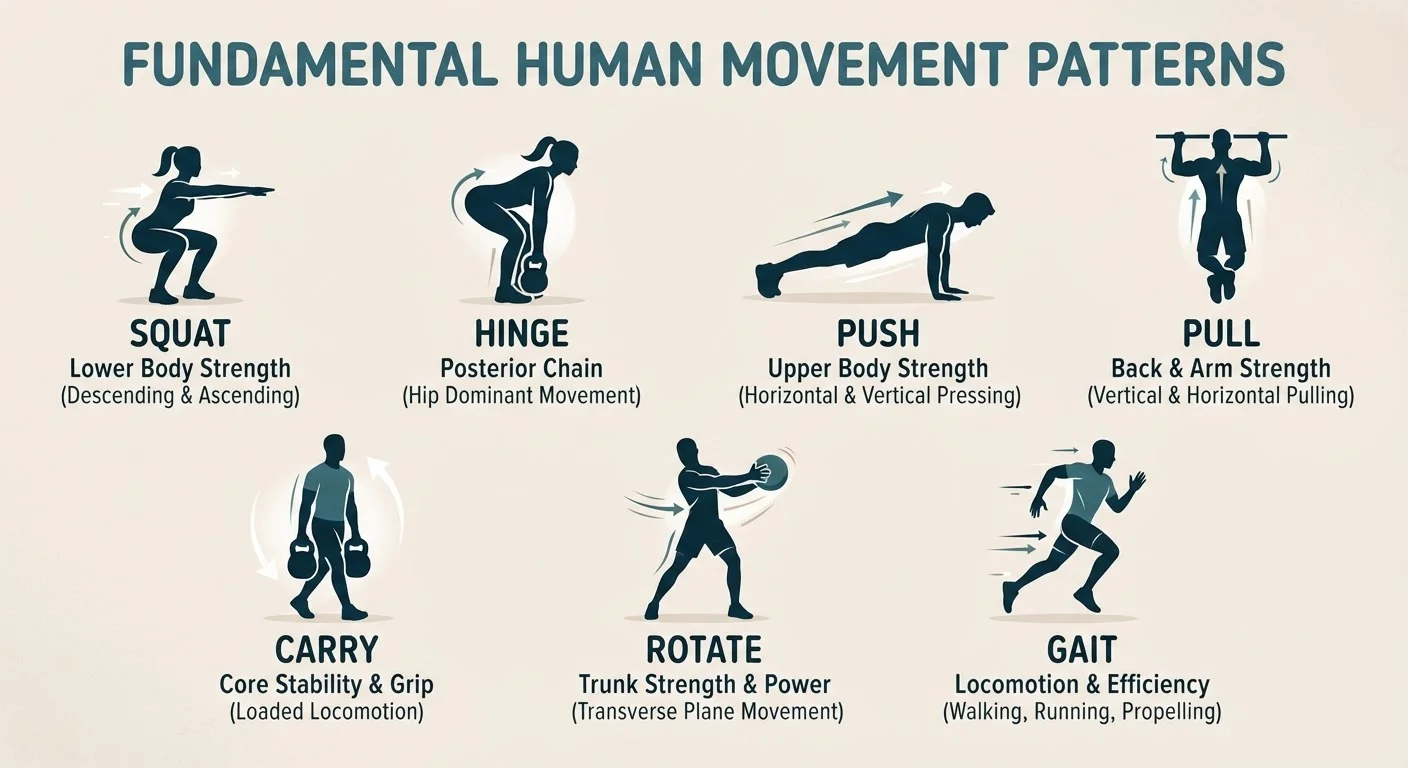
- Seven movement patterns — squat, hinge, push, pull, carry, rotate, and gait — cover nearly all human physical activity.
- Each pattern recruits distinct muscle groups and protects specific joints when performed well.
- Neglecting any one pattern often contributes to compensations, imbalances, or overuse injuries over time.
- You don't need a gym to train these patterns — most can be practiced with bodyweight alone.
- Consistent, low-complexity practice of all seven builds the durable foundation that sport and fitness programs build upon.
Foundational Movement Patterns
Foundational movement patterns are the seven basic ways the human body moves: squat, hinge, push, pull, carry, rotate, and gait. Nearly every physical task — from getting out of a chair to carrying bags — is a variation of one or more of these patterns. Training them intentionally builds strength, coordination, and resilience that transfers directly to daily life.
In exercise science, these patterns are often used to structure program design because they engage overlapping muscle groups and reflect the biomechanical demands of functional human movement.
Why Seven Patterns Explain Almost Everything
Human movement looks endlessly varied — yet researchers and coaches have long observed that nearly every physical task reduces to a small set of fundamental actions. The seven foundational patterns are not a fitness trend; they reflect how the musculoskeletal system is actually structured to bear load and generate force. Understanding them gives you a reliable lens for evaluating exercise, diagnosing weak spots, and building habits that hold up across decades.
This framework is explored in depth as part of a complete movement framework, but here we focus specifically on what each pattern is and why it matters day-to-day.
80%
Adults who experience low back pain at some point
The World Health Organization estimates approximately 619 million people globally live with low back pain, with sedentary lifestyles and movement deficiencies identified as contributing factors.
7
Distinct movement patterns covering all human physical tasks
Exercise scientists and strength coaches broadly recognize these seven categories as the minimal set needed to describe the full range of functional human movement demands.
2x
Increased fall risk with poor single-leg stability
Research published in movement and aging literature consistently links reduced single-leg balance — a marker of gait pattern integrity — with significantly higher fall incidence in adults over 50.
The Seven Patterns, Defined
1. Squat
A squat is any movement where both knees bend while the hips descend — getting into a chair, picking something up from a low shelf, or sitting on the floor. It primarily loads the quadriceps, glutes, and core. Weakness here often shows up as knee pain or an inability to rise from low surfaces without using arms for support.
2. Hinge
The hinge involves bending at the hips while maintaining a long spine — think of picking up a heavy object from the floor or leaning forward to load a dishwasher. The posterior chain (hamstrings, glutes, lower back) drives this movement. The hinge is arguably the most undertrained pattern in sedentary adults, and its absence is frequently linked to lower back complaints.
3. Push
Any movement pressing load away from the body — horizontally (push-up, opening a heavy door) or vertically (placing something on a high shelf). The chest, shoulders, and triceps are the primary movers. Balanced pushing strength supports shoulder joint health and posture.
4. Pull
The counterpart to pushing: drawing load toward the body — rowing, pulling open a door, or lifting a bag into an overhead compartment. The upper back, biceps, and rear deltoids do the work. Many adults push far more than they pull, which contributes to rounded shoulders and thoracic stiffness.
5. Carry
Carrying — walking while holding load — is deceptively demanding. Groceries, a child, a backpack: these are all loaded carries. The pattern builds grip strength, core anti-rotation stability, and postural endurance simultaneously. It transfers directly to everyday functional capacity.
6. Rotate
Rotation encompasses any twisting or anti-twisting demand on the trunk — swinging a bag into a car, reaching across the body, or simply turning to look behind you. The obliques, thoracic spine, and hips work together here. Controlled rotation is also protective: stiff rotators often force excessive load onto the lumbar spine.
3. Gait (Locomotion)
Walking, jogging, climbing stairs — gait is the pattern most performed yet least deliberately trained. Single-leg stability, hip extension, and arm swing coordination are all embedded in every step. Gait quality tends to reveal deficiencies in the other six patterns; it is where they integrate.
What Happens When Patterns Break Down
No pattern exists in isolation. When one is weak or poorly controlled, neighboring patterns compensate — and that compensation accumulates. A limited hip hinge often causes the lumbar spine to flex excessively during lifting. A restricted squat pattern shifts load onto the knees or lower back. Over time these compensations quietly create the kind of chronic discomfort that people attribute to "getting older" rather than to addressable movement gaps.
Signs your movement habits may be working against you walks through several common examples of how these breakdowns develop without obvious warning.
Putting the Patterns Into Practice
The most practical approach is to audit your current movement and identify which patterns you rarely perform. If your day involves desk work and driving, you are likely getting abundant sitting (a compressed squat), minimal hinging, very little pulling, and gait only incidentally. A short daily practice — even ten to fifteen minutes — that touches each pattern begins to correct those gaps without requiring a gym membership or elaborate programming.
If you are starting from scratch, this grounded introduction for beginners provides a structured entry point. And once you have the basics in place, a daily movement audit can help you identify specific gaps before adding structured exercise.
Start With One Pattern Per Day
Rather than trying to incorporate all seven at once, designate one pattern as your focus each day of the week. A simple bodyweight squat in the morning, a few hip hinge reps before dinner — small, deliberate reps build motor patterns effectively over time. Consistency across all seven matters more than intensity in any one.
This article is for general informational purposes only and does not constitute medical or exercise advice. If you have an existing injury, health condition, or concerns about your movement capacity, consult a qualified healthcare or movement professional before beginning any new exercise practice.