

Key Takeaways
- Bodyweight training qualifies as genuine resistance training — not just a beginner's substitute.
- Muscle adaptation depends on progressive overload, which is achievable without any equipment.
- Compound bodyweight movements train multiple muscle groups simultaneously, improving efficiency.
- Consistency and exercise variation matter more than access to a gym for general fitness gains.
- Equipment-free training has meaningful limitations at advanced strength levels — understanding them helps set realistic goals.
Equipment-Free Fitness
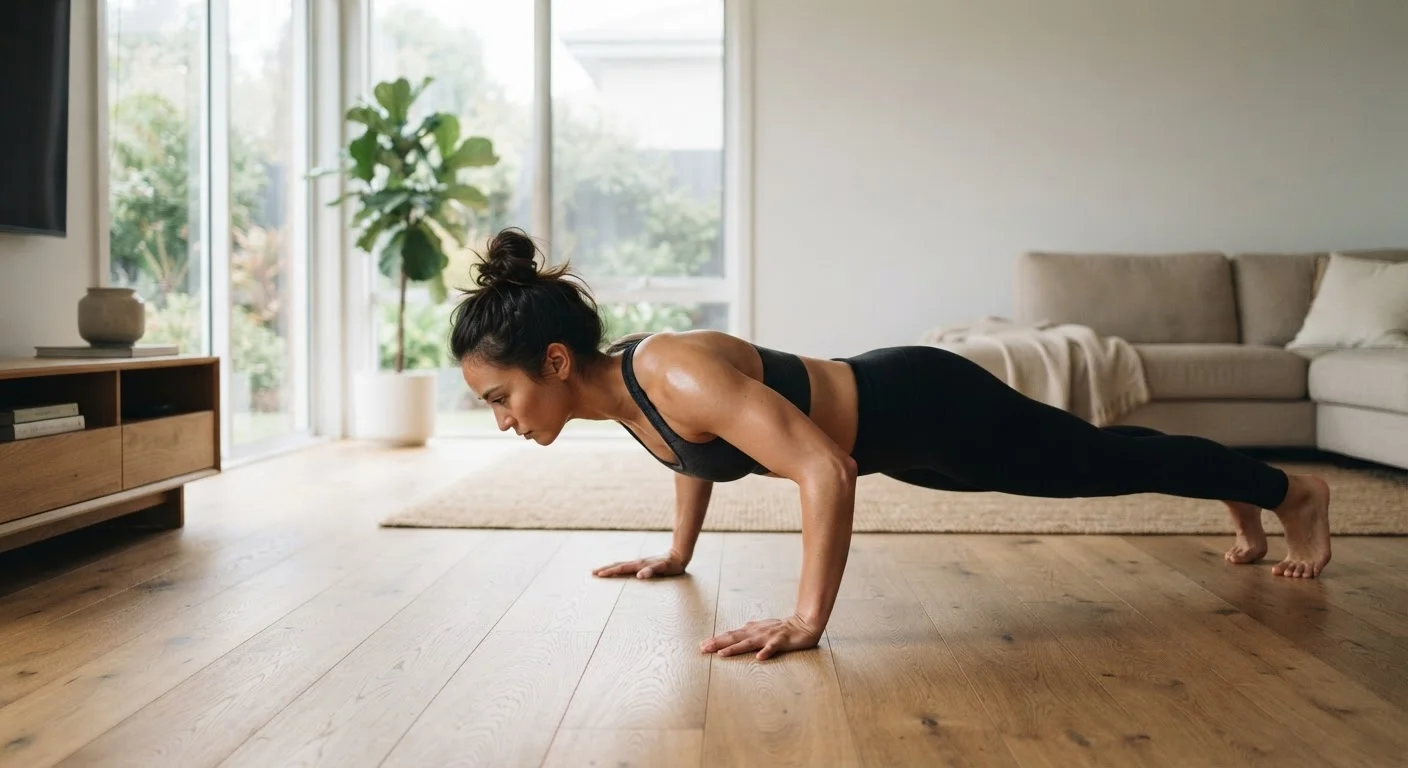
Equipment-free fitness, often called bodyweight training, is exercise that uses your own body's weight as the primary source of resistance. No machines, dumbbells, or memberships are required. Common movements include push-ups, squats, lunges, and planks — performed anywhere with enough floor space to stand.
In exercise science, bodyweight training is classified as a form of resistance training. When performed with sufficient intensity and progressive overload, it can stimulate the same muscle-protein synthesis pathways targeted by weighted exercises.
Why No Equipment Doesn't Mean No Results
The gym-or-nothing mindset is one of the most common barriers to regular exercise — and one of the least justified. Fitness research is clear that the stimulus for muscle adaptation is mechanical tension applied to muscle tissue. Whether that tension comes from a barbell or a well-executed push-up is, from a physiological standpoint, secondary to the challenge level and consistency of effort.
Bodyweight training works by leveraging gravity and body position to create that mechanical challenge. A standard squat, for example, loads the quadriceps, glutes, and hamstrings through a full range of motion — the same muscle groups targeted by a leg press machine. The movement pattern, not the machine, is what drives adaptation.
72%
Adults who cite cost or access as gym barriers
Multiple public health surveys have found that cost and location are among the most frequently reported barriers to regular gym attendance among U.S. adults.
~2x
Load increase from unilateral vs. bilateral squat
Biomechanical research suggests that single-leg squat variations can generate roughly double the per-limb demand compared to a standard two-legged bodyweight squat.
8–12 weeks
Typical timeframe for measurable strength gains
Exercise science literature consistently identifies 8–12 weeks of progressive resistance training as sufficient to produce detectable improvements in muscular strength in previously untrained individuals.
This is why exercise scientists classify bodyweight training as a legitimate form of resistance training — not merely a stepping stone to the "real" thing. For the majority of adults pursuing general health, strength, and mobility goals, equipment is a convenience, not a requirement.
The Science of Progressive Overload Without Weights
Progressive overload — gradually increasing the demand placed on muscles over time — is the foundational principle behind any effective strength program. In gym settings, this usually means adding weight to a bar. Without equipment, the same principle applies through different levers.
You can increase difficulty by manipulating leverage (elevating feet during a push-up shifts more load to the shoulders and upper chest), range of motion (deep squat variations engage muscles through longer positions), tempo (slowing the descent phase of a movement increases time under tension), and unilateral loading (performing single-leg or single-arm variations doubles the load on one side of the body).
Track Your Reps and Variations, Not Just Time
A common mistake in equipment-free training is measuring progress only by how long you exercise. Instead, log the specific exercise variation and how many reps you completed. When a variation becomes easy, that's your signal to advance to a harder version — that's progressive overload in practice. See simple methods for tracking home fitness progress for practical approaches.
Each of these techniques produces a measurable increase in training stimulus. Research on single-leg squat variations, for instance, shows they can generate ground reaction forces comparable to barbell-loaded bilateral squats. This matters because it demonstrates that "harder" doesn't require heavier — it requires smarter programming.
For a detailed look at what peer-reviewed studies actually demonstrate, see what the research says about bodyweight exercise and strength.
Key Movement Patterns to Understand
Effective bodyweight training is organized around fundamental human movement patterns rather than muscle-isolation exercises. Understanding these patterns helps you build balanced, complete sessions without any equipment at all.
- Push: Movements that press resistance away from the body — push-ups and their variations train chest, shoulders, and triceps.
- Pull: Movements that draw resistance toward the body — while harder without equipment, inverted rows under a table or towel-based rows fill this role.
- Hinge: Hip-dominant movements like single-leg deadlifts or glute bridges load the posterior chain effectively.
- Squat: Knee-dominant movements — bodyweight squats, split squats, and pistol progressions — develop leg strength and hip mobility.
- Carry and brace: Core stabilization through planks, hollow holds, and dynamic movements builds the anti-rotation and anti-extension strength essential for injury resilience.
Rotating through these patterns across a week of training ensures no major muscle group is neglected. For a structured approach to organizing them into a home routine, the complete framework for home-based fitness offers an end-to-end guide.
Honest Limitations and How to Work Within Them
Equipment-free fitness is genuinely effective — but it isn't limitless. Understanding where it excels and where it falls short leads to smarter decisions about your training.
The biggest constraint is the upper ceiling on lower-body loading. Once your legs are strong enough that bodyweight squats feel easy, advancing requires creative variation — and eventually, for those pursuing maximum lower-body hypertrophy or sport-specific power, some form of added resistance becomes beneficial.
Upper-body pulling movements are another real challenge. Without a pull-up bar or similar anchor point, replicating a rowing or chin-up pattern takes improvisation and may not fully replicate the loading of dedicated equipment. This is a legitimate gap worth acknowledging.
That said, for the broad population goal of improving strength, body composition, cardiovascular fitness, and mobility — equipment-free training is more than sufficient. The balanced look at bodyweight training's strengths and limits explores these trade-offs in detail.
If you're just beginning and unsure where to start, starting home workouts when you've never had a routine provides a practical, zero-experience entry point.
This article is for general informational purposes only and is not a substitute for personalized medical or fitness advice. Consult a qualified healthcare professional before beginning any new exercise program, especially if you have existing health conditions or injuries.