

Key Takeaways
- Adaptogens are herbs studied for stress modulation, but evidence quality varies widely between individual plants.
- Ashwagandha has the most consistent human trial data among commonly used adaptogens for stress and anxiety symptoms.
- Rhodiola shows meaningful but more modest evidence, particularly for fatigue associated with stress.
- Most adaptogen studies are short-term and small-scale, limiting firm conclusions about long-term effects.
- Adaptogens are not regulated as drugs and carry real safety considerations, including drug interactions.
- These herbs are best understood as one potential tool within a broader, evidence-based stress management approach.
Adaptogens and Stress
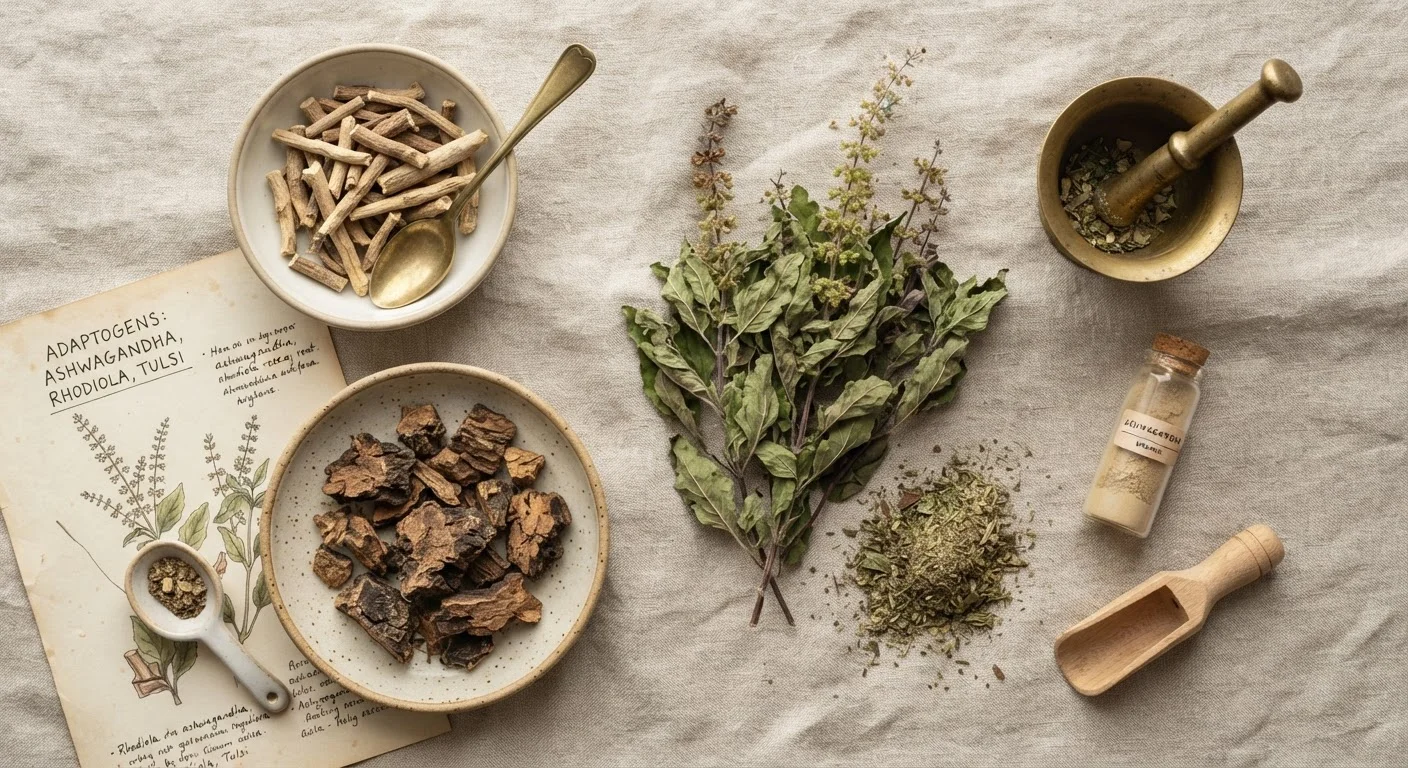
Adaptogens are a category of herbs and plant-derived compounds traditionally used to help the body respond to physical and psychological stress. The term describes substances thought to normalize the body's stress-response systems without pushing them in one specific direction. Research into this category is active but still developing, meaning some herbs show promising early results while others lack strong human trial data.
Many adaptogens are hypothesized to modulate the hypothalamic-pituitary-adrenal (HPA) axis and sympathoadrenal system — two key pathways in the physiological stress response — though human evidence for this mechanism varies considerably by herb.
What Adaptogens Are — and What They Aren't
The word adaptogen was coined in Soviet pharmacological research in the 1940s to describe substances that could non-specifically increase the body's resistance to stress. Today the term is applied broadly — sometimes loosely — to a range of herbs with varying levels of scientific scrutiny behind them.
To understand the evidence honestly, it helps to first understand the category itself. For a fuller grounding, see how adaptogens are defined and how they work. The short version: adaptogens are not a pharmacological drug class with a unified mechanism. They are a loose functional grouping of plants, each with its own active compounds, safety profile, and evidence base.
This distinction matters. Saying "adaptogens reduce stress" is a bit like saying "vegetables are healthy" — true in a general sense, but unhelpful for making informed decisions about specific plants.
Ashwagandha: The Most-Studied Adaptogen for Stress
Among adaptogens, ashwagandha (Withania somnifera) has the most robust human clinical trial record for stress and anxiety outcomes. Multiple randomized controlled trials — including a well-cited 2019 study published in Medicine — have found that ashwagandha extract reduced self-reported stress scores and serum cortisol levels compared to placebo over eight weeks.
A 2012 double-blind trial in Indian Journal of Psychological Medicine similarly reported significant reductions in stress assessment scores and cortisol in adults with a history of chronic stress. Effect sizes were meaningful, not just statistically significant.
~30%
Reduction in cortisol levels with ashwagandha
A 2012 double-blind randomized controlled trial in the Indian Journal of Psychological Medicine reported approximately 27–30% reductions in serum cortisol in the ashwagandha group versus placebo over 60 days.
8–12 weeks
Typical trial duration in adaptogen studies
Most peer-reviewed human trials evaluating adaptogens for stress run between eight and twelve weeks, limiting conclusions about longer-term effects and safety.
< 100
Average participants per adaptogen trial
A review of published ashwagandha and rhodiola trials shows most studies enroll fewer than 100 participants, which constrains statistical power and generalizability.
That said, important caveats apply. Many trials use proprietary extract forms that may not match every commercial product. Sample sizes are often small (60–100 participants). Most studies are funded partially by supplement industry sources, which introduces potential bias. And trial durations rarely exceed twelve weeks, leaving long-term effects unknown.
Rhodiola Rosea: Promising, but a Different Profile
Rhodiola rosea has a credible but more modest evidence base. Research suggests it may help with stress-related fatigue — the kind of cognitive and physical tiredness that accumulates under sustained pressure — more than with anxiety symptoms directly.
A 2009 trial in Phytomedicine found that rhodiola extract reduced burnout-related fatigue in medical professionals. A 2015 study comparing rhodiola to a common anxiolytic found comparable but slower-acting effects on generalized anxiety — a finding that warrants cautious interpretation given the study design.
Rhodiola's active compounds (rosavins and salidroside) appear to influence serotonin and dopamine pathways, though the precise mechanisms in humans are not fully established. For a side-by-side look at how ashwagandha and rhodiola differ in practice, see this comparison of the two herbs.
Matching the herb to your primary symptom
If stress-related fatigue and cognitive fog are your main concerns, rhodiola may be a more relevant starting point based on available evidence. If anxiety and general stress perception are your focus, ashwagandha's trial data is more directly applicable. Discussing both with a healthcare provider helps you match evidence to your individual situation.
Other Adaptogens: Thinner Evidence
Herbs like eleuthero (Eleutherococcus senticosus), holy basil (Ocimum tenuiflorum), and schisandra are frequently marketed as adaptogens, but their human trial data for stress-specific outcomes is considerably thinner. Most supporting evidence comes from animal studies, in vitro research, or small uncontrolled human trials — meaningful starting points, but not a basis for strong recommendations.
This does not mean these herbs have no value, only that the evidence cannot yet support confident claims. Readers interested in the broader landscape of herbal evidence can explore herbs with meaningful evidence behind them for a balanced overview.
Safety Considerations You Shouldn't Skip
Because adaptogens are sold as dietary supplements in the US — not regulated as drugs — their purity and potency can vary significantly between products. This is a real and underappreciated concern.
Beyond quality control, specific safety issues include:
- Drug interactions: Ashwagandha may affect thyroid hormone levels and interact with immunosuppressants and sedative medications. Rhodiola may interact with antidepressants, particularly MAOIs.
- Pregnancy and nursing: Most adaptogens lack adequate safety data for pregnant or breastfeeding individuals. Avoidance is generally recommended until more data exists.
- Autoimmune conditions: Some adaptogens may stimulate immune activity, which could be problematic for people managing autoimmune disease.
Always consult a qualified healthcare provider before starting any adaptogen, particularly if you are managing a health condition or taking prescription medications. This is general educational information, not personal medical advice.
Supplements Are Not Drugs: A Key Distinction
In the United States, adaptogenic herbs sold as supplements are not required to demonstrate safety or efficacy before reaching store shelves. This is fundamentally different from the drug approval process. Third-party testing organizations — such as USP or NSF International — evaluate some supplement products for purity and label accuracy, which can help narrow options. However, testing certification does not validate health claims.
Where Adaptogens Fit in a Stress Management Approach
Even where evidence for adaptogens is encouraging, it is worth placing them in context. Stress management strategies with stronger and more consistent evidence — including cognitive behavioral approaches, regular physical activity, mindfulness, and sleep hygiene — should form the foundation of any stress resilience plan. See an overview of stress relief techniques backed by research for a broader view of what works.
Adaptogens, when used thoughtfully and with professional guidance, may represent a meaningful complementary element for some people. They are best understood as one potential layer of support — not a standalone solution. And because stress physiology intersects with nutrition, it may also be worth exploring what dietary research says about stress-supporting nutrients alongside any herb-based approach.
This article is for informational and educational purposes only. It is not medical advice and should not be used to diagnose, treat, or manage any health condition. Always consult a qualified healthcare professional before starting any new supplement or making changes to your health routine.