

Key Takeaways
- Seed cycling is a wellness practice with limited direct clinical evidence supporting its hormonal claims.
- The seeds themselves contain beneficial nutrients — lignans, zinc, omega-3s — with established health research.
- No peer-reviewed study has confirmed that seed cycling directly regulates estrogen or progesterone levels.
- Seed cycling is generally low-risk for most healthy adults, but it is not a substitute for medical care.
- Understanding your cycle through tracking can complement any dietary approach you explore.
What Is Seed Cycling, and Why Is It Trending?
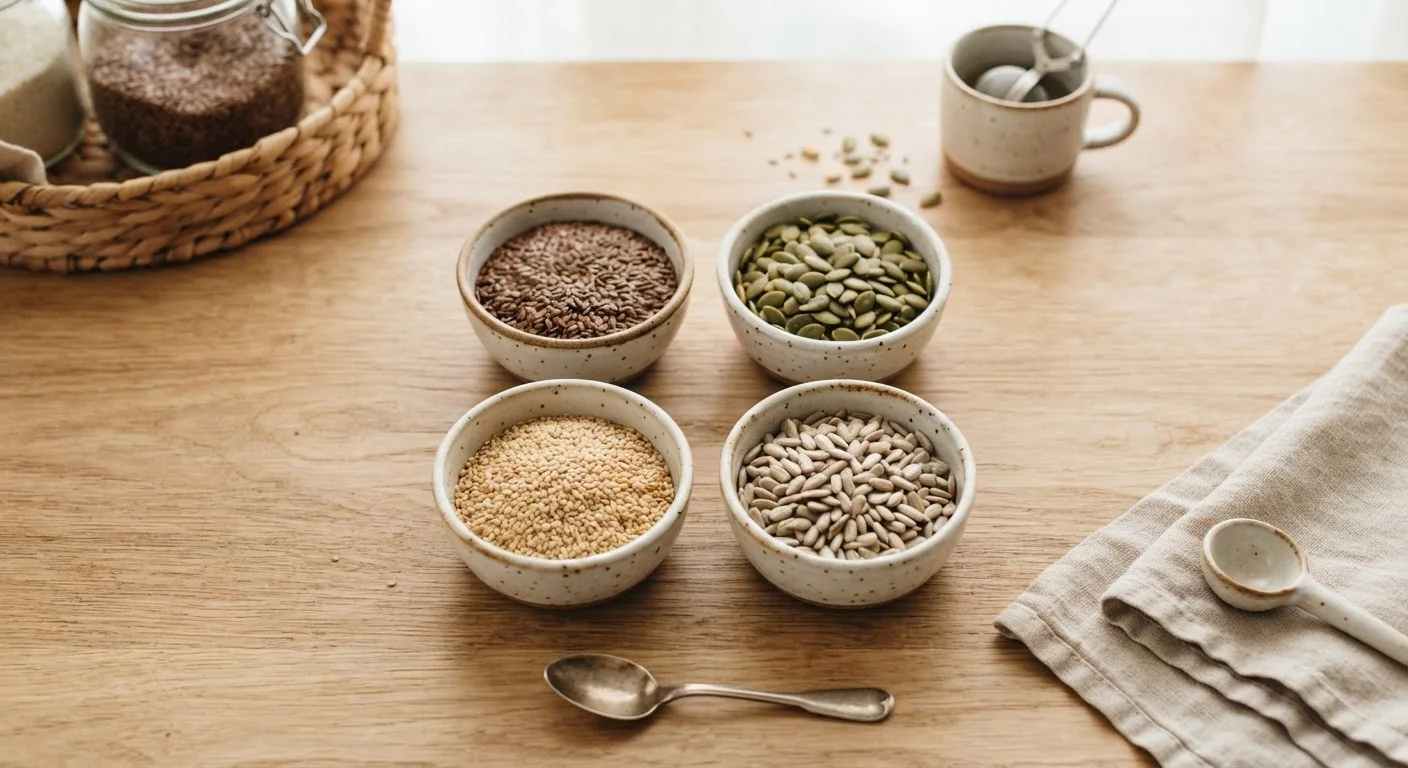
Seed cycling involves eating specific seeds during two phases of your menstrual cycle — flaxseeds and pumpkin seeds during the follicular phase (days 1–14), then sesame seeds and sunflower seeds during the luteal phase (days 15–28). Proponents claim this rotation supports estrogen production in the first half of the cycle and progesterone in the second half, easing symptoms like PMS, irregular periods, and hormonal acne.
The practice has found a large audience on social media and in wellness communities, often positioned as a gentle, food-based approach to hormonal balance. That accessibility is part of its appeal — seeds are inexpensive, widely available, and easy to add to smoothies or salads. But enthusiasm in wellness spaces doesn't always track with scientific evidence, and it's worth understanding exactly where seed cycling stands.
For a broader look at how nutrition intersects with hormonal health, see what the research supports on nutrition and hormonal balance.
Myth
Seed cycling has been scientifically proven to regulate estrogen and progesterone levels.
Fact
No peer-reviewed clinical trial has confirmed that seed cycling directly regulates estrogen or progesterone in humans.
The core claim — that rotating specific seeds in sync with menstrual phases controls hormone levels — lacks direct clinical evidence. While the individual nutrients in these seeds (lignans, zinc, omega fatty acids) have their own research base, no study has tested seed cycling as a protocol and measured hormonal outcomes. The proposed mechanism remains theoretical.
Myth
The seeds used in seed cycling have no real nutritional value.
Fact
Flaxseeds, pumpkin seeds, sesame seeds, and sunflower seeds are all genuinely nutrient-dense foods with well-documented health benefits.
Flaxseeds are high in lignans and alpha-linolenic acid (an omega-3 fatty acid). Pumpkin seeds are a solid source of zinc and magnesium. Sesame seeds also contain lignans and calcium. Sunflower seeds offer vitamin E and selenium. These nutrients contribute to overall health, and including more of them in your diet is generally a positive dietary choice — independent of any cycle-syncing framework.
Myth
If seed cycling worked for someone else, it will work for me too.
Fact
Individual responses to dietary changes vary widely due to genetics, gut microbiome composition, baseline hormone levels, and overall diet.
Anecdotal reports of improved PMS, more regular cycles, or clearer skin after starting seed cycling are common in wellness communities. However, these individual experiences can reflect many variables: dietary improvements overall, increased body awareness, the placebo effect, or natural cycle variation. Without controlled conditions, it's not possible to attribute changes specifically to seed cycling.
Myth
Seed cycling is a safe alternative to medical treatment for hormonal conditions like PCOS.
Fact
Seed cycling is not an evidence-based treatment for any diagnosed hormonal condition and should not replace professional medical evaluation or care.
Conditions like polycystic ovary syndrome (PCOS), endometriosis, and thyroid disorders involve complex hormonal and metabolic factors that require proper diagnosis and, often, medical management. Relying on an unproven dietary practice in place of professional care can delay treatment and allow conditions to progress. A nutritious diet — including seeds — can support overall wellbeing as part of a broader health plan, but not as a standalone treatment.
Myth
You need a perfectly regular 28-day cycle for seed cycling to be relevant.
Fact
Seed cycling proponents often suggest adaptations for people with irregular cycles, though the overall evidence base remains the same regardless of cycle length.
Many wellness guides recommend that people with irregular or absent periods use the lunar calendar as a reference point. This is a practical workaround, but it further underscores that seed cycling is a structured wellness habit rather than a clinically validated therapy. The absence of evidence for regular-cycle users applies equally here.
What the Research Does — and Doesn't — Support
The nutrients found in these seeds do have credible research behind them. Flaxseeds are among the richest dietary sources of lignans, plant compounds that interact with estrogen receptors in the body. A small number of studies suggest flaxseed consumption may modestly influence estrogen metabolism, though effects vary significantly by individual and context. Pumpkin seeds are a good source of zinc, which plays a role in reproductive hormone pathways. Sesame seeds also contain lignans, and sunflower seeds provide vitamin E and selenium — both relevant to antioxidant function.
What's missing is direct evidence that rotating these seeds in sync with menstrual cycle phases produces measurable hormonal changes. No randomized controlled trial has tested seed cycling as a protocol. The mechanistic logic — that eating certain seeds at certain times can meaningfully shift estrogen or progesterone — hasn't been validated in humans. That doesn't make the practice harmful, but it does mean the specific claims go beyond what current research supports.
~30g
Daily flaxseed intake studied for hormonal effects
Several small studies have examined flaxseed's influence on estrogen metabolism using approximately 30 grams per day — roughly 3 tablespoons — though results vary and population sizes are limited.
0
Randomized trials testing seed cycling as a protocol
As of available published literature, no peer-reviewed randomized controlled trial has tested seed cycling specifically as an intervention for hormonal balance.
If you're interested in understanding your cycle more deeply alongside any dietary exploration, tracking your cycle for hormonal awareness offers a practical starting point.
Practical Perspective: Is Seed Cycling Worth Trying?
For most healthy adults, adding a tablespoon or two of seeds to daily meals is nutritionally sound and very low-risk. If seed cycling gives you a structured way to eat more whole foods and tune into your cycle, that's genuinely valuable — even if the specific hormonal rotation isn't the mechanism driving any benefits you notice. Improved diet quality, increased self-awareness, and placebo-supported wellbeing are all real effects worth acknowledging.
That said, seed cycling should not replace evaluation or treatment for conditions like PCOS, endometriosis, perimenopause, or thyroid disorders. If you're experiencing significant hormonal symptoms, the most important step is speaking with a qualified healthcare provider. Dietary patterns can support overall health, but they aren't a substitute for diagnosis or medical care.
Seed Cycling Is Not a Medical Treatment
If you are experiencing symptoms that suggest a hormonal imbalance — such as significantly irregular periods, severe PMS, unexplained weight changes, or fertility concerns — please consult a qualified healthcare provider. These symptoms can have underlying causes that require diagnosis and appropriate care. Dietary approaches, including seed cycling, are not substitutes for professional medical evaluation.
You might also find it useful to explore a monthly hormonal health self-check to build a clearer picture of your patterns over time — whether or not you incorporate seed cycling.
This article is for general informational and educational purposes only and does not constitute medical advice. Always consult a qualified healthcare professional regarding any health concerns or before making changes to your diet or wellness routine.