

Key Takeaways
- The skin is a robust barrier, not a simple sponge — most topically applied substances do not fully penetrate into the bloodstream.
- Molecule size and fat-solubility are among the most critical factors determining whether a substance crosses the skin barrier.
- Skin condition, body location, and formulation method significantly affect how much of any substance actually penetrates.
- Plant oils, herbal compresses, and other natural applications primarily act on the skin's surface or uppermost layers.
- Always consult a healthcare professional before using topical remedies to treat a medical condition.
Skin Absorption (Percutaneous Penetration)
Skin absorption refers to the process by which substances applied to the skin's surface pass through its layers and enter the body's tissues or bloodstream. The skin is a highly selective barrier, meaning most substances cannot simply pass through on contact. Whether a compound penetrates depends on its chemical properties, the condition of the skin, and where it is applied.
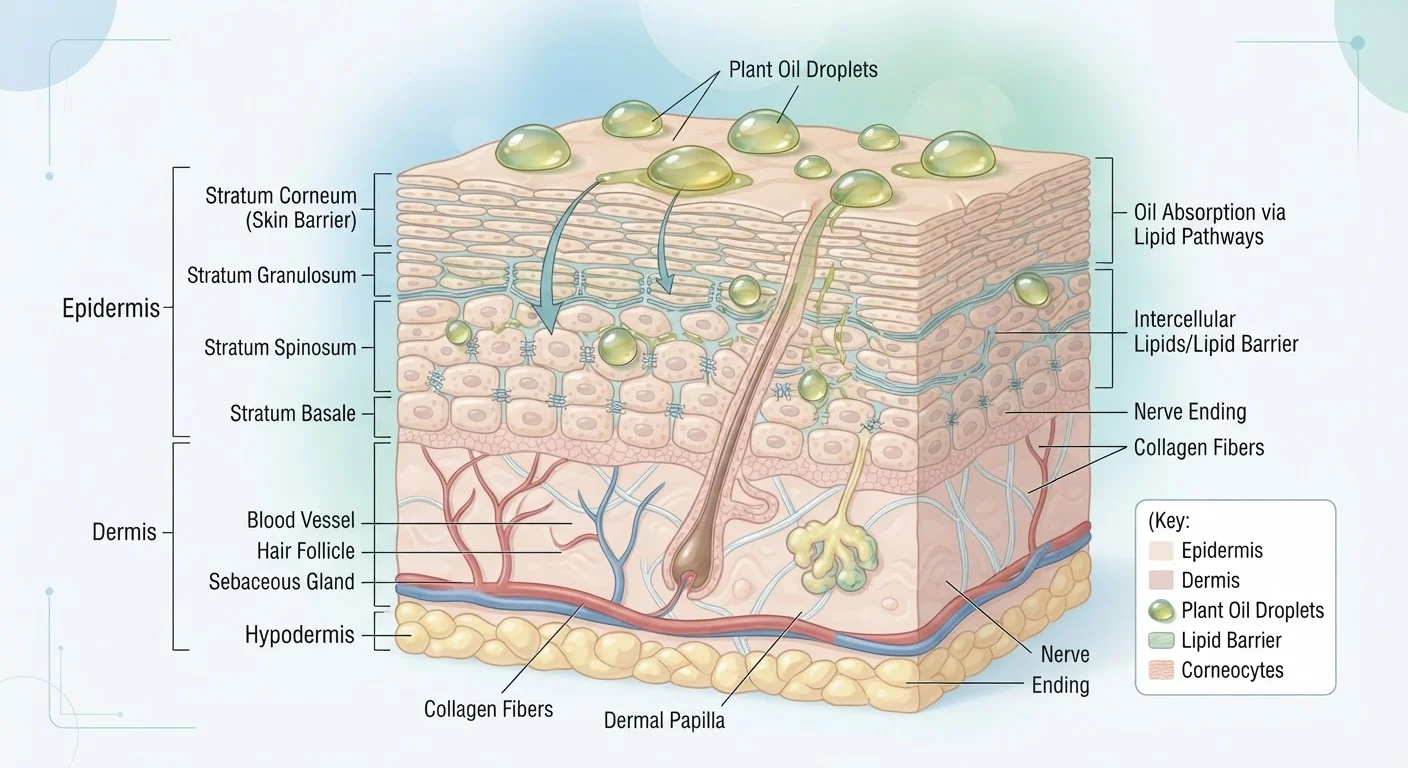
Percutaneous penetration is governed largely by the stratum corneum — the outermost skin layer — which acts as a lipid-rich, tightly packed shield. Molecules that are small, lipophilic (fat-soluble), and non-ionized tend to penetrate most readily.
The Skin Barrier: Built to Keep Things Out
Your skin is the body's largest organ, but its primary job is protection — not absorption. The outermost layer, called the stratum corneum, is composed of flattened dead cells embedded in a matrix of lipids (fats). This structure is sometimes described as a "brick and mortar" arrangement, and it's remarkably effective at blocking foreign substances from entering.
For a molecule to penetrate this barrier and reach the living layers beneath, it generally needs to be:
- Small in molecular size — larger molecules are physically blocked by the tight cellular structure.
- Lipophilic (fat-soluble) — the lipid-rich stratum corneum favors fat-soluble compounds over water-soluble ones. This is why fat-soluble vs. water-soluble molecules behave so differently in biological systems.
- Present in sufficient concentration — a higher concentration gradient between the skin surface and deeper layers drives penetration.
Most everyday topical applications — from herbal compresses to plant oils — do not meet all these criteria in ways that produce significant systemic absorption.
Skin Absorption Is Not the Same as Systemic Absorption
A substance can penetrate the stratum corneum — the outermost skin layer — without ever reaching the bloodstream in meaningful amounts. The living epidermis and dermis below also present metabolic and physical barriers. Researchers study percutaneous absorption at multiple levels: surface, epidermal, dermal, and systemic. Most botanical topicals reach only the first one or two.
What Actually Influences Penetration
Absorption is not a fixed property of any substance alone. Several variables interact to determine how much of a topical application actually penetrates:
Skin Condition and Integrity
Healthy, intact skin is a much stronger barrier than compromised skin. Conditions like eczema, psoriasis, or simple cuts reduce barrier function, allowing greater penetration of whatever is applied. This can be clinically useful — as with some medicated patches — but it also means caution is warranted when applying potent botanicals to damaged skin.
Location on the Body
Skin thickness and follicle density vary considerably across the body. The eyelids, scalp, and inner wrists absorb more than the forearms or back. The palms and soles, with their thick stratum corneum, absorb the least.
Formulation and Delivery Method
How a substance is prepared matters as much as what the substance is. Oils create an occlusive layer that can mildly enhance penetration of other compounds. Emulsions (creams and lotions) distribute substances differently than pure oils or water-based compresses. Heat — as used in warm compresses — can temporarily dilate pores and increase local blood flow, modestly improving surface-level uptake.
~500 Da
Maximum molecular weight for effective skin penetration
The '500 Dalton rule,' described in dermatological literature, suggests molecules larger than approximately 500 Daltons rarely penetrate the stratum corneum effectively.
Up to 40×
Variation in absorption by body site
Research published in dermatology literature indicates absorption rates can vary up to 40-fold between the most and least permeable body sites, such as the scrotum versus the heel.
Oils, Compresses, and Botanical Applications: What the Evidence Says
Natural topical applications have a long history of traditional use, and a growing body of research examines their mechanisms — though the evidence is often preliminary or mixed.
Plant Oils
Oils such as coconut, jojoba, and rosehip have molecular structures that allow some penetration into the stratum corneum. Research suggests they can improve skin hydration and lipid barrier function. However, systemic absorption of their fatty acids remains minimal in most circumstances. Their value is primarily local: softening, protecting, and supporting the skin surface.
Herbal Compresses
Warm compresses made with herbs like chamomile or ginger deliver heat and plant compounds simultaneously to a specific area. The warmth increases local circulation, and some volatile compounds (such as terpenes) may penetrate more readily than polar, water-soluble constituents. However, rigorous clinical evidence for compresses as a delivery method for most plant actives remains limited.
Essential Oils
Because essential oil molecules are typically small and lipophilic, they have greater skin-penetration potential than most other botanical preparations. Some research confirms detectable serum levels of certain compounds after topical application. This is precisely why essential oils should be diluted before use — undiluted application risks local irritation or sensitization, and concentrated systemic exposure carries its own considerations.
Dilute Essential Oils Before Topical Use
Because essential oils have relatively high skin-penetration potential, using them undiluted significantly increases the risk of irritation, sensitization, or stronger-than-intended systemic effects. A typical dilution guideline is 1–3% essential oil in a carrier oil, though the appropriate ratio depends on the specific oil and the individual. Consult a qualified aromatherapist or healthcare provider for personalized guidance.
Practical Implications for Everyday Use
Understanding skin absorption has real implications for how you evaluate natural topical remedies. A few grounding principles:
- Surface action is still meaningful. Even if a botanical doesn't penetrate deeply, moisturizing, anti-inflammatory, and antimicrobial effects at the skin surface can be genuinely useful.
- "Natural" does not mean systemic-risk-free. Compounds that do penetrate — including some essential oils and certain alkaloids in herbal preparations — can have real physiological effects.
- Context matters. Applying a remedy to large areas of skin, using it under occlusion (wrap or bandage), or applying it to compromised skin all increase the potential for greater absorption than a small-area, intact-skin application.
- Formulation is not trivial. The carrier medium affects how far a compound travels into the skin. This is why commercial pharmaceutical patches use specific polymer matrices to control release, not simply raw ingredients.
For anyone considering topical remedies to address a health concern — particularly over a chronic or large area — a conversation with a healthcare professional is the most reliable next step.
This article is for informational and educational purposes only and does not constitute medical advice. Always consult a qualified healthcare provider before using topical treatments to address any medical condition.