

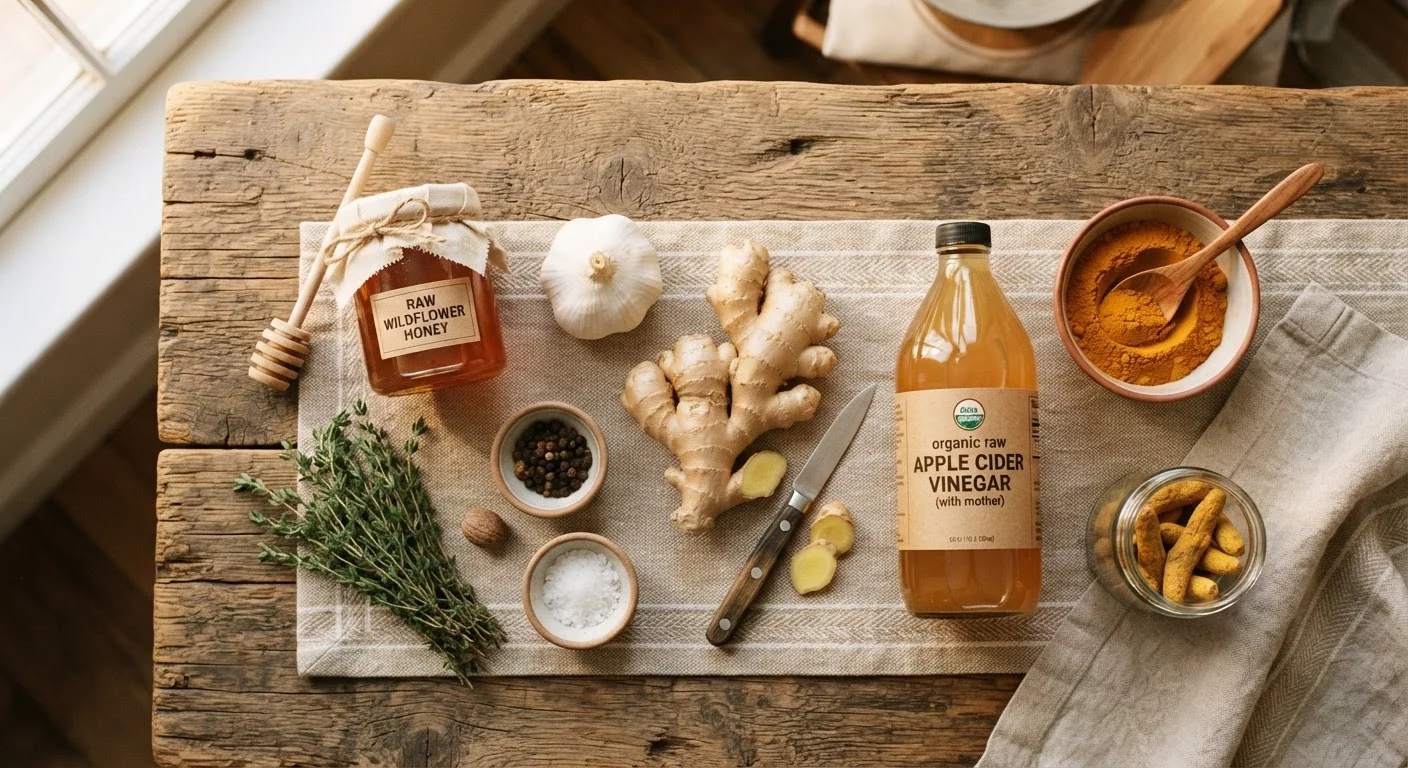
| Ingredients covered | 7 common pantry staples |
| Ailments indexed | 8 minor health complaints |
| Highest evidence ingredient | Colloidal oatmeal (FDA-recognized skin protectant) (U.S. Food and Drug Administration OTC monograph) |
| Honey safety note | Not safe for children under 12 months (CDC and AAP guidance) |
| Content type | General health information — not medical advice |
How to Use This Reference
This glossary pairs widely available kitchen ingredients with the minor health complaints they're most commonly associated with — whether through clinical research, traditional practice, or both. Each entry notes the evidence tier so you can judge confidence level at a glance. Think of it as a practical lookup tool, not a treatment guide.
This content is general health information only, not medical advice. Always consult a qualified healthcare professional before using any remedy for a health concern, especially if you take medications or have an existing condition.
For a deeper tour organized by pantry location, see our room-by-room pantry wellness guide. To understand how these remedies interact with conventional treatments, read our compatibility guide.
| Ingredients covered | 7 common pantry staples |
| Ailments indexed | 8 minor health complaints |
| Highest evidence ingredient | Colloidal oatmeal (FDA-recognized skin protectant) (U.S. Food and Drug Administration OTC monograph) |
| Honey safety note | Not safe for children under 12 months (CDC and AAP guidance) |
| Content type | General health information — not medical advice |
Ingredient-to-Ailment Reference Glossary
Entries are listed alphabetically by ingredient. Evidence tiers are defined in the glossary below.
Evidence Tier
A shorthand label used in this glossary to indicate the level of scientific support for a remedy's use. Tiers range from 'Good' (multiple human trials with consistent results) to 'Emerging' (early or limited human data) to 'Anecdotal' (traditional use without controlled study).
Colloidal Oatmeal
Finely milled oats suspended in a liquid base, commonly used in skin-soothing preparations. The FDA classifies it as a skin protectant, distinguishing it from regular dietary oatmeal.
Curcumin
The primary active polyphenol compound in turmeric, responsible for its yellow pigment and most studied biological properties. Its absorption in the body is limited without an enhancer such as piperine.
Bioavailability
The proportion of an ingested substance that enters the bloodstream and is available to produce an effect. Low bioavailability means most of a compound is processed before it can act.
Piperine
An alkaloid found in black pepper that can significantly increase curcumin absorption in the digestive tract, commonly paired with turmeric in supplement formulations.
Enteric-Coated
A pharmaceutical or supplement coating designed to prevent dissolution in the stomach, allowing the contents to be released in the intestines instead — relevant to peppermint oil capsules studied for IBS.
Antimicrobial
Having the ability to kill or inhibit the growth of microorganisms such as bacteria or fungi. Lab findings do not always translate to the same effects when used on human skin or internally.
Traditional Use
A remedy practice passed down through generations of cultural or folk medicine, not necessarily validated by controlled clinical trials. Traditional use can inform research questions but is not equivalent to scientific proof.
Apple Cider Vinegar
- Primary traditional uses
- Heartburn relief, blood sugar moderation after meals, minor sore throat
- Evidence tier
- Mixed — small clinical studies show modest post-meal glucose effects; heartburn use is anecdotal and mechanistically debated
- Key caution
- Undiluted use can erode tooth enamel; avoid if esophageal sensitivity is present
Garlic
- Primary traditional uses
- Immune support during cold season, mild antimicrobial topical application
- Evidence tier
- Emerging — some trials suggest reduced cold duration; topical use carries skin irritation risk
- Key caution
- Can interact with blood-thinning medications; consult a provider before use in that context
Ginger
- Primary traditional uses
- Nausea (including motion sickness and pregnancy-related nausea), digestive discomfort, mild inflammation
- Evidence tier
- Moderate clinical support for nausea; anti-inflammatory effects observed in lab studies
- Key caution
- Pregnant individuals should discuss use with a healthcare provider before relying on it for nausea management
Honey (Raw)
- Primary traditional uses
- Cough suppression, minor wound covering, sore throat coating
- Evidence tier
- Good — multiple trials support honey as comparable to some OTC cough suppressants in children over one year; wound use has clinical backing in specific contexts
- Key caution
- Never give honey to infants under 12 months due to botulism risk
Oatmeal (Colloidal)
- Primary traditional uses
- Itchy or irritated skin, mild eczema flares, sunburn soothing
- Evidence tier
- Good — colloidal oatmeal is an FDA-recognized skin protectant with clinical data supporting barrier function
- Key caution
- Topical use only; not applicable as a dietary remedy for skin conditions
Peppermint
- Primary traditional uses
- Tension headache (topical oil), indigestion, bloating
- Evidence tier
- Moderate — enteric-coated peppermint oil studied for IBS symptoms; topical application for headache has small-trial support
- Key caution
- Can worsen acid reflux; avoid near infants' faces due to respiratory risk from menthol
Turmeric (Curcumin)
- Primary traditional uses
- Joint discomfort, post-exercise soreness, digestive support
- Evidence tier
- Emerging — curcumin shows anti-inflammatory activity in vitro; human bioavailability is low without piperine (black pepper)
- Key caution
- High supplemental doses may interact with anticoagulant medications
For plant-based remedies beyond the kitchen pantry, explore our herbal remedies hub or consult the everyday herb cabinet reference.
Natural Doesn't Always Mean Safe for Everyone
Several ingredients in this glossary — including garlic, peppermint, and turmeric — have known interactions with common medications such as anticoagulants. Special populations including pregnant individuals, young children, and those managing chronic conditions should not rely on this glossary alone. Consult a qualified healthcare provider before using any kitchen remedy as a regular health intervention.
Matching Ailments to Ingredients: Reverse Lookup
If you know your complaint and want to find relevant ingredients, use this index. All entries correspond to the detailed glossary above.
FDA-recognized
Colloidal oatmeal as a skin protectant
The U.S. FDA includes colloidal oatmeal in its OTC skin protectant monograph, one of the few kitchen-derived ingredients with this regulatory distinction.
~33%
Reduction in cold duration with garlic (select trials)
A Cochrane-referenced review noted some evidence suggesting garlic supplementation may reduce cold duration, though researchers flagged the need for larger, high-quality trials.
Low
Curcumin bioavailability without enhancers
Research consistently notes that curcumin is poorly absorbed when consumed without piperine or a lipid-based carrier, limiting its real-world effectiveness from food alone.
| Ailment | Relevant Ingredient(s) | Evidence Tier |
|---|---|---|
| Nausea | Ginger | Moderate |
| Cough / Sore throat | Honey, Apple cider vinegar | Good / Anecdotal |
| Headache (tension) | Peppermint (topical) | Moderate |
| Itchy / irritated skin | Colloidal oatmeal | Good |
| Bloating / indigestion | Peppermint, Ginger | Moderate |
| Joint / muscle soreness | Turmeric | Emerging |
| Cold duration | Garlic | Emerging |
| Post-meal blood sugar | Apple cider vinegar | Mixed |
Understanding how any of these fit alongside conventional care matters as much as knowing the remedy itself. Our compatibility guide covers which combinations are generally safe and which warrant caution. For a broader scientific and historical framing, the full-spectrum herbal medicine guide is a useful complement to this reference.
This article is for informational purposes only and is not a substitute for professional medical advice, diagnosis, or treatment.