

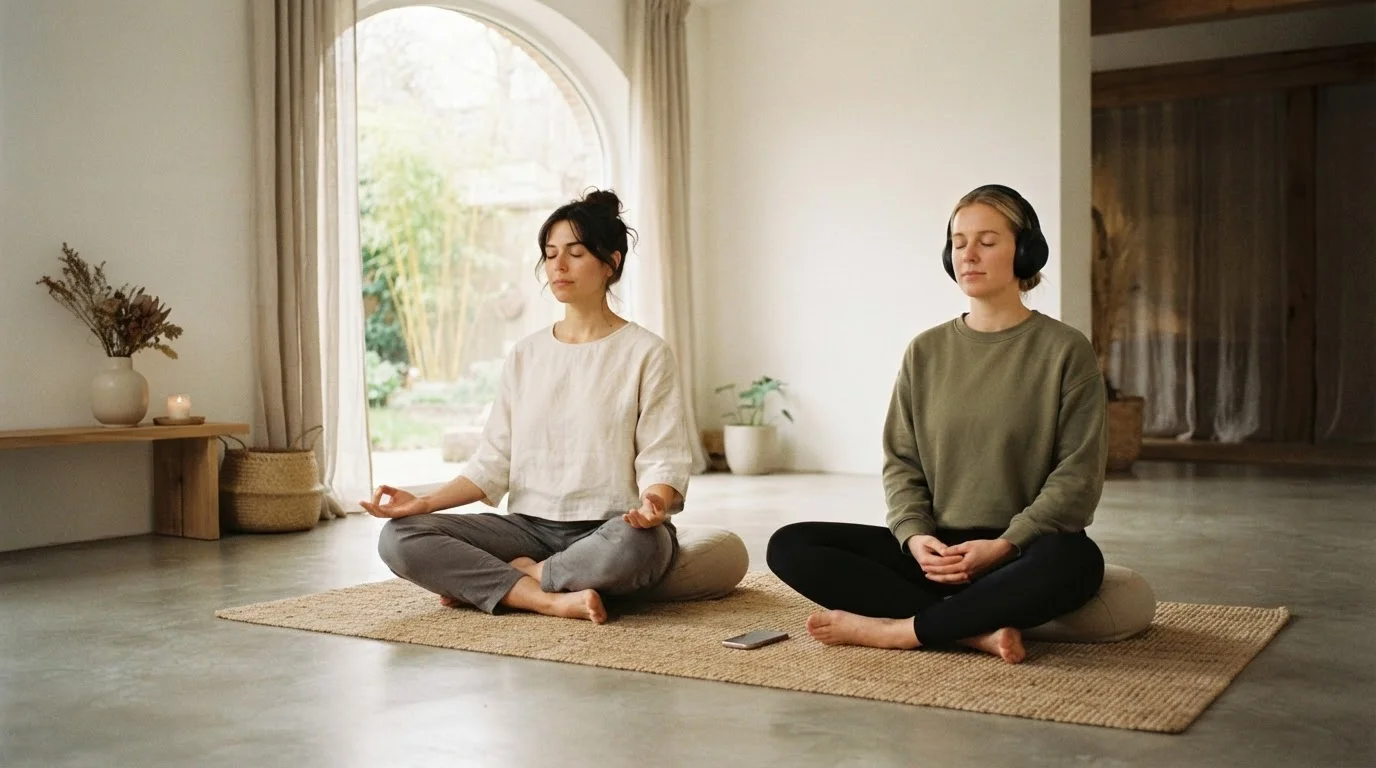
Key Takeaways
- Breath awareness uses your own breathing as a silent anchor; no app or audio is required.
- Guided meditation provides verbal prompts that walk you through each step of a session.
- Both approaches share the same core goal: training attention and reducing stress.
- Breath awareness builds independent concentration skills over time; guidance offers immediate structure.
- Switching between both styles is common and often beneficial as your practice matures.
- Neither method requires prior experience — both are accessible starting points for adults.
Option A
Breath Awareness Meditation
The self-directed, anchor-based practice.
Best for: People who prefer silence, want to build independent focus, and can sit comfortably with minimal instruction.
Option B
Guided Meditation
The instructor-led, structure-supported approach.
Best for: Beginners or busy adults who benefit from external prompts, narration, and a clear session format to stay on track.
If you want a practice you can do anywhere, anytime without technology
Breath Awareness Meditation
Because it requires no audio, app, or equipment, breath awareness is the most portable option. Your anchor is always with you.
If your mind races and you struggle to stay on track alone
Guided Meditation
A narrator's steady voice gives the wandering mind something concrete to follow, reducing the frustration that often derails new practitioners.
If you're building a long-term independent meditation habit
Breath Awareness Meditation
Over time, self-directed breath practice strengthens attentional control in ways that don't depend on external scaffolding.
If you're completely new to meditation and feel intimidated by silence
Guided Meditation
Guided sessions lower the entry barrier by providing structure, making the first few weeks feel manageable and encouraging.
If you want to explore different meditation traditions before committing to one style
Guided Meditation
Guided formats span body scans, loving-kindness, visualisation, and more — letting you sample widely without separate instruction for each.
What Each Practice Actually Involves
At its core, breath awareness meditation asks you to sit quietly, close your eyes, and place your full attention on the physical sensation of breathing — the rise of your chest, the coolness of air at your nostrils, the pause between exhale and inhale. When your mind wanders (and it will), you notice this and gently return. That cycle of noticing and returning is the practice. No audio, no narration, no guiding voice required.
Guided meditation, by contrast, relies on an instructor or recorded voice to direct your attention step by step. A session might open with an invitation to relax your shoulders, move through a body scan, introduce a visualisation, and close with a few moments of silence. The guide makes all the structural decisions so you don't have to. For a broader look at where both approaches sit within the wider landscape of meditation, see our plain-language glossary of meditation styles.
| Criterion | Breath Awareness | Guided Meditation |
|---|---|---|
| Instruction needed | None after basic orientation | Audio or instructor each session |
| Equipment required | None | Device or recording |
| Best for beginners | Moderate — silence can feel hard | High — structure eases entry |
| Builds independent focus | Strong over time | Moderate; relies on guide |
| Session flexibility | Fully flexible, any length | Tied to recording length |
| Style variety | Limited to breath focus | Wide: body scan, visualization, etc. |
| Immediate relaxation response | Builds gradually | Often quicker for new practitioners |
How Each Affects Focus and Stress
Research in mindfulness science consistently links breath-focused attention training to improvements in sustained concentration and reduced reactivity to stress. Because the practitioner continually self-corrects without external prompts, the skill of redirecting attention becomes highly transferable to daily life — at work, in conversation, or during difficult moments.
Guided meditation tends to produce measurable relaxation responses more immediately, partly because the pacing and tone of a skilled narrator activates the parasympathetic nervous system — the body's "rest and digest" mode. Studies on app-based guided programs have found reductions in self-reported stress and anxiety after relatively short intervention periods, though researchers note that effects vary widely by individual and program quality.
8 weeks
Typical MBSR program duration
The Mindfulness-Based Stress Reduction program, developed at UMass Medical School, uses eight weeks of structured breath-focused practice to study stress reduction outcomes.
~65%
Adults who report stress daily
According to the American Psychological Association's ongoing Stress in America research, a substantial majority of U.S. adults report experiencing stress on most days.
It's worth understanding that breath is a powerful tool beyond seated meditation, too. Our related piece on breathwork principles in calming yoga explores how conscious breathing extends naturally into movement practices.
Who Typically Thrives With Each Style
Breath awareness tends to suit people who already have some comfort with stillness, who prefer simplicity, or who want a practice that works just as well on a park bench as on a meditation cushion. It also suits those drawn to a secular, skill-based framework. If you've explored other format differences — such as open-eye versus closed-eye meditation — you're likely ready to experiment with self-directed breath work.
Guided meditation tends to click for beginners, for people managing high anxiety levels, and for those who find silence activates more mental chatter rather than less. It's also a natural entry point for anyone curious about how mindfulness compares to other traditions, since guided formats often blend techniques from multiple lineages. If you're drawn to deep rest practices alongside meditation, you might also explore how yoga nidra differs from seated meditation.
Practical Starting Points for Each Approach
To try breath awareness: set a timer for five minutes, sit in a comfortable upright position, and direct your attention to the physical sensation of your breath. Each time a thought carries you away, note it without judgment and return to the breath. No special setup is needed. Gradually extend the duration as your tolerance for stillness grows.
To try guided meditation: choose a session length of ten to fifteen minutes from a reputable source — many libraries, wellness platforms, and non-profit organizations offer free recordings. Look for sessions with a calm, measured pace and a clear theme (sleep, focus, anxiety relief) so you can evaluate what resonates. You can also combine both: use guidance to open a session and sit in silent breath awareness for the final few minutes.
Whichever you begin with, consistency matters more than duration. Short, regular sessions — even five minutes daily — tend to yield more noticeable benefits than occasional longer ones. If you want to understand how breath patterns extend into your physical activity as well, our article on breathing and movement offers a practical complement to your seated practice.
This article is for general informational and educational purposes only and is not a substitute for professional medical or psychological advice. If you have a mental health condition or are experiencing significant distress, please consult a qualified healthcare professional.