

Key Takeaways
- Testosterone affects mood, energy, bone density, fat metabolism, and sleep — not just libido and muscle.
- Most testosterone in the blood is bound to proteins; only free testosterone is biologically active.
- Levels naturally decline with age, typically beginning in a man's 30s.
- Low testosterone is a clinical condition that requires a doctor's assessment, not self-diagnosis.
- Lifestyle factors including sleep, exercise, and nutrition can influence hormonal health within normal ranges.
Testosterone
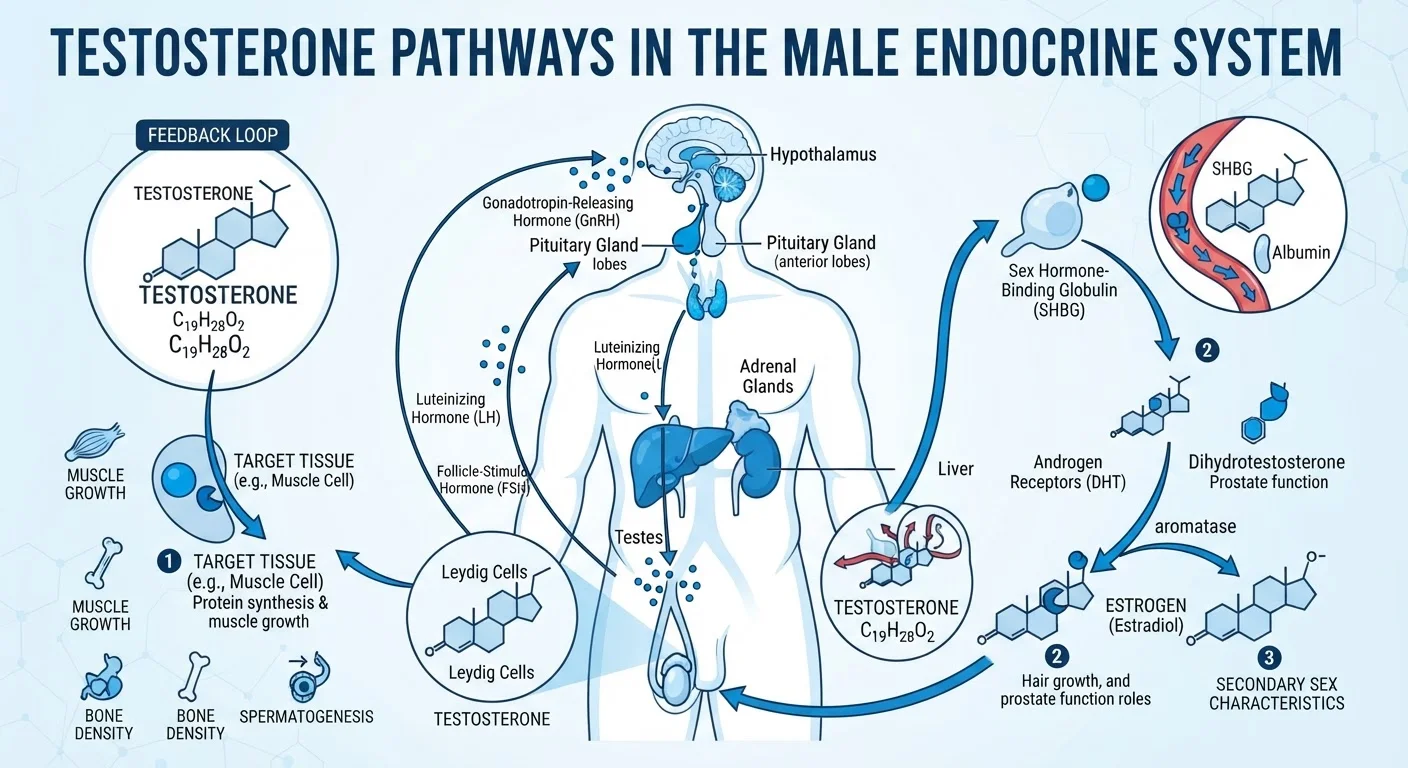
Testosterone is the primary male sex hormone, classified as an androgen, and produced mainly in the testes with smaller amounts made by the adrenal glands. It plays a central role in male development, reproduction, and a wide range of physiological processes throughout life — from regulating mood and metabolism to maintaining bone density and muscle mass. While commonly associated with sex drive and physical strength, its influence extends to nearly every major organ system in the body.
Testosterone circulates in the bloodstream in two forms: bound (attached to proteins like SHBG and albumin) and free (unbound and biologically active). Only free testosterone can enter cells and exert hormonal effects, which is why total testosterone levels alone don't always tell the full story.
More Than a Sex Hormone
When most people hear the word testosterone, they think muscle and sex drive. That association isn't wrong — testosterone does regulate both. But reducing the hormone to those two functions misses the scope of what it actually does in the body every day.
Testosterone is produced primarily in the Leydig cells of the testes, under instruction from the brain's hypothalamic-pituitary axis. The hypothalamus releases gonadotropin-releasing hormone (GnRH), which signals the pituitary gland to release luteinizing hormone (LH), which in turn tells the testes to produce testosterone. This feedback loop is self-regulating: when levels rise, the brain dials production back; when they fall, production increases.
Understanding this system matters because symptoms of hormonal imbalance can originate at multiple points along the pathway — not just in the testes themselves. For a deeper look at how these levels shift across a man's life, see how testosterone changes from your 20s to your 60s.
1–2%
Annual testosterone decline after age 35
Research estimates that total testosterone decreases by roughly 1–2% per year beginning in a man's mid-30s, though individual variation is significant.
300–1,000 ng/dL
Normal total testosterone range for adult men
Reference ranges vary by laboratory, but most clinical guidelines use this range as a general benchmark for adult male testosterone levels.
~15%
Testosterone reduction after one week of sleep restriction
A study published in the Journal of the American Medical Association found that restricting sleep to five hours per night for one week reduced testosterone levels by 10–15% in young men.
The Body Systems Testosterone Influences
Testosterone's effects are wide-reaching because androgen receptors are found throughout the body — in muscle tissue, bone, the brain, the cardiovascular system, and fat cells.
Muscle and Physical Composition
Testosterone stimulates muscle protein synthesis and inhibits protein breakdown, supporting the maintenance of lean mass. It also influences how the body distributes fat. Lower testosterone is associated with increased visceral fat accumulation — the type stored around the abdominal organs — which itself has metabolic consequences. The relationship between body composition and hormones is bidirectional: body fat directly affects testosterone metabolism.
Bone Density
Testosterone plays a critical role in bone mineral density. It stimulates bone-forming cells (osteoblasts) and is partially converted to estradiol — a form of estrogen — within bone tissue, which also supports bone maintenance. Men with chronically low testosterone face a higher risk of osteopenia and osteoporosis over time.
Red Blood Cell Production
Testosterone stimulates erythropoiesis — the production of red blood cells — by prompting the kidneys to release erythropoietin. This is why adequate testosterone levels are linked to healthy hemoglobin levels and why exogenous testosterone can cause polycythemia (excess red blood cells) as a clinical side effect.
Mood, Cognition, and Sleep
The brain is densely populated with androgen receptors, particularly in regions governing mood, motivation, and executive function. Research has documented consistent associations between low testosterone and increased rates of depression, irritability, reduced motivation, and impaired concentration in men. These aren't vague complaints — they reflect real neurological mechanisms.
Testosterone also interacts with dopaminergic and serotonergic pathways, influencing the brain's reward system and emotional regulation. This doesn't mean testosterone is a mood cure-all, but it does mean that mood symptoms in men shouldn't automatically be divorced from hormonal considerations.
Sleep adds another layer. Testosterone is primarily secreted during sleep, with the largest pulse occurring in the early morning hours. Chronic sleep deprivation demonstrably reduces testosterone levels — research has shown that even one week of restricted sleep can meaningfully lower levels in young, healthy men. The relationship runs in both directions: low testosterone can also disrupt sleep quality and is associated with sleep apnea risk.
“Testosterone is not simply a 'male hormone' in the narrow sense — it is a systemic regulator that touches nearly every tissue in the body, including the brain. Ignoring its broader roles leads to an incomplete understanding of men's health across the lifespan.”
— Dr. Abraham Morgentaler, Urologist and Clinical Professor, Harvard Medical School; author of research on testosterone and men's health
What Can Influence Testosterone Levels
Testosterone levels aren't static. While genetics and age set a broad baseline, numerous modifiable factors shape where a man's levels fall within — or outside — the normal range.
- Sleep: Poor or insufficient sleep consistently suppresses testosterone. Prioritizing seven to nine hours of quality sleep is one of the most evidence-supported ways to support hormonal health.
- Exercise: Resistance training in particular is associated with acute and longer-term support of testosterone production. Chronic overtraining without adequate recovery, however, can have the opposite effect.
- Body weight: Excess adipose tissue (body fat) converts testosterone to estrogen via an enzyme called aromatase, reducing circulating testosterone over time.
- Chronic stress: Elevated cortisol — the primary stress hormone — competes with testosterone at the receptor level and suppresses its production.
- Nutrition: Certain micronutrients are involved in testosterone synthesis. Zinc, vitamin D, and magnesium have the most credible evidence behind them.
For a grounded overview of which lifestyle strategies have real research support, see what the evidence actually shows about natural approaches. And to separate fact from popular mythology, testosterone and physical vitality: separating biology from myth is worth reading alongside this piece.
This article is for general informational purposes only and does not constitute medical advice. If you have concerns about your hormone levels or symptoms, consult a qualified healthcare provider for proper evaluation and guidance.