
Sleep, Stress, Movement, Nutrition: What Each Wellness Quiz Domain Is Really Testing

Why Wellness Quizzes Are Organized by Domain
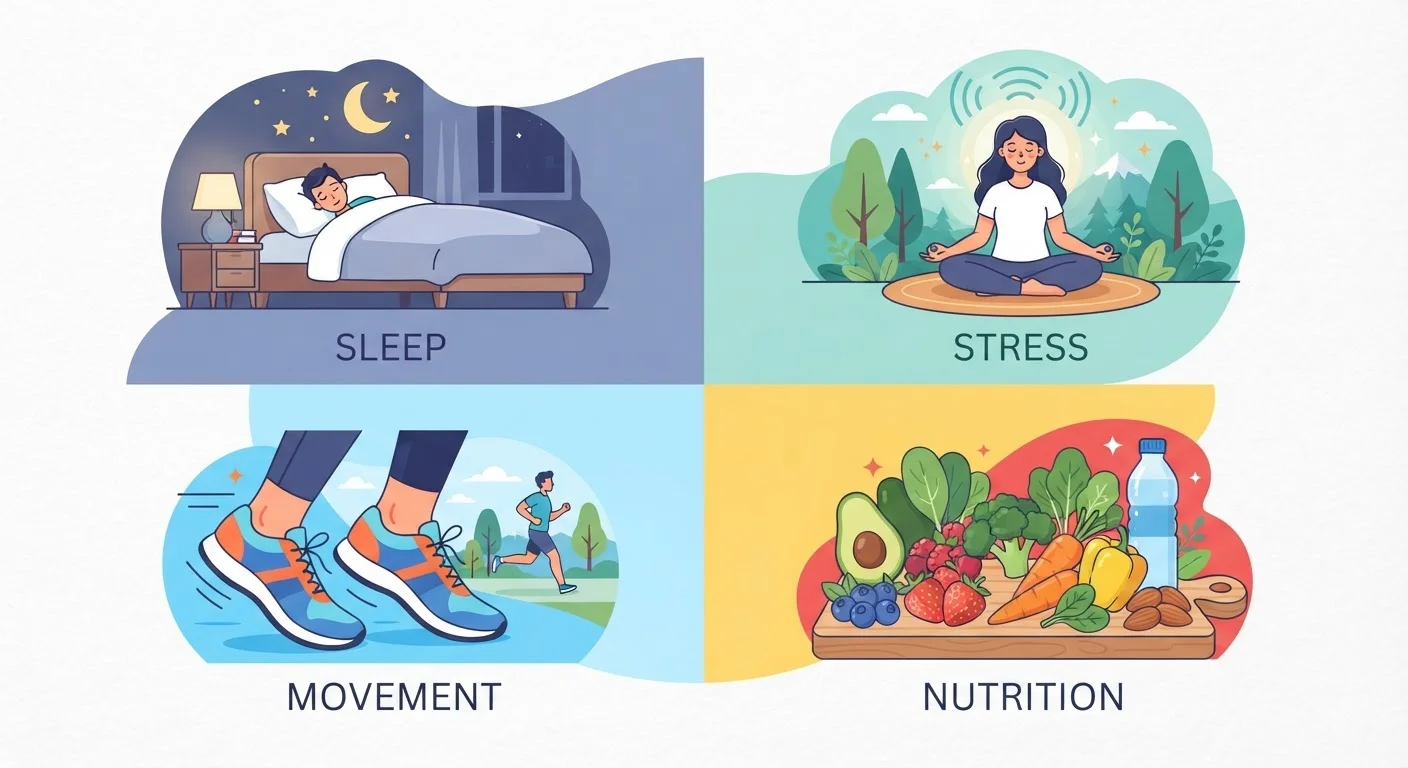
Wellness quizzes rarely ask random questions. They are structured around domains — clusters of related behaviors and experiences that research has consistently linked to health outcomes. The four domains that appear most often are sleep, stress, movement, and nutrition. Understanding what each domain is actually probing helps you interpret your results with more precision and act on them more effectively.
For a broader look at what these tools can and cannot tell you, see what wellness quizzes actually measure. This reference focuses on what sits behind the questions themselves.
Sleep: More Than Hours in Bed
Sleep questions rarely stop at "How many hours do you sleep?" A well-constructed sleep domain assesses at least three dimensions: duration (total sleep time), quality (how restorative the sleep feels), and consistency (whether your sleep and wake times are relatively stable across the week).
Behavioral indicators quizzes probe here include how long it takes to fall asleep, how often you wake during the night, and whether you feel rested in the morning. These map loosely onto clinical constructs like sleep onset latency and sleep efficiency — metrics used in formal tools such as the Pittsburgh Sleep Quality Index.
What the quiz cannot detect: underlying sleep disorders such as sleep apnea, periodic limb movement disorder, or circadian rhythm disruptions that require clinical evaluation. If your quiz score flags persistent poor sleep, that is a prompt to discuss it with a healthcare provider, not a diagnosis. See how validated questionnaires differ from informal quizzes for context on where informal tools have limits.
Sleep onset latency
The amount of time it takes a person to fall asleep after getting into bed. Consistently long latency — often defined clinically as more than 30 minutes — is associated with poorer sleep quality.
Sleep efficiency
The ratio of time spent asleep to total time spent in bed, expressed as a percentage. Higher efficiency generally reflects more consolidated, restorative sleep.
Perceived stress
A person's subjective sense of how unmanageable or overwhelming the demands of daily life feel. It differs from objective stressor load and is shaped by individual coping resources and appraisal.
Sedentary behavior
Waking activity characterized by very low energy expenditure, most commonly prolonged sitting. Research treats it as a distinct health risk, separate from whether a person meets overall activity targets.
Dietary pattern
The overall combination and frequency of foods consumed habitually over time, rather than the nutrient content of individual meals. Pattern-based approaches are central to current nutrition science.
Emotional regulation
The ability to recognize, understand, and manage emotional responses. In wellness assessments, it is increasingly treated as a measurable component of mental and stress health.
Stress: Frequency, Intensity, and Recovery
The stress domain is the most psychologically layered of the four. Quizzes in this space typically measure perceived stress — how overwhelming daily demands feel — rather than objective stressors. This distinction matters: two people facing the same workload may report very different stress levels depending on their coping resources and appraisal style.
Questions often probe how frequently you feel overwhelmed or out of control, whether you have reliable recovery time, and how stress manifests physically (tension, fatigue, disrupted sleep). Some tools also include items on emotional regulation — whether you can name and manage negative emotions rather than suppressing or ruminating on them.
The key domains a meaningful self-assessment should cover article expands on why emotional regulation is increasingly treated as its own wellness indicator. For domain-specific comparisons, how quizzes differ across physical, mental, and social health is a useful companion read.
Movement: Volume, Type, and Functional Capacity
Movement questions in wellness quizzes assess three layers: aerobic activity volume (how many days and minutes per week), strength or resistance activity, and sedentary behavior — particularly prolonged sitting, which research treats as a distinct risk factor independent of overall activity levels.
A quiz may ask whether you meet general physical activity recommendations (for adults, these are often expressed as moderate-intensity aerobic activity across most days of the week, alongside muscle-strengthening activity — check current guidelines from your national health authority for specifics). It may also ask about functional movement: can you climb stairs, carry groceries, or sustain balance without difficulty? These items reflect everyday physical capacity, not just gym attendance.
27%
U.S. adults meeting both aerobic and muscle-strengthening guidelines
According to data from the U.S. Centers for Disease Control and Prevention, fewer than one in three adults meet both components of recommended physical activity guidelines.
6–8 hrs
Recommended nightly sleep for most adults
Major health authorities, including the American Academy of Sleep Medicine, recommend 7–9 hours for adults, with fewer than 6 hours consistently associated with adverse health outcomes.
55%+
Waking hours typically spent sedentary
Research published in epidemiological journals estimates that many U.S. adults spend more than half their waking hours in sedentary behavior, independent of leisure exercise habits.
Men's and women's wellness programs often weight movement questions differently based on population-specific patterns. Resources like the men's mental wellness hub and the everyday women's wellness hub provide context for how movement intersects with stress and mood across different groups.
Nutrition: Patterns Over Perfection
Nutrition is the domain where quiz questions most often feel frustratingly blunt. Because quizzes cannot analyze what you ate yesterday, they focus on habitual dietary patterns: how frequently you eat vegetables, fruit, whole grains, and legumes; how often ultra-processed foods dominate meals; and whether meals are skipped regularly.
Some tools also ask about meal timing and eating context — whether you often eat quickly, under distraction, or due to emotional cues rather than hunger. These behavioral markers give a fuller picture than nutrient counts alone.
Critically, nutrition quiz scores should never be used to derive calorie targets or specific dietary prescriptions. If your results suggest an area to improve — say, low vegetable variety — the appropriate next step is general habit-building, not self-prescribed elimination plans. Anyone managing a health condition that affects dietary needs should consult a registered dietitian before making significant changes.
For the complete picture of how wellness quizzes fit into a broader self-awareness practice, the complete guide to wellness quizzes as a health awareness tool covers interpretation and habit-building in depth.
This article is for informational and educational purposes only and does not constitute medical advice. Always consult a qualified healthcare professional for personal health concerns, diagnosis, or treatment decisions.