

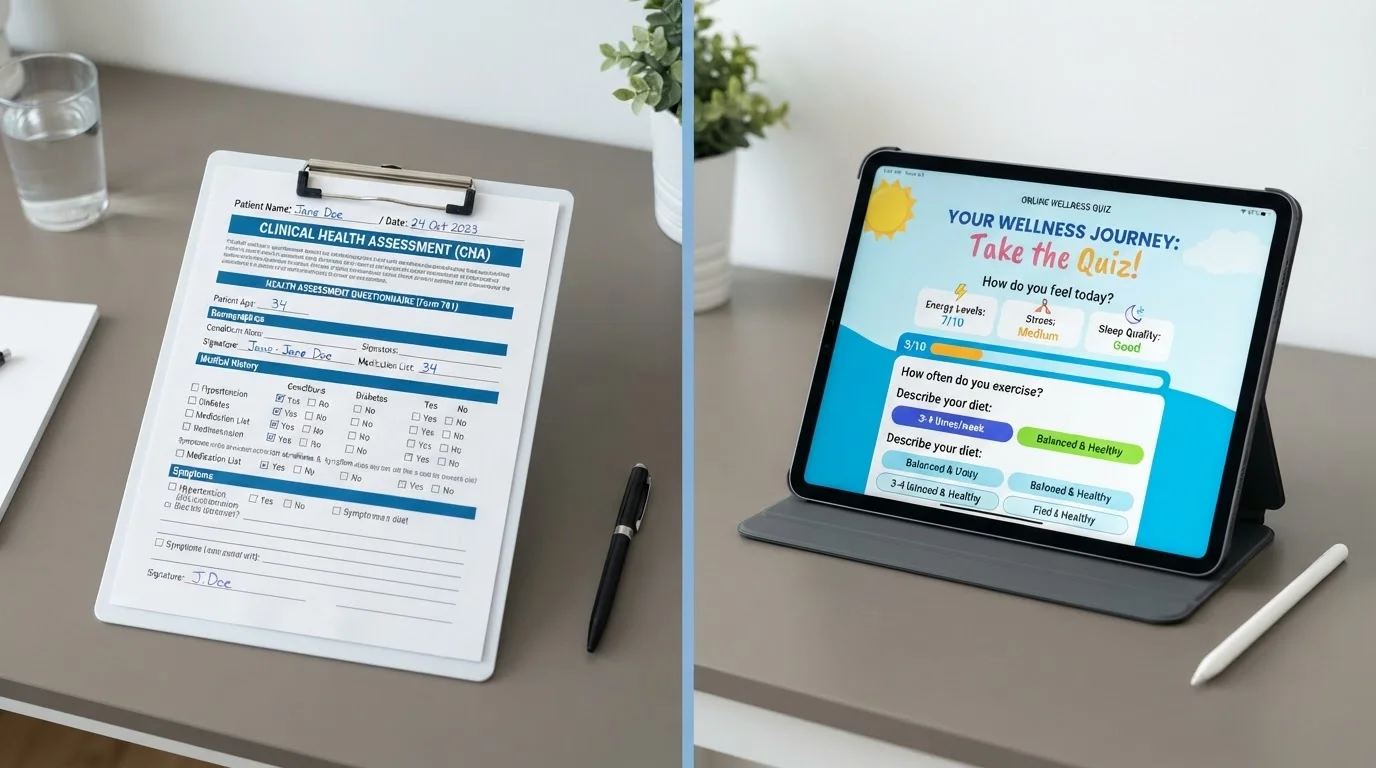
Key Takeaways
- Validated questionnaires are developed through rigorous research and tested for reliability and accuracy across populations.
- Informal wellness quizzes can prompt useful self-reflection but carry no clinical weight or standardized scoring.
- Neither tool replaces a professional evaluation — both serve different purposes in a personal health journey.
- Understanding which type of quiz you're using helps you interpret results appropriately.
- Red flags in informal quizzes include vague scoring, product recommendations, and undefined methodology.
Option A
Validated Health Questionnaires
The clinically tested, research-backed standard.
Best for: Individuals seeking structured, evidence-based screening that aligns with how healthcare providers assess risk or symptom severity.
Option B
Informal Wellness Quizzes
The accessible, self-guided awareness starter.
Best for: Anyone looking for a low-barrier entry point to reflect on daily habits, stress levels, or lifestyle patterns without clinical context.
If you want a reliable starting point for a clinical conversation
Validated Health Questionnaires
Tools like the PHQ-9 or GAD-7 are designed to produce results a provider can meaningfully interpret alongside your history and symptoms.
If you want a quick check-in on your general lifestyle habits
Informal Wellness Quizzes
A well-constructed informal quiz can highlight areas of daily life worth examining, like sleep quality or stress load, without requiring clinical infrastructure.
If you are tracking changes in mood, energy, or mental health over time
Validated Health Questionnaires
Standardized scoring allows for meaningful comparison across time, making validated tools more useful for monitoring patterns than informal alternatives.
If you are new to wellness self-assessment and exploring where to start
Informal Wellness Quizzes
Their approachable format and broad framing make them a useful first step before deciding whether a more structured assessment is warranted.
What Makes a Questionnaire 'Validated'?
A validated health questionnaire is one that has undergone systematic testing to confirm it measures what it claims to measure — accurately and consistently. Validation typically involves multiple phases: item development grounded in clinical theory, testing across diverse populations, and statistical analysis to confirm reliability (the tool gives similar results when conditions are stable) and validity (the tool actually reflects the underlying construct it targets).
Well-known examples include the PHQ-9 for depression screening, the GAD-7 for generalized anxiety, and the Pittsburgh Sleep Quality Index for sleep disturbance. Each has published sensitivity and specificity data, meaning researchers know how often these tools correctly identify those with and without the condition in question.
Healthcare providers use these instruments because the results are interpretable within a clinical framework — a score doesn't just feel meaningful, it corresponds to a defined threshold with established clinical significance. That's a very different proposition from most wellness quizzes found online. For a broader look at what self-assessment tools can and cannot reveal, see what wellness quizzes actually measure.
How Informal Wellness Quizzes Are Built — and Why It Matters
Informal wellness quizzes are generally created by content teams, wellness brands, or app developers rather than clinical researchers. They are rarely subjected to the psychometric testing required for validation. This doesn't make them worthless — a thoughtfully crafted quiz can still prompt meaningful self-reflection — but it does mean the results must be held lightly.
The key structural differences often include:
- Undefined scoring logic: How individual answers combine into an overall result is rarely transparent.
- Broad, non-specific questions: Items like "Do you feel tired often?" lack the precision needed to differentiate meaningfully between causes or severity levels.
- No normative data: Without population benchmarks, there's no way to know whether a "moderate" result reflects a genuine concern or just an average day.
Understanding these gaps is important because informal quizzes are often the first wellness tool a person engages with. Knowing their limits helps you use them wisely. Common misconceptions about wellness quizzes explores this further, particularly the tendency to treat quiz outcomes as diagnoses.
| Criterion | Validated Questionnaires | Informal Wellness Quizzes |
|---|---|---|
| Development process | Peer-reviewed, psychometric testing | Editorial or brand-driven creation |
| Scoring transparency | Published, standardized cutoffs | Often opaque or arbitrary |
| Clinical utility | Used in provider settings | Not clinically applicable |
| Reliability over time | Tested for test-retest reliability | Rarely assessed |
| Accessibility | Often available free online or via clinics | Widely available, no barriers |
| Best use | Symptom tracking, clinical prep | Habit reflection, awareness |
| Risk of misinterpretation | Lower with proper guidance | Higher without clinical context |
Where Each Tool Has Genuine Value
Despite their differences, both validated questionnaires and informal quizzes serve real purposes when applied appropriately.
Validated tools shine when you need structured data — for instance, tracking whether anxiety symptoms have shifted over several weeks, or preparing for a mental health appointment with something concrete to share. Their standardized format means results are comparable across time and across individuals.
Why the same quiz gives different results two weeks apart explains why this consistency matters and what genuine change in scores actually looks like.
Informal quizzes are useful as awareness prompts. A quiz that asks you to rate your sleep, movement, stress, and nutrition habits in a single sitting can surface patterns you hadn't consciously noticed — not because the scoring is clinically meaningful, but because the act of structured self-reflection itself has value. See the psychology behind why wellness quizzes feel so revealing for more on this mechanism.
PHQ-9
Widely used validated depression screener
The PHQ-9 has demonstrated sensitivity above 80% for detecting major depressive disorder in primary care settings, according to published validation studies.
GAD-7
Standard anxiety screening tool
The GAD-7 was validated in a study of over 2,700 patients and is now used routinely in clinical and research settings to assess generalized anxiety severity.
This article is for general informational purposes only and does not constitute medical advice. Always consult a qualified healthcare professional for personal health concerns, diagnosis, or treatment decisions.