

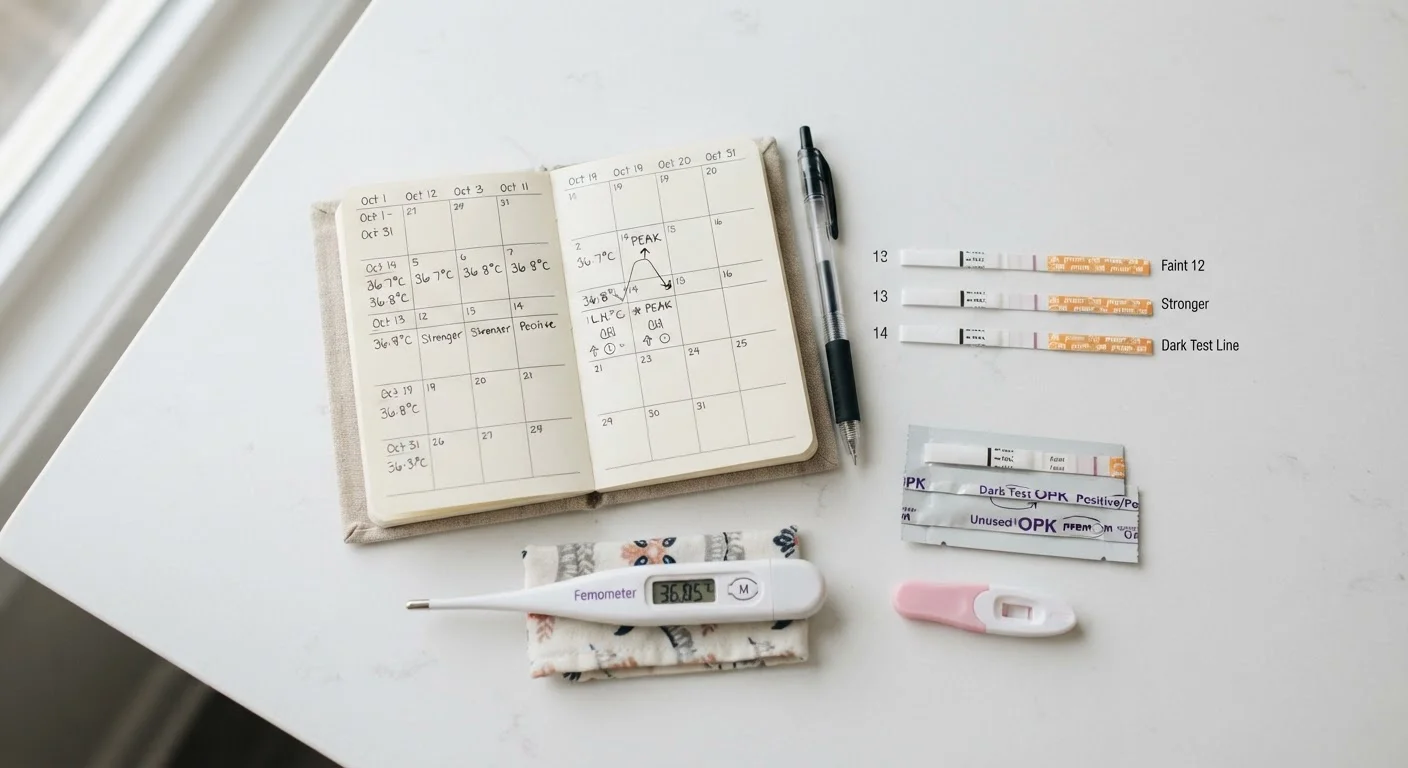
Key Takeaways
- No single ovulation tracking method is perfectly accurate on its own; combining approaches improves reliability.
- Basal body temperature confirms ovulation has already occurred rather than predicting it in advance.
- Cervical mucus observation is free and continuous, but requires consistent daily attention and practice.
- OPKs detect the LH surge before ovulation but cannot confirm that ovulation actually followed.
- Individual cycle variability means personal experience matters as much as method accuracy statistics.
- Consult a healthcare provider if you have concerns about ovulation, fertility, or cycle irregularities.
Our Verdict
Each of the three methods measures a different biological signal, which means they complement rather than replace each other. BBT charting offers confirmation after the fact; cervical mucus gives real-time, hormone-driven information at no cost; and OPKs provide advance warning of the LH surge with relatively little interpretation required. For most people, a combination of two or more approaches yields the clearest picture of their cycle.
| Best for | Recommended |
|---|---|
| Those who want retrospective cycle confirmation and pattern data over time | Basal Body Temperature (BBT) Charting |
| Those seeking a zero-cost, hormone-connected daily awareness practice | Cervical Mucus Observation |
| Those who want a straightforward, predictive signal with minimal interpretation | Ovulation Predictor Kits (OPKs) |
| Those trying to conceive or build detailed cycle awareness | Combination of all three methods |
Why Ovulation Tracking Methods Are Not Interchangeable
Ovulation tracking isn't one-size-fits-all — the three most commonly used methods (basal body temperature charting, cervical mucus observation, and ovulation predictor kits) each measure a different hormonal or physiological signal at a different point in the cycle. Understanding what each one actually detects helps you choose the approach — or combination of approaches — that fits your body, lifestyle, and goals.
Whether you're trying to conceive, practicing fertility awareness for contraception, or simply building hormonal self-awareness, knowing the mechanics behind each method matters. It's also worth noting upfront: none of these methods is a diagnostic tool, and none replaces guidance from a qualified healthcare provider for fertility or reproductive concerns.
Combining Methods Builds a Fuller Picture
Using two or more methods together — for example, BBT alongside cervical mucus observation — helps cross-check signals and reduces the chance of missing your fertile window due to one method's limitations. Many fertility awareness educators recommend this "symptothermal" approach as a way to build both predictive and confirmatory data simultaneously. Even a few months of consistent tracking can help you recognize your own cycle patterns more clearly.
Basal Body Temperature: A Confirmatory Signal
Basal body temperature (BBT) is your body's resting temperature, taken first thing in the morning before any movement or activity. After ovulation, the hormone progesterone causes a sustained rise of roughly 0.2–0.5°C (about 0.4–1.0°F) that persists until your next period. Charting this shift over several cycles reveals your ovulation pattern retrospectively.
What it tells you: BBT confirms that ovulation has most likely occurred — it does not predict when it will happen. This makes it most useful for identifying patterns over multiple cycles rather than timing intercourse in a single cycle.
Accuracy considerations: BBT readings are highly sensitive to disruptions: alcohol, illness, poor sleep, travel, and even a change in wake-up time can shift your temperature. Consistent measurement conditions are essential. Research suggests BBT charting can identify the post-ovulatory phase reliably when tracked carefully, but pinpointing the fertile window prospectively is less accurate.
Best suited for: People who are disciplined morning trackers, who want to build a longitudinal picture of their cycles, or who are combining methods. BBT also pairs well with phase-by-phase cycle observation.
Cervical Mucus: Your Body's Built-In Fertility Signal
Cervical mucus — the discharge produced by the cervix — changes in texture, color, and quantity throughout the menstrual cycle in direct response to rising and falling estrogen levels. As ovulation approaches, mucus typically becomes more abundant, clearer, and stretchy (often described as resembling raw egg whites). This quality supports sperm survival and motility. After ovulation, it typically becomes thicker and less noticeable.
What it tells you: Daily mucus observation provides a real-time, continuous hormonal signal — the only one of the three methods that does so without equipment. The presence of fertile-quality mucus indicates that estrogen is rising and ovulation may be approaching, making it a genuinely prospective indicator.
Accuracy considerations: Cervical mucus observation requires learning to recognize your own patterns, which takes time. Infections, certain medications, sexual arousal, and vaginal products can all affect mucus appearance. Studies on fertility awareness methods that include mucus observation generally show reasonable effectiveness when the method is learned properly and applied consistently — but the learning curve is real. For a deeper look at what each stage of mucus reflects hormonally, see what your cervical mucus can tell you.
Best suited for: Those comfortable with daily body observation and willing to invest time in learning their personal patterns.
Ovulation Predictor Kits: A Measurable Hormone Surge
Ovulation predictor kits (OPKs) detect the surge in luteinizing hormone (LH) that typically precedes ovulation by 24–36 hours. Most use urine test strips; more advanced versions also measure estrogen metabolites to extend the detectable fertile window. A positive result indicates the LH surge is underway, signaling that ovulation is likely imminent.
What it tells you: OPKs are the most predictive of the three methods — they offer advance notice rather than retrospective confirmation. However, a positive OPK does not guarantee that ovulation will actually follow. Conditions such as polycystic ovary syndrome (PCOS) can cause multiple LH surges without ovulation occurring, making OPK interpretation more complex for some users.
OPKs and PCOS: Interpret With Care
People with polycystic ovary syndrome (PCOS) often have chronically elevated or multiple LH surges throughout their cycle, which can produce positive OPK results even when ovulation does not follow. If you have PCOS or irregular cycles, OPK results alone may be misleading. Discuss ovulation monitoring options with your healthcare provider for guidance tailored to your situation.
Accuracy considerations: Head-to-head, OPKs generally detect the LH surge reliably in people with regular cycles. Testing at the same time each day (typically early afternoon rather than first morning urine) improves consistency. They involve ongoing cost and produce daily waste, which some users find a drawback.
Best suited for: Those who prefer a clear, objective result and find behavioral observation methods less practical. OPKs are especially common among those actively trying to conceive.
Side-by-Side Comparison
The table below summarizes how each method compares across the criteria most relevant to everyday decision-making. Note that individual results always vary — these reflect general patterns, not guarantees.
| Basal Body Temperature | Cervical Mucus | OPKs | |
|---|---|---|---|
| What it measures | Post-ovulatory progesterone rise | Estrogen-driven mucus changes | Pre-ovulatory LH surge |
| Timing relative to ovulation | Confirms after ovulation | Predicts approaching ovulation | Predicts 24–36 hours ahead |
| Equipment needed | BBT thermometer | None | Urine test strips |
| Ongoing cost | Low (one-time thermometer) | None | Moderate (recurring strips) |
| Learning curve | Moderate | High | Low to moderate |
| Disrupted by illness or lifestyle | Yes — highly sensitive | Yes — some factors | Minimally |
| Confirms ovulation occurred | Yes (retrospectively) | No | No |
| Useful for irregular cycles | Partially | Yes | Partially — with caveats |
It's also worth considering how these tools differ from algorithm-based cycle predictions. Calendar and app-based calculations use historical data to estimate your fertile window but do not detect real-time biological signals — a meaningful distinction explored further in the honest case for and against relying on body calculators.
This article is for general informational purposes only and does not constitute medical advice. If you have concerns about your cycle, ovulation, or fertility, please consult a qualified healthcare provider.