

Key Takeaways
- Seed cycling is a wellness practice, not a clinically validated hormonal therapy.
- Seeds like flax and pumpkin contain nutrients that may support overall health, but hormone-regulating effects are unproven.
- No robust human clinical trials have confirmed that seed cycling reliably balances estrogen or progesterone.
- Seeds are a nutritious addition to most diets, with low risk, but should not replace medical care.
- Always consult a healthcare provider for persistent hormonal symptoms or menstrual irregularities.
What Is Seed Cycling, and Why Is It So Popular?
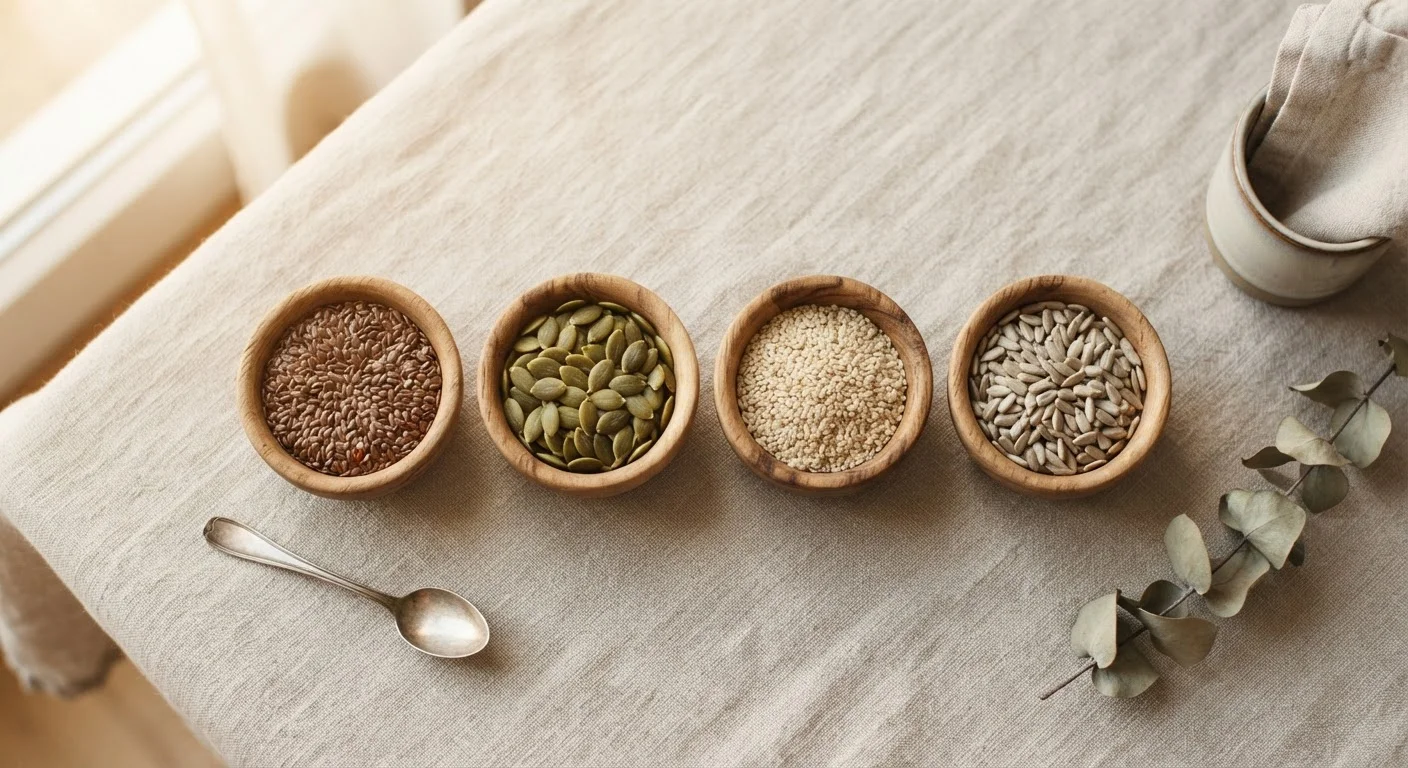
Seed cycling is a dietary practice that involves eating specific seeds during each phase of the menstrual cycle — typically flaxseeds and pumpkin seeds during the follicular phase (days 1–14), then sesame seeds and sunflower seeds during the luteal phase (days 15–28). Proponents claim this rotation supports the body's natural hormonal fluctuations: boosting estrogen in the first half of the cycle and progesterone in the second.
The practice has flourished on social media and wellness blogs, often framed as a gentle, food-first approach to easing PMS, irregular cycles, and perimenopausal symptoms. Its appeal is understandable — seeds are affordable, easy to add to smoothies or salads, and carry a reassuring sense of doing something proactive for your body. But popularity is not the same as proof, and it's worth slowing down to examine what the evidence actually says.
For a broader look at how nutrition intersects with hormonal health, see our evidence-based overview of nutrition and hormonal balance.
Common Myths About Seed Cycling — and What We Actually Know
Separating the enthusiasm from the evidence requires looking honestly at the specific claims made about seed cycling. Below are the most common misconceptions, along with what current research does and doesn't support.
Myth
Eating specific seeds in sync with your cycle directly regulates estrogen and progesterone levels.
Fact
No clinical trials have demonstrated that seed cycling measurably alters circulating estrogen or progesterone in humans.
This is the central claim of seed cycling, and it remains unsupported by controlled human research. While flaxseeds contain lignans — phytoestrogens that interact weakly with estrogen receptors — the step from "contains phytoestrogens" to "reliably shifts hormone levels in a clinically meaningful way" is a significant leap. Studies on flaxseed lignans have shown modest effects in some contexts (such as postmenopausal women), but these findings do not translate to a validated protocol for cycle-phase rotation. The body's hormonal regulation involves the hypothalamic-pituitary-ovarian axis, a tightly governed feedback system that is not straightforwardly influenced by dietary seeds alone.
Myth
Seed cycling is a well-researched, clinically validated practice.
Fact
As of current literature, no peer-reviewed randomized controlled trials have specifically tested seed cycling as a protocol.
Wellness communities often cite nutrient studies — on zinc, selenium, lignans, or omega-3s individually — as indirect evidence for seed cycling. But applying individual nutrient research to a bundled, phase-specific rotation protocol is not scientifically sound. Evidence for an intervention means testing that specific intervention. Seed cycling, as a defined practice, has not been subjected to that scrutiny. This doesn't make it harmful, but it does mean claims of proven efficacy are not accurate.
Myth
Seed cycling can fix hormonal imbalances like PCOS or estrogen dominance on its own.
Fact
Conditions like PCOS are complex and require proper medical evaluation; dietary seeds alone are not a treatment.
Polycystic ovary syndrome (PCOS) involves insulin resistance, androgen excess, and disrupted ovulation — mechanisms that are not addressed by seed rotation. "Estrogen dominance" is a term popular in wellness spaces but not a formally recognized clinical diagnosis in endocrinology. If you're experiencing symptoms attributed to these conditions — irregular cycles, excessive hair growth, persistent fatigue — a healthcare provider can order appropriate hormonal panels and discuss evidence-based management options. Relying solely on seed cycling risks delaying care that could genuinely help.
Myth
The two-week seed rotation perfectly mirrors natural hormonal phases.
Fact
A 28-day cycle is an average, not a universal standard, and the rotation doesn't adapt to individual cycle length.
Many women have cycles shorter than 24 days or longer than 35 days, and cycle length can vary month to month due to stress, illness, and other factors. The seed cycling protocol assumes a textbook 28-day cycle divided neatly at day 14 — a framework that simply doesn't reflect the biological diversity of real menstrual cycles. This rigidity is rarely acknowledged in popular descriptions of the practice, which can leave women who don't fit the template confused or unnecessarily anxious about whether they're doing it correctly.
Myth
Because it's natural and food-based, seed cycling has no potential downsides.
Fact
Seeds can interact with certain health conditions and medications, and excessive intake of some seeds carries real considerations.
Flaxseeds, for example, have mild estrogenic activity and are generally advised cautiously for people with hormone-sensitive conditions — a conversation best had with a healthcare provider. Ground flaxseed can also affect digestion, and large amounts may interact with blood-thinning medications. Sesame seeds are a recognized allergen for some individuals. None of this makes seeds dangerous for most people, but "it's just food" is not a complete safety analysis, especially for those with underlying health conditions or who are pregnant.
The Real Nutritional Value of These Seeds
Even if the hormone-balancing claims are overstated, the seeds themselves are genuinely nutritious. Flaxseeds are among the richest plant sources of alpha-linolenic acid (an omega-3 fatty acid) and lignans — plant compounds with weak estrogenic activity that have been studied in the context of breast health and menopausal symptoms. Pumpkin seeds provide zinc, magnesium, and healthy fats. Sunflower seeds are a solid source of vitamin E and selenium. Sesame seeds contribute calcium and additional lignans.
These nutrients support general health, including immune function, skin integrity, and cardiovascular wellness. Incorporating a variety of seeds into a balanced diet is a reasonable choice with a well-established nutritional rationale — even if the specific hormonal rotation logic remains unvalidated.
~800mg
Lignans per 100g of flaxseeds
Flaxseeds are one of the richest known dietary sources of lignans, according to nutritional composition data published in peer-reviewed food science literature.
~74%
Of US women report using complementary health approaches
According to National Center for Health Statistics data, a substantial majority of US women incorporate some form of complementary or alternative practice into their wellness routines.
The distinction matters: eating seeds for their nutritional value is evidence-supported. Eating seeds in a specific two-phase rotation to deliberately shift circulating hormone levels is a different, much stronger claim — and that claim currently lacks clinical backing.
Who Might Try It, and What to Be Aware Of
For most healthy adults, adding seeds to their diet carries negligible risk. If you find the structure of seed cycling helpful as a mindfulness practice — a way to tune into your cycle and eat more intentionally — that benefit is real, even if the mechanism is not what advocates describe.
Seed Cycling Is Not a Medical Treatment
If you are experiencing significant hormonal symptoms — including irregular or absent periods, severe PMS, fertility challenges, or signs of perimenopause — please seek evaluation from a licensed healthcare provider. Dietary practices like seed cycling may complement a healthy lifestyle but are not substitutes for diagnosis or evidence-based medical care. Self-managing complex hormonal conditions without professional guidance can delay effective treatment.
However, seed cycling should not replace evaluation by a healthcare provider if you're experiencing significant menstrual irregularities, suspected PCOS, perimenopause symptoms, or infertility concerns. These are complex hormonal conditions that benefit from proper diagnosis and, where appropriate, evidence-based treatment. Delaying that care in favor of a wellness practice carries its own risks. For those exploring fertility tracking alongside dietary changes, our guide to fertility awareness methods offers grounded context.
This article is for general informational and educational purposes only and does not constitute medical advice. Always consult a qualified healthcare professional regarding any health concerns, symptoms, or before making significant changes to your diet or health routine.