

Key Takeaways
- Consistent meal timing — not dietary perfection — is the most sustainable foundation for busy eaters.
- Anchoring eating habits to existing daily routines dramatically reduces decision fatigue.
- A small weekly preparation window can protect nutritional quality across the entire week.
- Flexible food structures, like the plate method, work without calorie counting or rigid rules.
- Hunger awareness, not willpower, is the most reliable internal guide to eating well.
What you will need
Why Busy Schedules Break Eating Habits
Most people don't abandon consistent eating because they lack nutritional knowledge — they abandon it because the structure collapses under pressure. A packed calendar creates two predictable failure modes: meals get skipped or delayed until hunger becomes urgent, and food decisions get outsourced to whatever's fastest rather than what's nourishing.
Research in behavioural nutrition points to decision fatigue as a central driver. When cognitive load is high, food choices tend to default toward convenience and energy density rather than nutritional quality. This isn't a character flaw; it's a predictable response to an environment that isn't set up to support better choices.
The practical implication: sustainable eating habits for busy adults must be low-friction by design. That means fewer decisions at the moment of eating, not more willpower. It also means understanding why diet attempts fail before building a new approach.
Avoid Skipping Meals to 'Make Up Time'
Routinely skipping meals to cope with a busy schedule tends to increase hunger hormone levels later in the day, making impulse food choices more likely. Research consistently suggests that irregular meal patterns are associated with poorer dietary quality overall. If a meal genuinely isn't possible, a small, protein-containing snack is a more protective option than skipping entirely.
The strategies in this guide work by reducing the structural barriers to eating well — not by requiring you to try harder. The steps below build a system that holds up on your worst days, not just your best ones.
What you will need
How to Build Eating Habits That Hold
The following steps draw on habit formation research and established dietary science. They're designed to be implemented incrementally — you don't need to adopt all five at once. Start with the one that addresses your most consistent breakdown point.
Start With One Anchor Meal
Rather than overhauling every meal at once, identify the one meal in your day that is most predictable — often breakfast or lunch — and focus your consistency there first. Once that habit is stable, extending the same structure to other meals becomes considerably easier and requires less active effort.
Map your schedule to find your eating anchors
Before changing what you eat, establish when you'll eat. Review a typical week and identify two or three fixed time windows — tied to existing commitments like a morning commute, a mid-morning break, or the end of a work block — that can reliably serve as meal moments. These become your eating anchors.
Habit science consistently shows that attaching a new behaviour to an existing cue dramatically increases follow-through. Treat eating times the way you treat meetings: block them, protect them, and default to them even when the day feels chaotic.
Design a simple, repeatable food structure
You don't need a complex meal plan — you need a reliable template. The plate method is one well-supported approach: roughly half your plate from vegetables or fruit, a quarter from a lean protein source, and a quarter from a whole-grain or starchy food. This structure scales to almost any cuisine and requires no calorie tracking.
See our guide to building a balanced plate for practical ways to apply this proportion principle without rigid rules. The goal is a mental template you can reconstruct from whatever food is available — not an exact recipe to follow each time.
Run a focused weekly preparation window
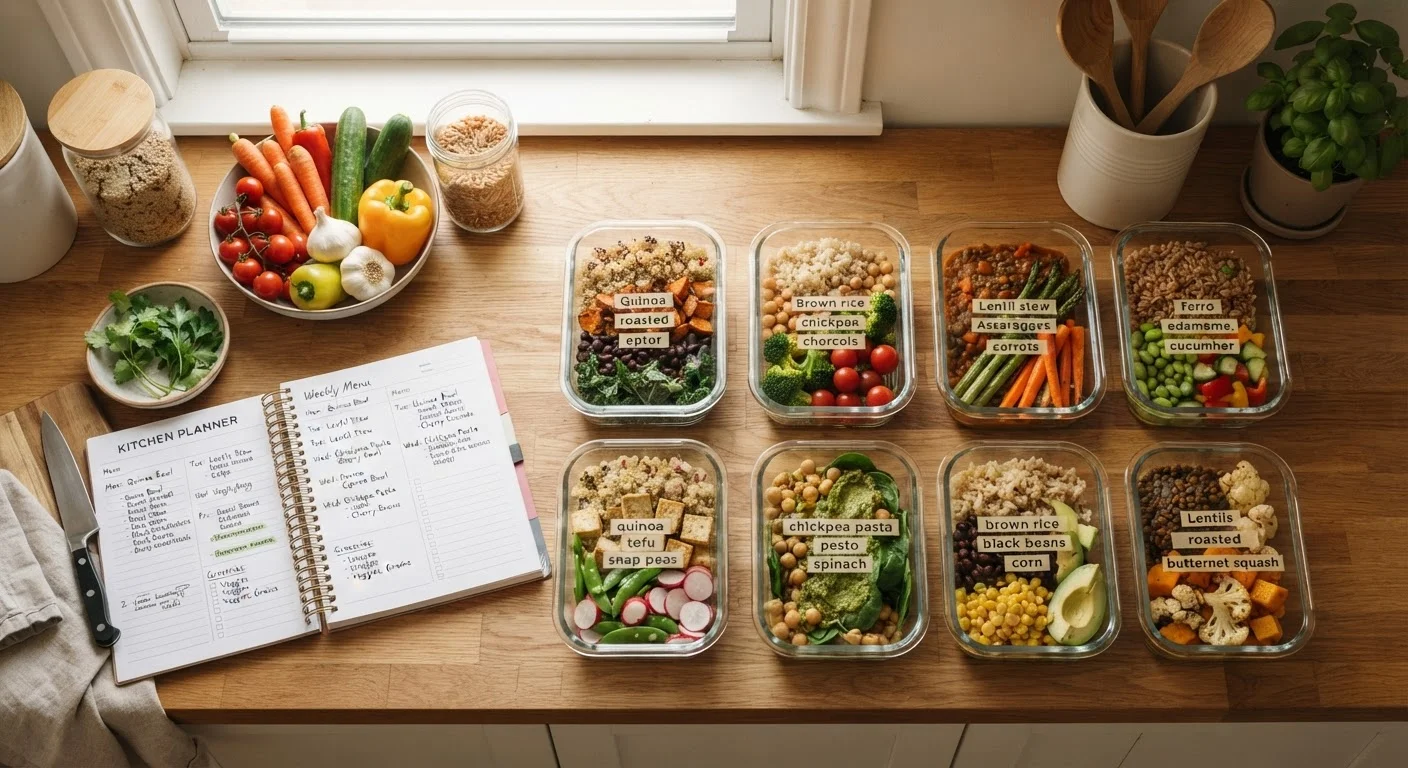
Identify one 30–45 minute window each week — Sunday evening works well for many people, but any predictable slot will do — to prepare a small number of foundational foods: a cooked grain, a protein source, and washed, ready-to-eat vegetables. These components don't need to become specific meals in advance; they become raw material that can be assembled quickly across the week.
This approach significantly reduces the daily decision burden that leads to defaulting on nutritional quality when time runs short. It also pairs naturally with a weekly eating habits audit, which can help you identify patterns and adjust your prep priorities over time.
Build a reliable snack backup system
Even well-anchored meal plans encounter unexpected disruptions. Having two or three portable, protein-containing snacks consistently available — in a desk drawer, a bag, or a car — prevents hunger from accumulating to the point where food quality no longer feels like a viable consideration.
Options like unsalted nuts, nut butter packets, plain Greek yoghurt, or hard-boiled eggs are practical examples that are widely available and require minimal preparation. The specific food matters less than having something reliable within reach before hunger becomes acute.
Calibrate to hunger rather than the clock alone
Eating anchors provide structure, but internal hunger cues remain important data. Over time, the goal is to eat at your anchored times while staying attentive to genuine hunger and fullness signals — not eating past fullness because it's a scheduled meal, and not overriding real hunger because it's not yet 'time.'
This calibration takes practice. For a deeper look at how meal timing, hunger awareness, and food quality interact in a sustainable eating approach, see the complete guide to sustainable daily nutrition.
For those whose energy levels are the primary concern alongside eating patterns, nutrition habits that support energy offers complementary guidance. And if you're looking to apply similar habit-anchoring principles to physical movement, building consistency in movement covers the same structural approach for exercise.
This Is General Information, Not Medical Advice
The strategies described here are general educational guidance for healthy adults. They are not a substitute for personalised nutrition advice from a registered dietitian or healthcare provider. If you have a health condition, are pregnant, or have specific dietary needs, consult a qualified professional before making significant changes to your eating patterns.
This article is for general informational purposes only and does not constitute medical or nutritional advice. Consult a qualified healthcare professional or registered dietitian for guidance tailored to your individual circumstances.