

| Primary goal of calming yoga | Activate the parasympathetic nervous system |
| Recommended Savasana duration | At least 5 minutes (General restorative yoga practice guidelines) |
| Key prop for restorative poses | Bolster, folded blanket, or yoga block |
| Breath pattern that supports calm | Slow, diaphragmatic with extended exhale (Autonomic nervous system research consensus) |
| Experience level required | Beginner-accessible — no prior yoga needed |
| Style these poses belong to | Restorative and gentle yoga |
How to Use This Reference
This guide is designed as a quick-lookup companion — not a step-by-step class. Each entry covers a pose's Sanskrit name, the body areas it targets, and the nervous system effects researchers and practitioners commonly associate with it. Whether you're building a home practice from scratch or looking for the right wind-down pose after a long day, use this table to match your needs to the right asana.
For context on why gentle movement affects stress physiology the way it does, see what happens to your nervous system during a gentle yoga session. And if you'd like a full framework for building a calming practice, the complete guide to yoga for calm is a natural next step.
| Primary goal of calming yoga | Activate the parasympathetic nervous system |
| Recommended Savasana duration | At least 5 minutes (General restorative yoga practice guidelines) |
| Key prop for restorative poses | Bolster, folded blanket, or yoga block |
| Breath pattern that supports calm | Slow, diaphragmatic with extended exhale (Autonomic nervous system research consensus) |
| Experience level required | Beginner-accessible — no prior yoga needed |
| Style these poses belong to | Restorative and gentle yoga |
This article is for general informational purposes only and is not a substitute for professional medical or therapeutic advice. If you have any injuries, health conditions, or concerns, consult a qualified healthcare provider before beginning any new movement practice.
Pose-by-Pose Reference: Calming Asanas at a Glance
The poses below are organized roughly from seated and supine (lying down) positions to gentle forward folds — an order that naturally supports a transition toward rest. Props such as bolsters, folded blankets, or blocks are encouraged wherever they help you hold a shape without effort.
Asana
A Sanskrit word meaning 'seat' or 'posture.' In modern yoga, it refers to any physical pose practiced as part of a yoga session.
Parasympathetic nervous system
The branch of the autonomic nervous system responsible for rest, digestion, and recovery. Activating it helps reduce the physical symptoms of stress and anxiety.
Restorative yoga
A style of yoga that uses props to support the body fully in passive poses, held for several minutes each, with the primary goal of inducing deep relaxation rather than building strength or flexibility.
Pratyahara
One of the classical 'eight limbs' of yoga, referring to the withdrawal of the senses inward — a state of reduced reactivity to external stimulation associated with calming the mind.
Savasana
Often called Corpse Pose, this is a supine pose of complete stillness practiced at the end of a yoga session to allow the body and nervous system to integrate the effects of the practice.
Diaphragmatic breathing
A breathing pattern in which the diaphragm — rather than the chest — drives inhalation, expanding the belly outward. Associated with slower breathing rates and parasympathetic activation.
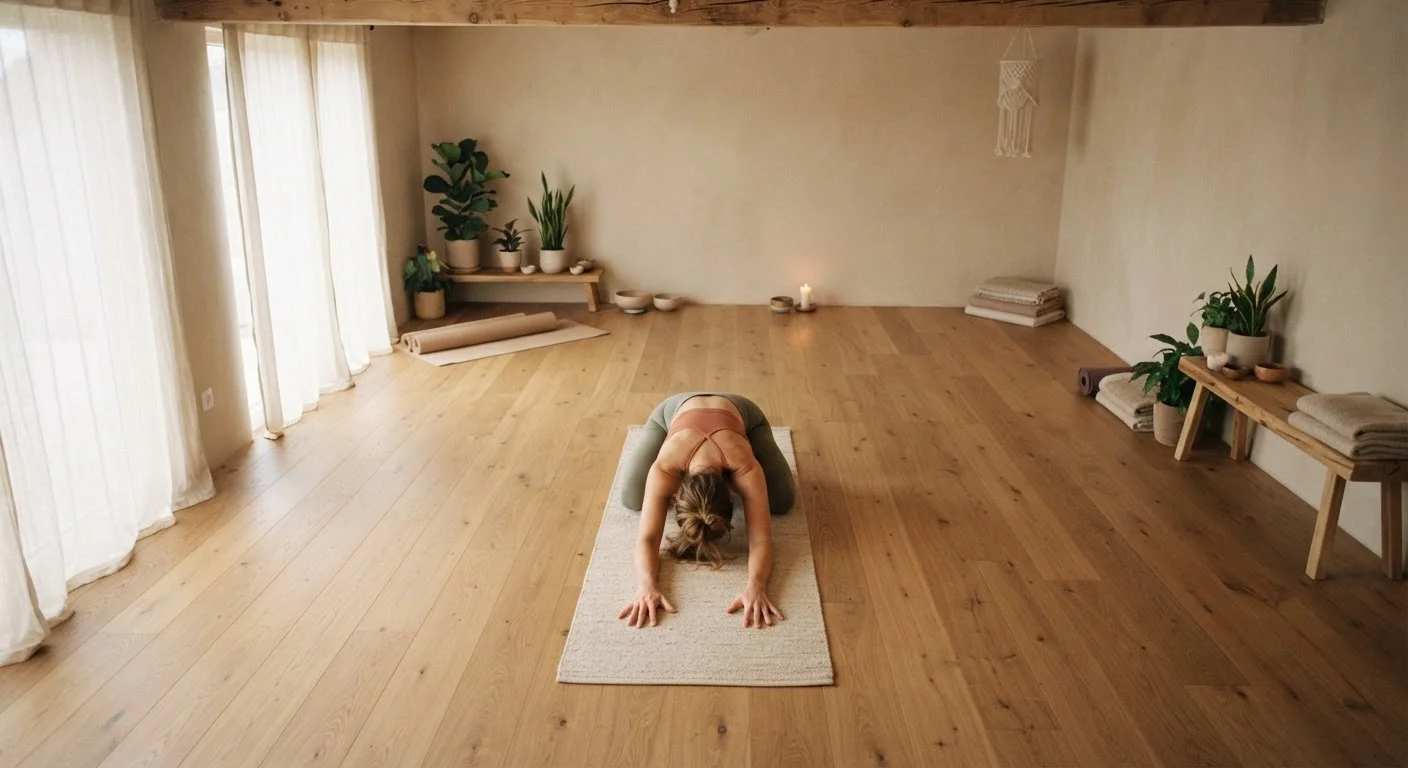
Balasana — Child's Pose
Target areas: Lower back, hips, shoulders
Nervous system effect: Forward folding activates baroreceptors in the torso and encourages a slower respiratory rate, both of which support parasympathetic activity. The grounding of the forehead can cue a sense of inward withdrawal (pratyahara).
Supta Baddha Konasana — Reclined Bound Angle Pose
Target areas: Inner thighs, groin, chest
Nervous system effect: Full supine position lowers the body's demand for postural muscle activation. The open-chest orientation supports slower, diaphragmatic breathing.
Viparita Karani — Legs-Up-the-Wall Pose
Target areas: Hamstrings, lower back, ankles
Nervous system effect: Mild inversion shifts venous blood flow toward the torso, which may reduce perceived heart-rate effort and promote a quieting response. Widely used in restorative yoga for end-of-day wind-down.
Paschimottanasana — Seated Forward Bend
Target areas: Hamstrings, spine, lower back
Nervous system effect: Slow forward folds with an elongated exhale are associated with reduced sympathetic arousal in several small studies on yoga and autonomic function. Use a strap or bolster to avoid straining.
Setu Bandha Sarvangasana — Supported Bridge Pose
Target areas: Chest, spine, hip flexors
Nervous system effect: When supported by a block under the sacrum, this becomes a gentle chest opener that encourages deeper breathing without physical effort — a hallmark of restorative practice.
Savasana — Corpse Pose
Target areas: Full body
Nervous system effect: Structured stillness in Savasana is consistently linked to reductions in self-reported stress and anxiety across yoga research. It is the deliberate endpoint of most calming sequences and should be held for at least five minutes to allow the nervous system to integrate preceding movement.
If you spend much of your day seated, the calming poses for desk workers article adapts several of these for the specific tension patterns that desk work creates.
Props Are Not Optional — They're the Point
In restorative and calming yoga, using a block, bolster, or blanket is not a concession to limited flexibility — it is the intended method. Props allow muscles to fully release their effort, which is exactly what invites the nervous system to downshift. If a pose feels like work, add support until it doesn't.
Breath is the thread connecting all of these poses. To understand how to use it intentionally, explore breathwork principles for calming yoga. For complementary non-movement practices, the Meditation Basics hub and Stress Relief Tools hub offer evidence-backed options to pair with your mat practice.