

Key Takeaways
- Wellness self-assessment tools are structured prompts, not clinical diagnoses.
- Different quiz types target different dimensions of health — sleep, stress, nutrition, and more.
- Honest, in-the-moment answers produce the most useful results.
- Quiz results are a starting point for reflection and conversation with a professional, not a conclusion.
- Validated tools carry more rigor than informal online quizzes.
Start here
What Is a Wellness Self-Assessment Tool?
Next
The Main Types of Wellness Quizzes
Then
How to Approach a Quiz Honestly
Apply it
What to Do With Your Results
Stay grounded
Limitations to Keep in Mind
What Is a Wellness Self-Assessment Tool?
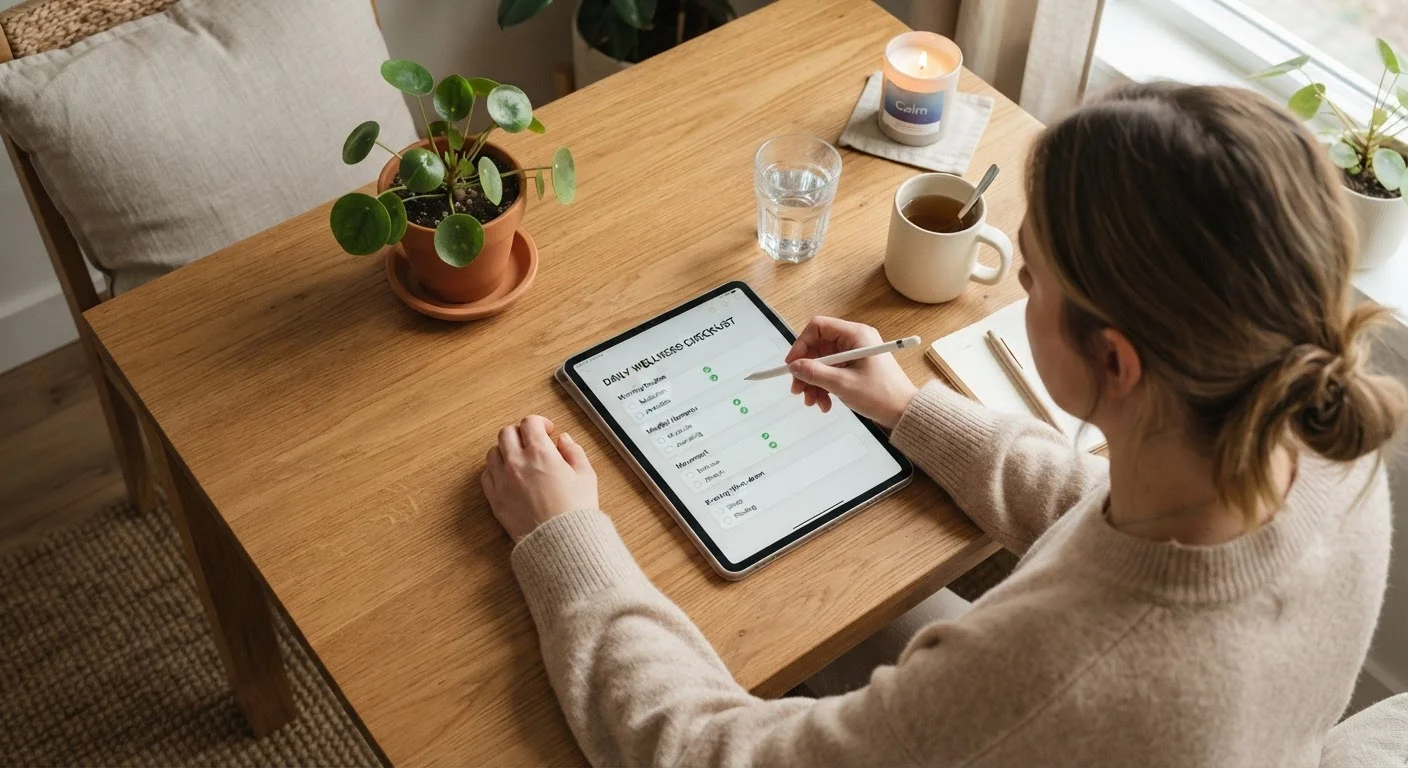
A wellness self-assessment tool is a structured set of questions designed to help you reflect on different aspects of your physical, mental, and lifestyle health. Think of it as an organized mirror — it doesn't measure your biology directly, but it surfaces patterns in how you feel, function, and behave across key health domains.
These tools range from brief five-question check-ins to detailed multi-domain questionnaires. Some are adapted from instruments used in clinical research; others are developed by wellness educators or public health organizations. All of them share a common purpose: converting your everyday experience into organized information you can actually use.
Self-report tool
A questionnaire where you supply the data based on your own experience or perception, rather than having something measured by a device or clinician.
Validated questionnaire
A research-tested survey that has been shown to consistently measure what it claims to measure across a wide range of people and settings.
Wellness domain
A distinct area of health — such as sleep, stress, nutrition, or emotional wellbeing — that contributes to overall wellness and can be assessed separately.
Recall bias
The tendency to remember recent or emotionally charged experiences more vividly than typical patterns, which can distort self-report answers.
Holistic assessment
An evaluation that looks at multiple wellness dimensions together rather than focusing on a single health area in isolation.
For a broader look at everything these tools can offer, see our complete guide to wellness quizzes as a health awareness tool.
The Main Types of Wellness Quizzes
Not all wellness quizzes work the same way. Understanding the main categories helps you choose the right tool for what you're trying to learn:
- Domain-specific quizzes focus on a single area — sleep quality, stress load, nutritional habits, or physical activity levels. They go deep on one dimension and are useful when you already sense an issue in that area.
- Holistic wellness surveys cover multiple domains in a single assessment. They're ideal for a first-time orientation because they reveal where you're thriving and where you may need attention.
- Validated clinical questionnaires are tools like the GAD-7 (generalized anxiety) or PHQ-2 (mood screening) that have been tested in research settings for reliability and consistency. They carry more weight than informal quizzes but are still self-report instruments.
- Lifestyle pattern assessments look at behavioral habits — alcohol use, sedentary time, screen exposure — and connect them to recognized wellness risk factors.
To understand what separates clinically grounded tools from popular informal quizzes, explore the differences between validated questionnaires and informal wellness quizzes.
How to Approach a Quiz Honestly
The accuracy of any self-assessment depends entirely on how candidly you respond. Two common traps undermine results: answering based on how you want to be doing rather than how you actually are, and rushing through questions without pausing to reflect.
Set Yourself Up for Honest Answers
Before starting any wellness quiz, take two minutes to settle in — put your phone on silent, close unrelated tabs, and remind yourself that the results are for your benefit only. Treating the quiz as a confidential journal entry rather than a performance removes the urge to present an idealized version of your habits.
Practical habits that improve the quality of your answers:
- Choose a calm moment. Avoid completing a wellness quiz immediately after a stressful event or during a distraction-heavy environment. Mid-morning on a regular weekday tends to yield more representative responses.
- Answer for your typical experience. Most questionnaires ask about the past two to four weeks. Focus on your usual patterns rather than exceptional good or bad days.
- Resist self-editing. There are no wrong answers in a self-assessment. Protective or flattering responses only reduce the usefulness of your results.
Understanding the domains a meaningful self-assessment should cover can also help you know what to pay attention to as you work through questions.
What to Do With Your Results
Results from a wellness quiz are most useful as a conversation starter — with yourself first, then possibly with a healthcare provider. After completing a quiz, try a three-step review:
- Note what surprises you. Gaps between how you thought you were doing in a given area and what your answers actually indicate are worth examining.
- Identify one or two actionable areas. Trying to improve everything at once rarely works. Pick the domain with the clearest opportunity and focus there initially.
- Share results with a professional when relevant. If your results suggest elevated stress, disrupted sleep, or mood concerns that have persisted for weeks, bring that information to a qualified clinician who can properly evaluate what it means for you specifically.
For those interested in how different wellness domains — from emotional regulation to sleep — connect to measurable health outcomes, our guide to key wellness domains is a practical next step.
Limitations to Keep in Mind
Wellness self-assessment tools are genuinely useful, but they have real boundaries worth understanding from the start. They rely entirely on self-report, which means recall bias and current mood can skew your answers. They do not measure biological markers, imaging, or objective clinical data. And they cannot account for individual medical history.
A quiz outcome is not a diagnosis. It is a signal — one data point among many. Learn more about what wellness quizzes actually measure and where their limits lie, and read about common misconceptions around quiz results before drawing firm conclusions from any single assessment.
PHQ-9 Patient Health Questionnaire
A widely used, clinically validated nine-item questionnaire for screening mood patterns. Publicly available and commonly used as a starting point in primary care conversations.
Pittsburgh Sleep Quality Index (PSQI)
A validated instrument that assesses seven components of sleep quality over the past month. Useful for anyone noticing persistent disruptions in rest and recovery.
CDC Healthy Days Measures
A brief set of general health-related quality-of-life questions developed by the U.S. Centers for Disease Control and Prevention, useful for tracking perceived physical and mental health over time.
This article is for general informational purposes only and does not constitute medical advice. Always consult a qualified healthcare professional regarding any health concerns or before making changes to your wellness routine.