

Key Takeaways
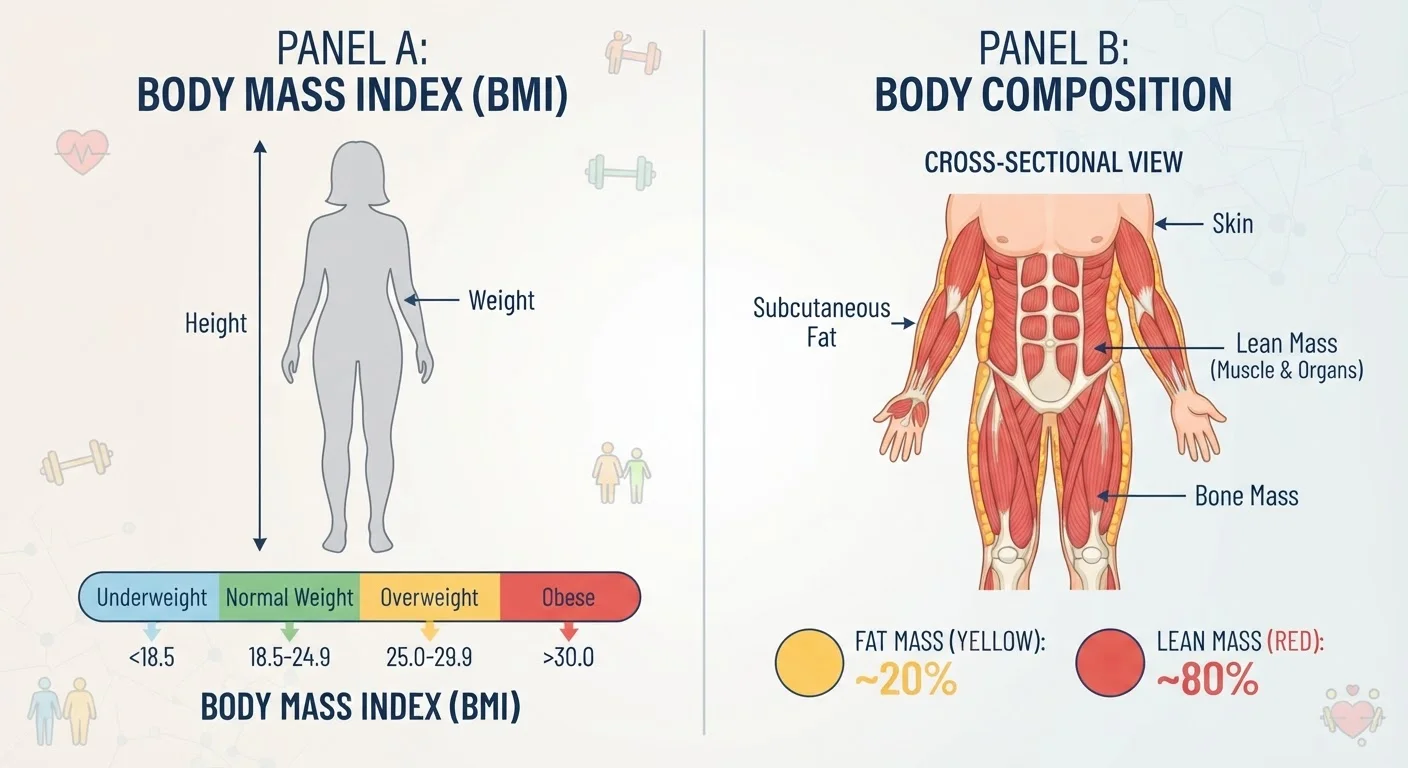
- BMI is calculated from height and weight alone and does not directly measure fat.
- Body fat percentage distinguishes fat mass from lean mass, offering more compositional detail.
- Two people with identical BMIs can have very different body fat percentages.
- BMI is useful for population-level screening; body fat percentage is more useful for individual assessment.
- Neither number alone tells the full health story — context, age, and sex all matter.
- Always discuss your results with a healthcare professional before drawing clinical conclusions.
Option A
Body Mass Index (BMI)
The fast, population-level screening tool.
Best for: Quick risk stratification across large groups or initial clinical screening when no other data is available.
Option B
Body Fat Percentage
The precise, tissue-specific body composition measure.
Best for: Individuals who want a clearer picture of how much of their weight is fat versus muscle, bone, and fluid.
If you want a quick, no-equipment health screen
Body Mass Index (BMI)
BMI requires only height and weight, making it fast and accessible for an initial snapshot — though it should never be the only metric used.
If you're tracking fitness progress or muscle gain
Body Fat Percentage
Body fat percentage distinguishes fat loss from muscle gain, giving you meaningful feedback that the scale and BMI simply cannot provide.
If your clinician is assessing population-level disease risk
Body Mass Index (BMI)
BMI is the most widely validated tool for epidemiological research and is still routinely used in clinical guidelines as a screening threshold.
If you are an athlete or very muscular individual
Body Fat Percentage
Muscle is denser than fat, so athletic individuals often score in the 'overweight' BMI range despite low body fat. Body fat percentage captures this reality far more accurately.
What Each Number Actually Measures
Body Mass Index (BMI) is a ratio derived by dividing weight in kilograms by the square of height in meters (kg/m²). It was originally developed in the 19th century as a statistical tool for describing populations, not individuals. Because it uses only two inputs, it is fast and reproducible — but it has no way to distinguish whether your weight comes from fat, muscle, bone, or fluid.
Body fat percentage, on the other hand, expresses what fraction of your total body weight is adipose (fat) tissue. Measuring it requires additional data — either from a clinical tool such as dual-energy X-ray absorptiometry (DEXA), hydrostatic weighing, or a bioelectrical impedance device, or from a field estimate using skinfold calipers and circumference measurements. The result gives you a direct window into body composition in a way BMI cannot.
For a plain-language breakdown of both terms alongside other common calculator outputs, see our body calculator reference glossary.
| Criterion | BMI | Body Fat Percentage |
|---|---|---|
| Inputs required | Height and weight only | Requires additional measurement tool |
| What it measures | Weight relative to height | Fat as a proportion of total body mass |
| Distinguishes fat from muscle | No | Yes |
| Accessibility | Calculated instantly, no equipment | Requires device, assessment, or formula |
| Best use case | Population screening, clinical triage | Individual composition tracking |
| Accuracy limitations | Misclassifies athletes, older adults | Varies by measurement method used |
| Age/sex adjustment | Limited (separate pediatric charts) | Healthy ranges differ by age and sex |
Where BMI Falls Short — and Where It Still Holds Up
BMI's biggest limitation is the weight-to-height problem: it cannot separate fat from lean tissue. A competitive athlete with substantial muscle mass may register as 'overweight' by BMI despite carrying very little body fat. Conversely, an older adult with low muscle mass — a condition called sarcopenia — can fall in the 'normal' BMI range while carrying a clinically elevated proportion of fat.
Research consistently shows that BMI misclassifies body composition in specific populations, including older adults, women (who tend to carry more fat at any given BMI than men), and people of certain ethnic backgrounds where disease risk correlates with lower BMI thresholds. Our article on BMI's common blind spots explores these scenarios in detail.
Where BMI remains genuinely useful is in large-scale epidemiological work and as a first-pass clinical screen. At the population level, higher BMI correlates meaningfully with increased risk of type 2 diabetes, cardiovascular disease, and certain cancers. Used alongside other measurements — waist circumference, blood pressure, lipid panels — it contributes useful, if incomplete, information.
~30%
Adults misclassified by BMI alone
A study published in the International Journal of Obesity estimated that roughly 30% of adults with normal BMI carry excess body fat when measured directly.
6+ kg/m²
BMI difference at same body fat level
Research has shown that at equivalent body fat percentages, women typically register a BMI several points lower than men, illustrating BMI's sex-based inconsistency.
The Case for Tracking Body Fat Percentage
Body fat percentage answers questions that BMI cannot: Is the weight I've lost coming from fat or muscle? Is my fat distribution changing even though my weight is stable? Am I within a healthy compositional range for my age and sex?
Healthy body fat ranges differ by sex and age. Generally accepted reference ranges suggest that for adult women, 21–33% is considered healthy, while for adult men, 8–19% is typical — though these ranges shift with age. It's worth noting that different measurement tools can produce results that vary by several percentage points, so consistency in method matters more than the absolute number.
Because body composition norms shift significantly across life stages, understanding how age interacts with these metrics is important. Our piece on how body calculators change across the lifespan explains how muscle mass, fat distribution, and healthy ranges all evolve from young adulthood to older age.
If you're interested in additional ways to assess fat distribution beyond these two metrics, waist-to-hip ratio is another practical option worth exploring.
Using Both Numbers Together
The most informative approach is not to choose one metric over the other but to interpret them together. A BMI that flags a potential concern is a prompt to look more closely — not a diagnosis. Pairing it with body fat percentage data, waist circumference, and relevant blood markers gives a far richer picture than any single number alone.
If you're already using calorie-focused calculators, understanding your body composition can also inform those estimates. Our article on TDEE vs. BMR explains how lean mass affects your resting and total daily energy expenditure — another reason body fat percentage adds value beyond BMI alone.
Measurement Method Matters for Body Fat
Body fat percentage results can vary considerably depending on the tool used. DEXA scans are considered the most accurate but require clinical access. Bioelectrical impedance devices (common in home scales) are convenient but sensitive to hydration levels. Skinfold calipers depend heavily on assessor technique. For tracking trends over time, consistency in method is more important than the specific number any single test produces.
This article is for general informational purposes only and is not a substitute for personalized medical advice. Always consult a qualified healthcare professional before making decisions based on body composition metrics, especially if you have an existing health condition.