

Key Takeaways
- Standard BMI thresholds were developed using adult data and are not appropriate for children or older adults without age-specific adjustments.
- Basal metabolic rate (BMR) declines with age, meaning calorie needs calculated at 25 may significantly overestimate needs at 65.
- Body fat percentage benchmarks differ by decade; carrying more fat at 70 is not the same health signal as at 30.
- Muscle mass loss (sarcopenia) after age 50 can make weight-based metrics misleadingly stable even as body composition worsens.
- Calculator outputs are estimates — age is just one variable that widens the margin of error at population extremes.
Our Verdict
No single body calculator applies cleanly across the full human lifespan. Younger adults, older adults, and children each require age-adjusted reference ranges and context-aware interpretation. Using the right tool for your life stage — and understanding its limitations — matters more than chasing a number that may not have been designed with you in mind.
| Best for | Recommended |
|---|---|
| Adults aged 20–50 seeking a general health baseline | Standard BMI and TDEE calculators with activity-level adjustments |
| Adults over 60 concerned about muscle loss and metabolic slowdown | BMR calculators combined with body fat percentage tracking |
| Parents monitoring a child's growth and weight trajectory | CDC or WHO growth chart percentile tools, not adult BMI calculators |
| Anyone wanting fuller context around their numbers | Waist circumference and waist-to-hip ratio alongside weight-based metrics |
Why Age Is More Than Just a Calculator Input
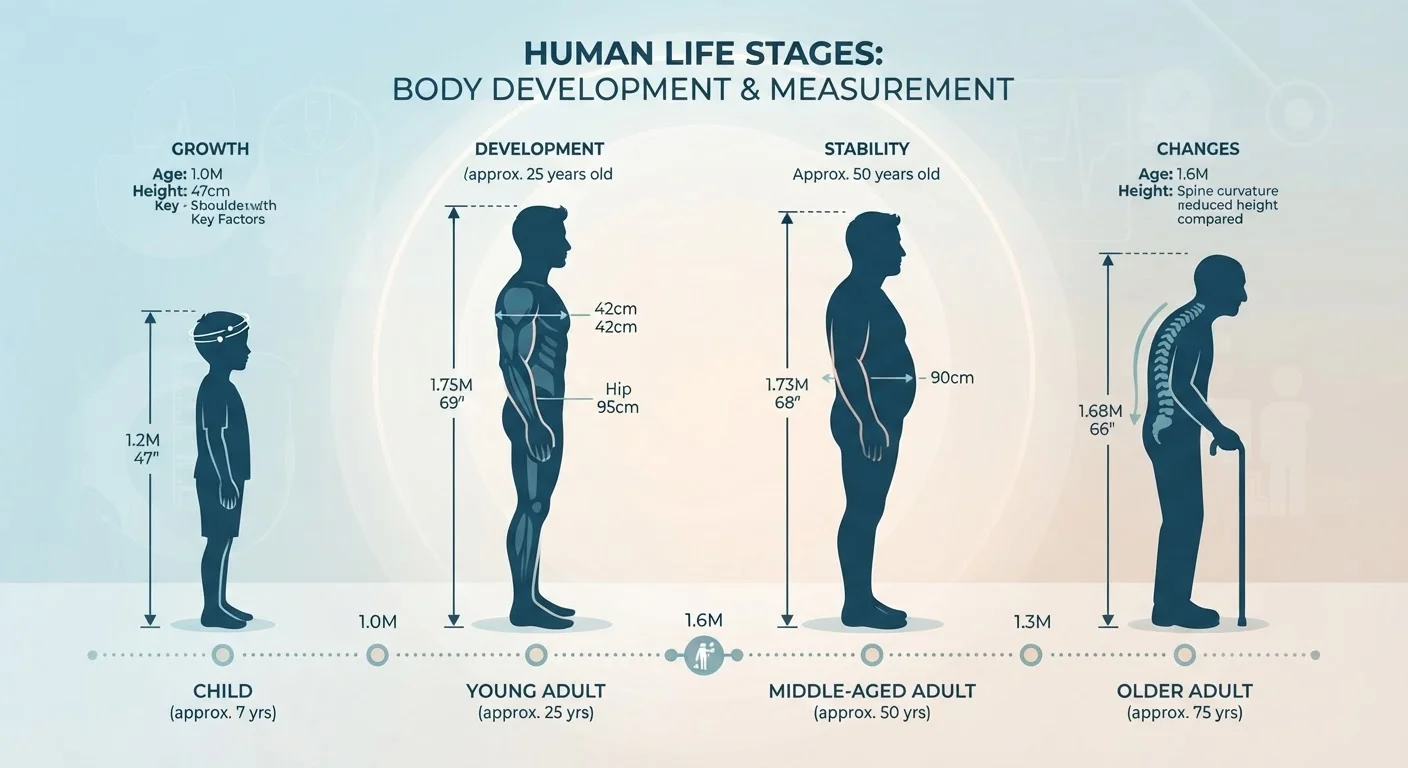
When you enter your age into a body calculator, it's easy to assume the tool simply plugs that number into a formula and spits out a result. In reality, age represents something far more consequential: it signals shifts in body composition, hormonal balance, metabolic rate, and bone density that fundamentally change what a given number means. A BMI of 27 carries different implications at age 25 than it does at age 72.
Body calculators — whether they estimate BMI, basal metabolic rate (BMR), total daily energy expenditure (TDEE), or body fat percentage — were largely developed using data from specific adult populations. That means their baseline assumptions may not translate well to children, adolescents, or older adults. Understanding those limitations helps you read your results with appropriate context rather than treating them as universal verdicts.
For a foundational overview of what these metrics actually measure, see our plain-language guide to key body metrics.
Childhood and Adolescence: Growth Charts, Not BMI Categories
Adult BMI categories — underweight, normal, overweight, obese — should not be applied to children or teenagers. Children's bodies change rapidly, and what constitutes a healthy weight depends on age, sex, and developmental stage. Pediatric health professionals use BMI-for-age percentile charts developed by the CDC and WHO, which compare a child's BMI to peers of the same age and sex rather than to a fixed threshold.
A BMI in the 85th to 94th percentile is considered "overweight" for a child, while at the 95th percentile or above, it falls into the "obese" category — but these cutoffs are percentile-based, not absolute. A 10-year-old and a 16-year-old with identical BMI values will be interpreted very differently.
Calorie needs in childhood and adolescence are also driven by growth demands, not just activity. Standard adult TDEE formulas underestimate this growth component. Parents and caregivers should consult a pediatrician or registered dietitian rather than using adult-oriented online calculators for children's nutritional needs.
Don't Use Adult BMI Tools for Children
Entering a child's height and weight into a standard adult BMI calculator will generate a number, but applying adult categories (underweight, normal, overweight, obese) to that number is clinically inappropriate and can be misleading. Always use age- and sex-specific growth chart tools — such as those provided by the CDC — and discuss results with a pediatric healthcare provider.
Young Adulthood to Midlife: When Standard Calculators Fit Best
The age range roughly spanning 20 to 50 is where most mainstream body calculators perform closest to their design intent. The major metabolic formulas — Mifflin-St Jeor, Harris-Benedict, and Katch-McArdle — were validated primarily on young-to-middle-aged adult populations. For most people in this range, BMI thresholds and TDEE estimates provide a reasonable, if imperfect, starting point.
That said, body composition still shifts meaningfully within this window. Muscle mass tends to peak in the late 20s to early 30s for many adults, and a gradual decline begins thereafter. Because muscle is metabolically more active than fat, even small changes in muscle-to-fat ratio affect BMR — meaning the calorie estimate that fit you at 28 may already be slightly high by 40, even if your weight on the scale hasn't changed.
Understanding the difference between TDEE and BMR can help you interpret which calculation matters most for your goals during this life stage.
| Childhood/Adolescence | Young Adulthood (20–50) | Older Adulthood (60+) | |
|---|---|---|---|
| BMI interpretation | Percentile charts (age/sex-adjusted) | Standard adult categories | Less predictive; use with caution |
| Calorie estimation accuracy | Growth needs not captured by adult formulas | Highest formula accuracy | Often overestimates due to muscle loss |
| Key body composition concern | Healthy growth trajectory | Muscle-to-fat ratio shift | Sarcopenia and fat redistribution |
| Recommended supplementary metric | Height-for-age, weight-for-age | Waist circumference, body fat % | Body fat %, grip strength, waist size |
| Calculator reliability | Low without age-specific tools | Moderate to good | Moderate; needs context |
Older Adulthood (60+): Where Calculator Assumptions Break Down Most
After age 60, several physiological changes converge in ways that make standard calculator outputs increasingly unreliable without adjustment. Sarcopenia — the progressive loss of skeletal muscle mass associated with aging — can cause body fat percentage to rise even when total body weight remains stable. A person who appears "weight-stable" by BMI may be losing muscle and gaining fat simultaneously, a shift that standard weight-based metrics won't capture.
BMR also declines more steeply in older adulthood. Research consistently shows that resting energy expenditure decreases with age, partly due to reduced muscle mass and partly due to other metabolic changes. Calorie estimates generated by formulas calibrated for younger adults may overestimate actual energy needs, which can lead to unintended weight gain if followed uncritically.
Additionally, the BMI thresholds used in younger adults may not carry the same predictive value in older populations. Some research suggests that slightly higher BMI values (roughly in the 25–27 range) may be associated with better outcomes in older adults — a phenomenon sometimes called the "obesity paradox" — though this remains an area of active investigation and should not be interpreted as a personal health target.
For anyone over 60, supplementing BMI with waist circumference or body fat percentage tracking gives a more complete picture. Our reference glossary of body calculator terms and ranges explains how these metrics are defined and what ranges are generally referenced by health practitioners.
Pair Your Calculator With a Professional Check-In
Body calculators offer useful estimates, but they work best as conversation starters rather than standalone verdicts. If you're over 60, consider asking your healthcare provider to incorporate a muscle mass or functional strength assessment alongside standard weight metrics. Tools like DEXA scans or bioelectrical impedance analysis can offer more precise body composition data than any formula-based calculator.
This article is for general informational purposes only and does not constitute medical advice. Consult a qualified healthcare professional before making decisions based on body calculator results, especially if you have an existing health condition or are in a special population group such as pregnancy, childhood, or older adulthood.