

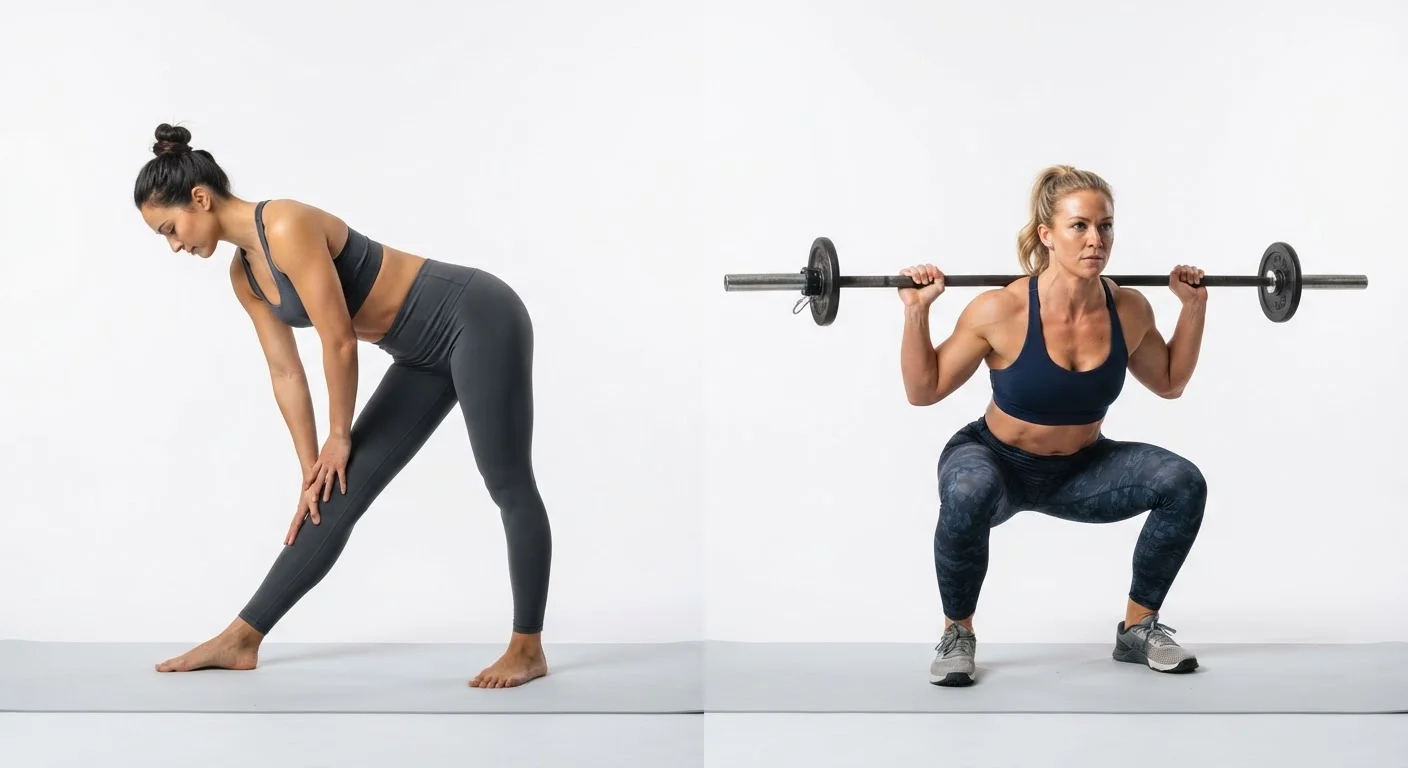
Key Takeaways
- Flexibility measures passive range of motion; mobility measures active, controlled range of motion.
- You can be flexible without being mobile, which limits how useful that range is in real movement.
- Mobility training typically combines strength, coordination, and range of motion work together.
- Most injury-prevention and performance goals are better served by improving mobility than flexibility alone.
- Both qualities have a role in a balanced training program — they are complementary, not competing.
Option A
Flexibility
The passive range your muscles can reach.
Best for: Best for those looking to reduce muscle tension and increase how far a joint can passively be moved.
Option B
Mobility
The active range you can control and use.
Best for: Best for those wanting to move freely and safely through functional, everyday and athletic movement patterns.
If your goal is reducing muscle tightness and post-workout soreness
Flexibility
Passive stretching helps lengthen muscles and ease tension after activity. It's a practical recovery tool when used consistently.
If your goal is injury prevention and functional movement
Mobility
Mobility training builds strength through your available range, meaning your joints are supported and controlled during real-world movement demands.
If you sit for long periods and feel stiff throughout the day
Mobility
Active mobility work retrains your nervous system to access and use the range your body loses during prolonged inactivity — something passive stretching alone can't fully address.
If you are building a well-rounded long-term movement practice
Flexibility
Combining regular stretching with mobility and strength work gives your body the widest foundation for durability over time. See the full comparison of stretching and strength training for more.
Two Terms, Two Distinct Concepts
Flexibility refers to the passive range of motion a muscle or group of muscles allows. Think of it as how far your hamstring can be lengthened when an external force — gravity, a strap, or a practitioner — applies the stretch. You are not in control of reaching that end range; the force is doing the work.
Mobility, by contrast, is the range of motion you can actively control. A mobile hip joint doesn't just reach a wide angle when pushed — it can move into and out of that angle with strength and coordination intact. This is sometimes called "usable range of motion" because it reflects what your nervous system trusts your body to do safely.
The practical difference: someone might be able to passively lie flat and have their leg raised to 90 degrees, but struggle to actively lift that same leg while standing. High flexibility, limited mobility. This gap is where many common movement problems originate.
This distinction matters especially for anyone training around common movement myths that keep people stuck, since many people assume that stretching alone is enough to move well.
| Criterion | Flexibility | Mobility |
|---|---|---|
| Definition | Passive range of motion | Active, controlled range of motion |
| Who does the work | External force (gravity, partner) | Your own muscles and nervous system |
| Primary training method | Static and passive stretching | Active drills, CARs, loaded movement |
| Best used | Post-workout or recovery sessions | Warm-ups and functional movement practice |
| Injury prevention value | Moderate — improves muscle length | Higher — builds strength at end ranges |
| Transfers to daily movement | Indirectly | Directly |
Why Mobility Is More Functional — and Harder to Build
Mobility demands more from your body than a passive stretch. It involves the nervous system, joint stability, muscle activation, and coordination all working simultaneously. This is why mobility drills often feel more challenging than static stretching even when the positions look similar.
Consider a deep squat. Achieving it passively — lowering yourself in slowly while holding a door frame — is far easier than holding a controlled, upright deep squat without support. The second version requires active hip, ankle, and thoracic mobility, plus the muscular control to maintain posture throughout.
~80%
Musculoskeletal injuries occurring at end ranges
Exercise science research consistently identifies the end ranges of joint motion as the position where muscles are most vulnerable to strain and injury.
2–3x
Frequency mobility work appears in rehab protocols vs. stretching alone
Physical therapy guidelines for joint rehabilitation increasingly emphasize active mobility training alongside passive range-of-motion work for more durable recovery outcomes.
Training mobility typically involves moving through ranges repeatedly rather than holding end-points, using techniques like controlled articular rotations (CARs), active stretching, and loaded mobility work. These approaches build strength at end ranges, which is where joint injury most commonly occurs.
It's also worth noting how breathing integrates here. Breath control supports spinal stability during active movement, which is one reason why breathing and movement are more connected than most people realize.
How to Train Both Without Overcomplicating It
For most busy adults, the most practical approach is to treat flexibility and mobility as complementary tools rather than either-or choices. Static stretching remains useful — particularly after training sessions when muscles are warm and the goal is recovery. It can reduce perceived tightness and improve passive range over time.
Mobility work, however, should anchor your warm-ups and movement practice. A few minutes of active joint circles, deep-range bodyweight movements, and dynamic patterns before activity primes your nervous system and reinforces the ranges you'll actually use. Over time, this is what builds durable, injury-resistant movement capacity.
A simple starting framework:
- Before activity: 5–10 minutes of active mobility drills targeting the joints most involved (hips, ankles, thoracic spine, shoulders).
- After activity: 5–10 minutes of passive or active-assisted stretching for recovery and tension relief.
- On rest days: Light mobility practice — floor-based movements, joint rotations — keeps range accessible without adding training stress.
If you want to understand how stretching fits into longer-term joint health alongside strength work, the comparison of strength training and stretching for joint health covers the mechanisms in detail.
This article is for general informational purposes only and does not constitute medical advice. Consult a qualified healthcare or movement professional before beginning any new exercise program, particularly if you have existing injuries or joint conditions.