

Key Takeaways
- Rest days are not optional — muscle repair and fitness gains happen during recovery, not during exercise.
- When your living room is your gym, boundaries between training and rest must be deliberately created.
- Low-intensity movement on recovery days often outperforms total inactivity for soreness and circulation.
- Tracking subjective fatigue signals is a reliable, equipment-free way to calibrate your rest schedule.
- Consistent sleep quality is the single most impactful recovery tool available to home exercisers.
Why Home Exercisers Need Deliberate Recovery Structure
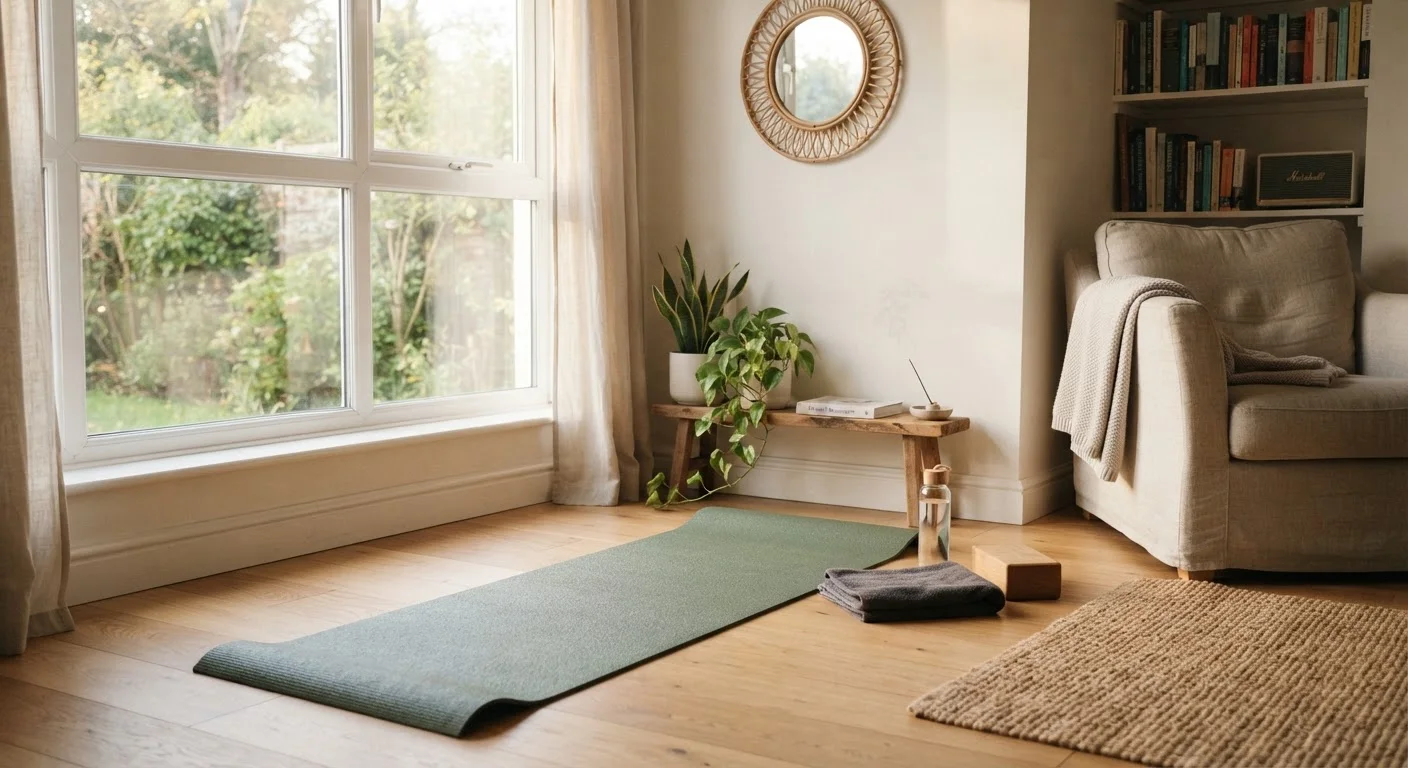
When your gym and your living room are the same place, the psychological cue to "leave training behind" disappears. There's no commute home, no locker room transition — just your mat sitting in the corner, quietly daring you to skip your rest day. Without deliberate structure, home exercisers frequently overtrain not out of dedication, but out of habit and convenience.
Understanding why recovery matters is the essential starting point. As explained in why recovery is training, muscle tissue repairs and grows stronger during rest, not during the workout itself. Skipping that repair window doesn't build resilience — it erodes it. For home exercisers, this means deliberately designing rest into the weekly schedule rather than letting momentum override good judgment.
The good news: structuring recovery at home requires no equipment, no gym membership, and no complex programming. It requires awareness, consistency, and a few practical habits.
Best Practices for Rest and Recovery at Home
The following practices are grounded in exercise science and adapted specifically for the home training context, where environmental cues and social accountability are limited.
Schedule rest days on your calendar the same way you schedule workouts.
Without a visible commitment, rest days become the first thing dropped when motivation is high. Pre-scheduling them treats recovery as a training variable, not a luxury. This also prevents the "I'll rest when I feel like it" trap that leads to accumulated fatigue.
Use a simple daily readiness check before deciding on training intensity.
Subjective fatigue — how rested, motivated, and physically ready you feel — correlates meaningfully with objective recovery markers. Checking in with your body each morning takes 30 seconds and provides immediately useful data. Home exercisers lack the gym environment that naturally signals when to push or pull back, making internal cues more important.
Distinguish between mild soreness and pain before training through it.
Delayed onset muscle soreness (DOMS) — the achiness that peaks 24–48 hours after a hard session — is normal and generally safe to train lightly through. Sharp, localized, or joint-based pain is a different signal entirely and warrants rest and professional guidance. Conflating the two leads either to unnecessary avoidance or genuine injury. Training through mild soreness has real trade-offs worth understanding.
Prioritize sleep as your primary recovery tool.
Sleep is when the body releases growth hormone, repairs connective tissue, and consolidates motor patterns. No stretching routine, supplement, or active recovery protocol replaces consistent, quality sleep. Home exercisers often undervalue this because it doesn't feel like "doing something" for fitness.
Incorporate low-intensity movement on recovery days rather than defaulting to full inactivity.
Light movement promotes blood flow to recovering muscles, reduces stiffness, and supports mood without adding training stress. For home exercisers, this is especially practical since the space for a short walk or a 10-minute stretch is always available. Research generally supports gentle activity over complete sedentariness for managing DOMS.
Build planned deload periods into your training cycle every four to six weeks.
Progressive overload — gradually increasing training difficulty — is effective only when paired with periodic reductions in volume or intensity. Without deload weeks, accumulated fatigue eventually suppresses performance and raises injury risk. Home exercisers often skip this because there's no coach or program enforcing it. Periodisation and planned deload weeks explains how to structure these phases effectively.
Choosing Between Active Recovery and Complete Rest
One of the most common questions home exercisers ask is whether to move gently or do nothing at all on off days. The answer depends on your fatigue level, training intensity, and what "rest" actually means to you.
Complete rest — doing nothing physically demanding — is appropriate after particularly intense sessions, during illness, or when fatigue is deep rather than surface-level. Active recovery, by contrast, involves low-intensity movement like walking, gentle stretching, or light mobility work. Research generally supports active recovery for reducing perceived soreness and maintaining circulation without adding meaningful training stress. See active recovery vs. complete rest for a detailed breakdown of when each approach fits best.
Active Recovery Isn't Always Better
While light movement often supports recovery, there are situations where complete rest is the right call — particularly after very high-volume weeks, during illness, or when motivation to move feels entirely absent rather than just low. Forcing activity on a genuinely depleted body can delay recovery rather than accelerate it. Learn more about how the research on active recovery vs. rest days applies to everyday exercisers.
A useful rule of thumb: if movement feels restorative rather than effortful, it's likely appropriate on a recovery day. If you're grinding through it, that's training — not recovery.
Quick Wins You Can Apply This Week
Improving your recovery structure doesn't require a program overhaul. These actions are immediately implementable and can meaningfully shift how your body responds to home training loads.
For a broader view of how to scaffold rest around your weekly effort, building a weekly recovery routine walks through matching rest volume to training intensity in a sustainable way.
This article is for general informational purposes only and does not constitute medical advice. Consult a qualified healthcare professional before starting or modifying any exercise routine, particularly if you have existing health conditions or injuries.