
Paleo vs. Mediterranean: Two Evidence-Cited Diets With Very Different Philosophies

Key Takeaways
- Paleo eliminates grains, legumes, and dairy; Mediterranean includes all three in moderation.
- The Mediterranean diet has a larger and longer-standing body of clinical research supporting cardiovascular and metabolic outcomes.
- Paleo's evidence base is smaller and more recent, with most trials short in duration.
- Both diets emphasize whole, minimally processed foods and discourage refined sugars and ultra-processed products.
- Sustainability and nutritional completeness vary significantly between the two approaches.
- Neither diet is a universal prescription — individual health context should always guide dietary choices.
Option A
Paleo Diet
The ancestral-eating framework built around pre-agricultural foods.
Best for: Those who want to eliminate grains, legumes, and processed foods entirely while focusing on whole, unprocessed animal and plant sources.
Option B
Mediterranean Diet
The broadly researched, plant-forward pattern inspired by traditional Southern European eating.
Best for: Those seeking a flexible, whole-foods-centered approach with a substantial long-term evidence base and room for grains, legumes, and moderate dairy.
If you want the strongest long-term research support for heart health
Mediterranean Diet
Decades of observational and interventional studies, including large randomized trials, consistently associate Mediterranean eating patterns with reduced cardiovascular risk markers.
If you prefer avoiding all grains and legumes and respond well to higher protein intake
Paleo Diet
Paleo's strict exclusion of grains and legumes appeals to those who find these foods problematic, and short-term studies show modest improvements in metabolic markers for some individuals.
If long-term dietary adherence and social flexibility matter to you
Mediterranean Diet
Its inclusive food list — allowing bread, legumes, wine in moderation, and dairy — makes it considerably easier to sustain across different social and cultural eating environments.
If you are managing an autoimmune condition and exploring elimination-style eating
Paleo Diet
Some clinicians and researchers investigate paleo-style elimination as a starting framework for autoimmune conditions, though evidence remains preliminary — consult a healthcare professional before making changes.
If nutritional completeness and micronutrient variety are a primary concern
Mediterranean Diet
The Mediterranean diet's inclusion of whole grains, legumes, and moderate dairy provides a broader micronutrient profile with fewer gaps compared to strict paleo eating.
Core Philosophy: Where the Two Diets Begin
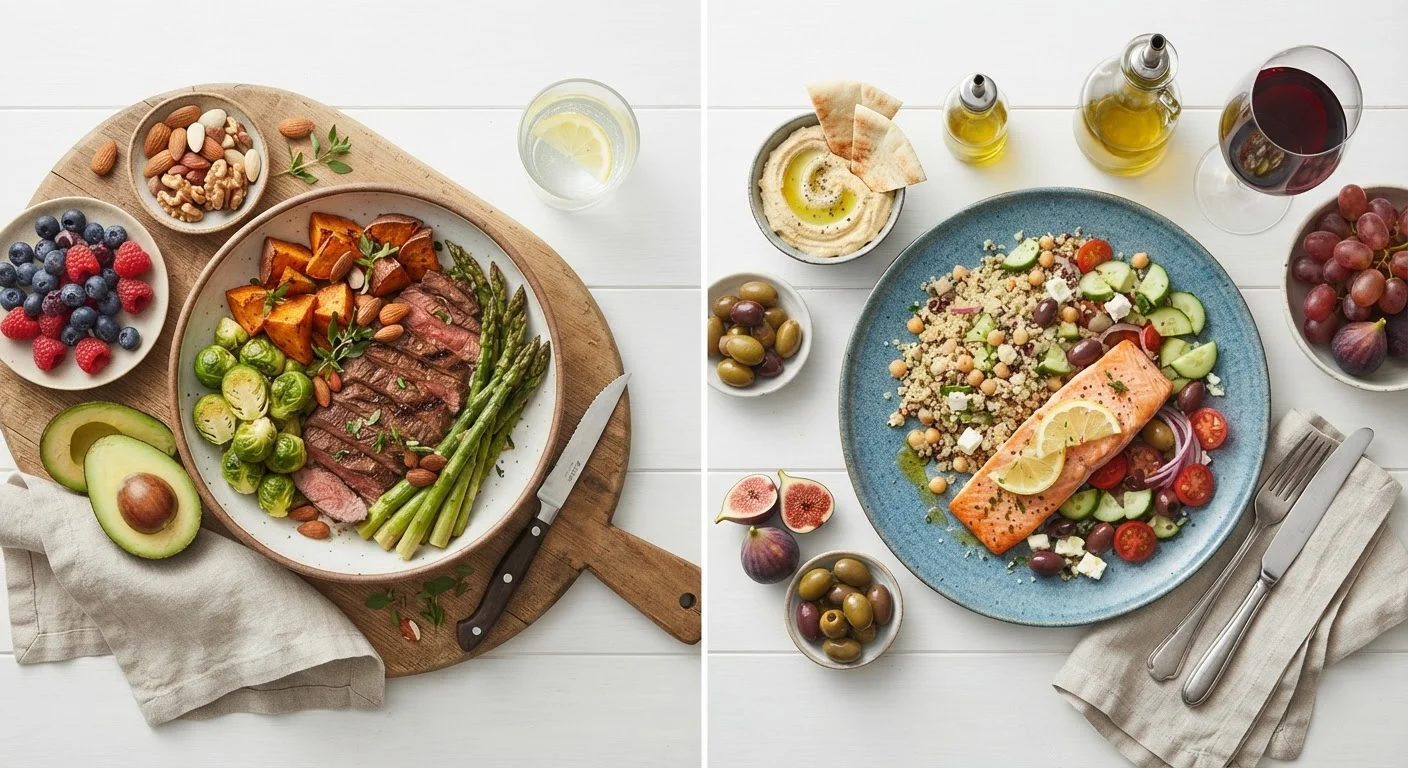
The Paleo diet is grounded in an evolutionary hypothesis: that human physiology is best adapted to the foods available before the agricultural revolution roughly 10,000 years ago. In practical terms, this means prioritizing meat, fish, eggs, vegetables, fruits, nuts, and seeds — while eliminating grains, legumes, dairy, refined sugar, and processed oils. The underlying premise is that modern chronic diseases partly stem from foods our ancestors never ate.
The Mediterranean diet, by contrast, is not built on an evolutionary argument but on observation. Researchers in the mid-twentieth century noticed that populations in countries like Greece, Italy, and Spain had notably lower rates of heart disease despite relatively high fat consumption. That pattern was traced to a dietary style rich in vegetables, legumes, whole grains, olive oil, fish, and moderate amounts of dairy and wine — with red meat eaten sparingly.
The philosophical gap is significant. Paleo is prescriptive and exclusionary by design; Mediterranean is descriptive and flexible. See how different frameworks define a healthy meal for a broader mapping of these distinctions.
What Each Diet Permits and Restricts
Understanding the food lists side by side clarifies how different daily eating actually looks under each approach.
| Criterion | Paleo Diet | Mediterranean Diet |
|---|---|---|
| Grains | Excluded | Included (whole grains preferred) |
| Legumes | Excluded | Included; a dietary staple |
| Dairy | Excluded | Moderate amounts permitted |
| Red meat | Permitted; often emphasized | Eaten sparingly |
| Primary fat source | Animal fats, nuts, avocado | Olive oil |
| Fish and seafood | Encouraged | Strongly emphasized |
| Processed foods | Excluded | Excluded or minimized |
| Underlying rationale | Evolutionary hypothesis | Epidemiological observation |
| Volume of clinical research | Limited; mostly short-term | Extensive; includes large RCTs |
One of the most practical divergences is legumes. Lentils, chickpeas, and black beans are Mediterranean staples and are associated with positive outcomes in cardiovascular and glycemic research. Paleo excludes them on the basis of antinutrient content — specifically lectins and phytates — though the clinical significance of these compounds in normally prepared foods remains debated among nutrition researchers.
Dairy follows a similar split. Hard cheeses and yogurt are moderate Mediterranean inclusions; paleo eliminates them entirely. For individuals who are lactose intolerant, paleo's exclusion may feel natural, but for others it removes a convenient source of calcium and protein.
The Evidence Base: How the Research Compares
The Mediterranean diet has one of the most studied evidence records in modern nutritional science. Large observational cohorts and randomized controlled trials — including the widely cited PREDIMED trial, which enrolled over 7,000 participants — have linked Mediterranean eating patterns to reduced rates of cardiovascular events, improved lipid profiles, and better glycemic control. The diet is endorsed by numerous national and international health organizations as a result.
7,000+
Participants in PREDIMED trial
The PREDIMED randomized controlled trial, published in the New England Journal of Medicine, is one of the largest dietary intervention studies examining cardiovascular outcomes under a Mediterranean eating pattern.
~30%
Relative reduction in major cardiovascular events
PREDIMED reported approximately a 30% relative risk reduction in major cardiovascular events among Mediterranean diet groups compared to a low-fat control — though the study was later partially re-analyzed and the finding remains broadly supported.
< 6 months
Typical duration of paleo diet trials
Most published randomized trials examining the paleo diet have run for fewer than six months, limiting conclusions about long-term efficacy and safety compared to the Mediterranean diet's decades-long evidence record.
Paleo's evidence base is considerably more limited. Most trials are small, short in duration (typically under six months), and focused on surrogate markers like fasting glucose and LDL cholesterol rather than long-term disease outcomes. Some studies show modest improvements in metabolic markers, particularly in people with type 2 diabetes or metabolic syndrome, but the research is not yet sufficient to draw broad conclusions. As a closer examination of Mediterranean diet evidence shows, even the stronger evidence base has nuances worth understanding.
This does not make paleo categorically ineffective — it means the research is at an earlier stage. For a framework to evaluate either approach rigorously, see how to evaluate a dietary approach before committing.
Sustainability, Nutritional Completeness, and Practical Fit
Adherence is one of the most underweighted factors in diet comparisons. A dietary pattern with strong evidence means little if an individual cannot sustain it. The Mediterranean diet's broad food list makes it structurally easier to follow in most US social contexts — it accommodates restaurant dining, shared meals, and cultural eating traditions far more readily than paleo's strict exclusions.
From a nutritional completeness standpoint, the Mediterranean diet's inclusion of whole grains and legumes reduces the risk of fiber and micronutrient gaps. Paleo eaters typically need to be more intentional about calcium intake (given the exclusion of dairy), and ensuring adequate carbohydrate sources from vegetables and fruit alone requires planning.
Neither pattern is risk-free for every individual. People with specific health conditions, food sensitivities, or particular life stages — pregnancy, older adulthood — should approach either diet with professional guidance rather than general advice. As explored in navigating conflicting nutrition advice, applying evidence to individual context requires more than choosing a side.
This article provides general nutrition information for educational purposes and is not a substitute for personalized medical or dietary advice. Consult a qualified healthcare professional before making significant changes to your diet, especially if you have an existing health condition.