

Key Takeaways
- A wellness quiz score is a snapshot, not a diagnosis — treat it as a starting point for reflection.
- Focus on one or two quiz categories at a time to avoid overwhelm and build sustainable habits.
- Translate abstract score gaps into specific, small daily behaviors you can schedule immediately.
- Revisit your quiz after four to six weeks to measure whether your habits are shifting your results.
- Consult a qualified healthcare provider if your quiz highlights symptoms requiring clinical evaluation.
What you will need
Why Most Quiz Results Go Nowhere
Wellness quizzes have grown increasingly popular as quick self-assessment tools, and for good reason — a well-designed quiz can surface patterns in sleep, stress, nutrition, or activity that are easy to overlook in daily life. But the majority of people who complete a quiz close the tab without taking a single concrete action. The result sits inert, neither helping nor harming.
The gap between insight and behavior change is not a willpower problem. It is a planning problem. Quiz scores are abstract — a number or a category label — and abstract information does not translate automatically into scheduled actions. Without a structured method for converting results into a weekly routine, even genuinely useful self-assessment data fades within days.
Understanding what wellness quizzes actually measure — and what they don't is the essential first step, but the second step is equally important: turning that awareness into a concrete weekly plan you can actually follow.
Quiz Results Are Not Medical Diagnoses
Wellness quiz scores are self-reported screening tools designed to surface patterns — they do not diagnose conditions or replace professional evaluation. If your results suggest significant concerns about mental health, sleep disorders, or chronic symptoms, please consult a qualified healthcare provider before acting on them independently.
What You'll Need Before You Start
This process works best when you approach it as a short planning session rather than a spontaneous impulse. Set aside 20–30 minutes with your quiz results in hand and your calendar open. The materials are minimal, but having them ready prevents the session from stalling.
What you will need
Wellness quiz results summary
Provides the domain scores or category breakdowns you will convert into specific habit targets.
Weekly planner or calendar
Used to schedule specific habit actions on designated days and times.
Habit tracking app or paper tracker
Helps you log daily completion so you can spot consistency patterns over time.
Stack New Habits Onto Existing Routines
Behavioral research supports 'habit stacking' — attaching a new behavior to something you already do reliably. For example, if your quiz flagged low hydration, place a full glass of water next to your morning coffee maker as an automatic prompt. This reduces the friction of starting and improves follow-through without requiring extra willpower.
Step-by-Step: From Score to Weekly Schedule
The following steps walk you through interpreting your quiz output, selecting a realistic focus, defining specific behaviors, and embedding them into your week. Follow them in order — each builds on the previous one.
Read your results with context, not alarm
Before planning anything, spend a few minutes understanding what your score actually reflects. Most wellness quizzes measure self-reported perceptions across categories like sleep quality, stress load, physical activity, or nutrition patterns. They are not clinical assessments. See our guide to interpreting quiz results without overreacting for a fuller breakdown of how to read scores with proportion.
Note which categories scored lowest relative to your personal baseline — these are your primary focus areas, not an indictment of your health overall.
Choose one or two focus domains
Look at the category breakdown and identify the one or two domains where your score suggests the most room for improvement. Prioritize areas that are both actionable (within your control this week) and meaningful to you personally — motivation matters for habit formation.
For example, if your quiz flagged poor sleep and low movement, choose one as your primary focus for the first two weeks. Narrowing scope is not giving up on the rest; it is a deliberate strategy for building momentum.
Translate each domain into one specific behavior
Abstract goals like 'improve sleep' or 'reduce stress' are too vague to schedule. For each focus domain, write down exactly one concrete behavior: the action, the frequency, and the time of day.
- Sleep domain: 'Set a consistent 10:30 PM device-off alarm, seven nights per week.'
- Movement domain: 'Take a 15-minute walk after lunch, five days per week.'
- Nutrition domain: 'Add one serving of vegetables to dinner, five nights per week.'
The behavior must be specific enough that you could mark it done or not done at the end of each day without ambiguity.
Schedule behaviors directly into your week
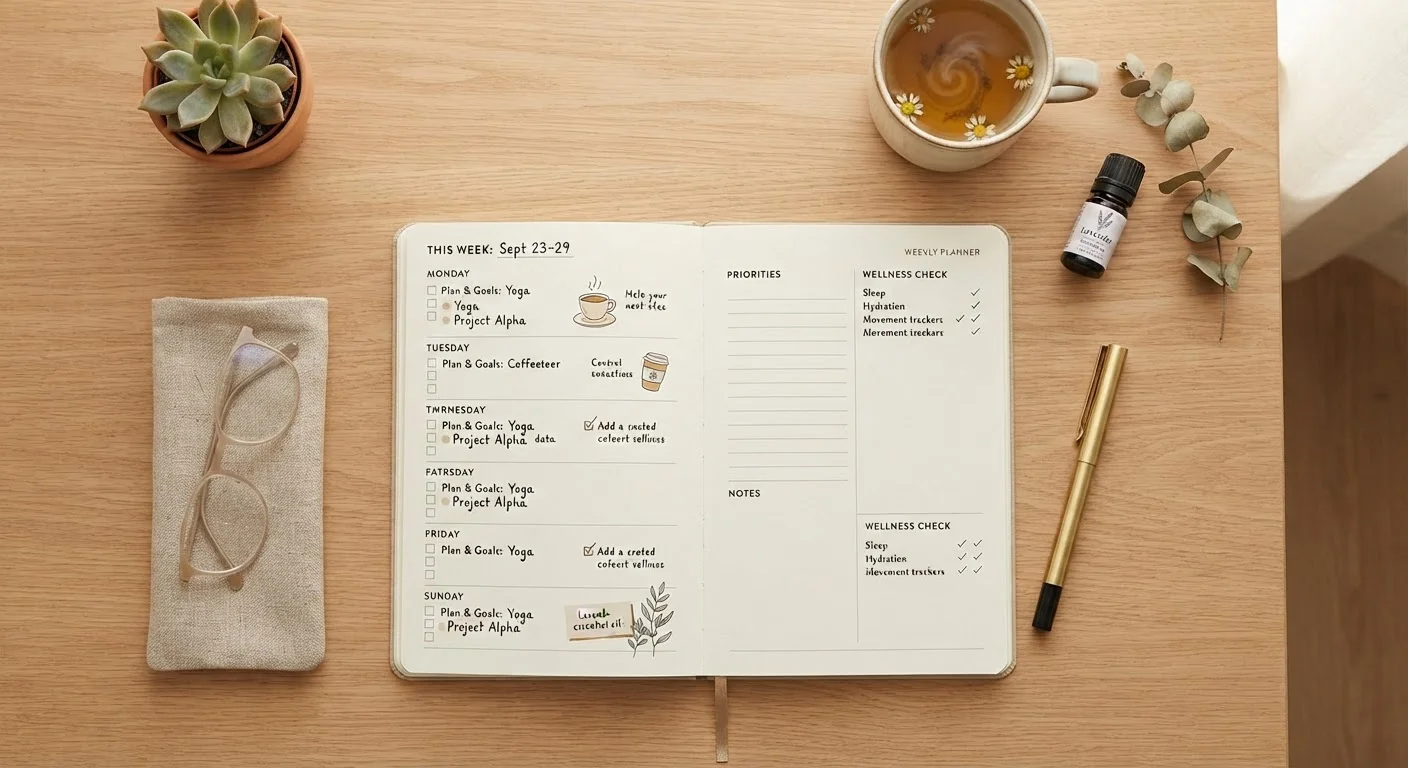
Open your planner or calendar and block the specific times you have identified. Treat these entries with the same commitment you would a work meeting. If the behavior recurs daily, set a repeating reminder rather than re-entering it each day — this reduces decision fatigue.
Also identify any likely obstacles ahead of time: a busy Wednesday evening, a travel day, or a recurring social commitment. Pre-decide how you will handle the habit on those days — whether you will adapt it, skip it, or replace it with a shorter version.
Track completion for four to six weeks
Use a simple daily tracker — even a paper checkbox — to log whether you completed each behavior. Consistency data is more useful than perfection. A week with four out of seven days completed tells you something different than a week with one out of seven.
After four to six weeks, review the tracking record before retaking the quiz. This sequence — behave, track, reassess — mirrors how periodic self-assessments reveal genuine lifestyle change rather than daily mood fluctuations.
Retake the quiz and compare, then adjust
After your four-to-six-week habit cycle, retake the same quiz under similar conditions — same time of day, similar stress context — for a fair comparison. Compare domain scores to your original results. Look for directional shifts rather than dramatic jumps; small improvements in a self-reported category after a month of consistent behavior are a meaningful signal.
If scores haven't shifted, re-examine whether the behavior was truly consistent, whether you targeted the right domain, or whether the quiz is measuring something more complex than a single habit can address. For a deeper look at why scores vary, see why the same quiz gives different results two weeks apart.
Keeping the Habit Loop Going Beyond Week One
The biggest risk to a quiz-based habit plan is the novelty effect: motivation is highest immediately after seeing your results and drops sharply within one to two weeks. Anticipating this curve — rather than being surprised by it — is what separates plans that stick from those that don't.
Two practical guardrails help: First, keep your initial behavior commitment genuinely small. A 10-minute walk is easier to protect on a chaotic day than a 45-minute workout. Second, build in a scheduled check-in at the two-week mark — not to overhaul the plan, but simply to note what is working and remove any friction that has appeared.
Avoid Targeting Too Many Areas at Once
It can be tempting to overhaul sleep, nutrition, movement, and stress management simultaneously after reviewing a quiz. Attempting too many changes at once is a well-documented predictor of habit failure. Commit to a maximum of two behavior changes per week and expand only once those feel automatic.
For a broader view of how self-assessment can become an ongoing personal health practice over time, explore the complete guide to using wellness quizzes as a health awareness tool.
This article is for informational purposes only and is not a substitute for professional medical advice, diagnosis, or treatment. Always consult a qualified healthcare provider with questions about your health or before making significant changes to your lifestyle.